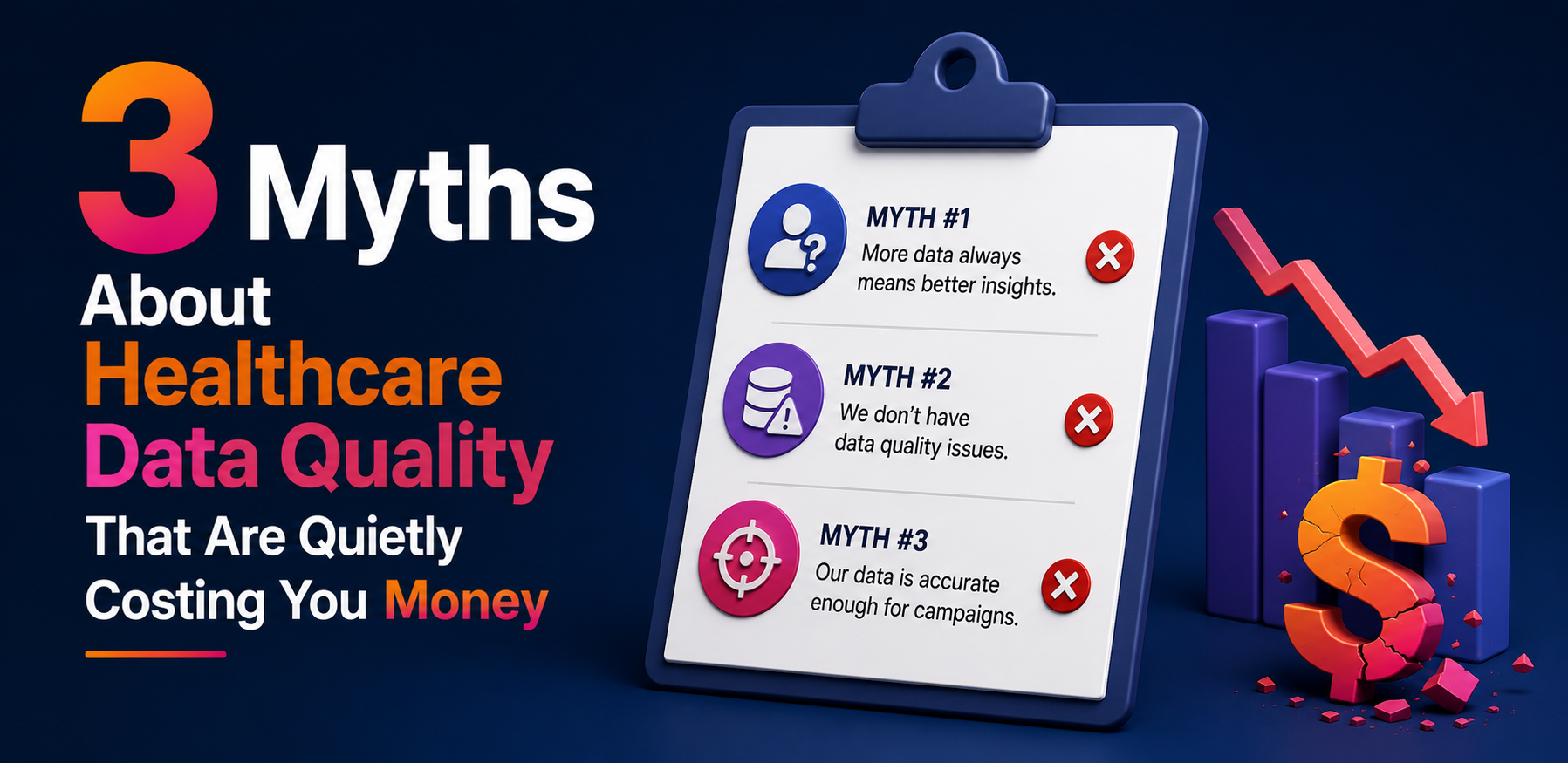
Three assumptions almost every commercial team makes, and why each one costs real money once you look closely.
Some assumptions about physician data are so common they stop feeling like assumptions at all. Here are three that hold up fine in conversation, and fall apart the moment anyone runs the numbers.
Myth 1: A bigger database means better reach
More names feels like more opportunity, so teams often chase database size: more contacts, broader specialty coverage, a bigger universe to market into.
Reach isn't determined by how many names are on a list. It's determined by how many of those names are actually reachable. The math makes this concrete: the 40,000-physician database referenced throughout this series reached 18,967 real physicians at its starting 47.4% mailability rate. A hypothetical list of just 25,000 physicians at 95% mailable would reach 23,750, nearly 5,000 more real physicians, from a list 15,000 names smaller. A smaller, accurate list can out-reach a larger, stale one, because names that aren't reachable were never really part of your audience to begin with.
Myth 2: A clean bounce rate means the list is healthy
Low returns feel like proof the list is in good shape. It's an incomplete signal, because it only catches one kind of failure.
A package delivered to a physician's old office, months after they moved on, isn't a bounce. It's a successful delivery to the wrong person, and it shows up in every report as a win. That means your bounce rate can look clean while a meaningful share of "successful" deliveries never reached anyone who could actually use them, and any ROI calculated on top of that delivery number inherits the same false confidence.
Check My Data Free →Myth 3: Data quality is an IT or vendor problem, not a marketing problem
It's easy to treat database hygiene as someone else's responsibility: the vendor's job, IT's job, whoever manages the CRM.
The cost of bad data doesn't land on whoever technically owns the pipeline. It lands on the commercial budget, in wasted product, wasted shipping, and missed prescribing moments. That mismatch is exactly why this problem tends to persist: the team that feels the financial pain often isn't the team with the authority to fix the source, and the team that could fix it rarely feels the pain directly enough to prioritize it.
Why these three matter together
Each of these myths sounds harmless on its own. Together, they explain why so many databases look fine in every internal conversation and still cost millions once anyone actually checks: bigger feels like better, quiet feels like clean, and someone else's job feels like not your problem, right up until the budget says otherwise.
Check My Data Free →