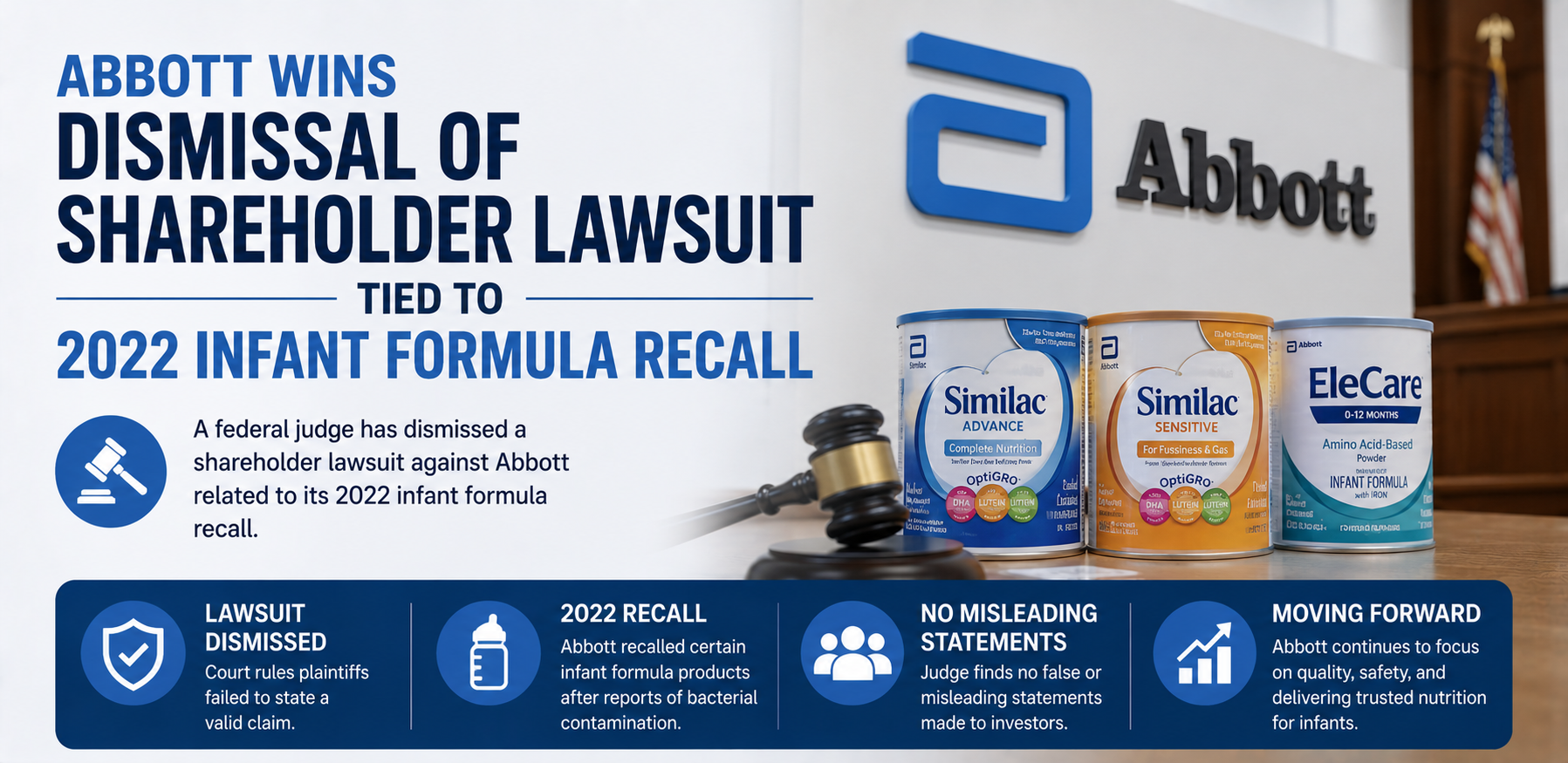
Abbott Wins Dismissal of Shareholder Lawsuit Tied to 2022 Infant Formula Recall
What's Happening
A U.S. federal judge has dismissed a shareholder lawsuit accusing Abbott Laboratories of misleading investors about the events that led to its 2022 infant formula recall and the nationwide formula shortage that followed.
The lawsuit claimed Abbott failed to disclose serious manufacturing and food safety issues at its infant formula facility in Sturgis, Michigan, while making reassuring public statements about product quality and regulatory compliance. Shareholders argued that these alleged omissions artificially inflated the company's stock price before the recall became public.
U.S. District Judge Steven Seeger dismissed the case, finding that although the allegations described potential operational failures, they did not sufficiently establish securities fraud. The court concluded that the plaintiffs had not adequately shown that Abbott intentionally misled investors or made materially false statements with the intent to inflate its share price. The judge allowed shareholders the opportunity to amend their complaint, though he also noted that doing so would likely be difficult.
The ruling is a significant legal victory for Abbott in one of several ongoing legal matters connected to the 2022 recall.
Looking Back at the 2022 Infant Formula Crisis
The lawsuit stems from one of the most disruptive public health and supply chain events in recent U.S. healthcare history.
In early 2022, Abbott voluntarily recalled several powdered infant formula products manufactured at its Sturgis, Michigan facility after reports linked certain infant illnesses to bacterial contamination. The plant was temporarily shut down while federal investigators conducted inspections and corrective actions.
The recall involved widely used formula brands, including:
- Similac.
- Alimentum.
- EleCare.
Because Abbott supplied more than 40% of the U.S. infant formula market before the recall, the production halt quickly contributed to a nationwide shortage that left many families struggling to obtain essential nutrition for infants with both routine and specialized dietary needs.
The crisis prompted emergency responses from federal agencies, temporary import programs, increased production from competing manufacturers, and renewed discussions about supply chain resilience within the infant nutrition industry.
Understanding the Shareholder Lawsuit
The legal case was not about whether the recalled formula caused illnesses or whether Abbott violated food safety regulations.
Instead, it focused on securities law.
Shareholders alleged that Abbott:
- Delayed disclosing manufacturing problems.
- Failed to adequately inform investors about contamination risks.
- Presented overly optimistic statements regarding product quality and regulatory compliance.
- Misled investors about operational conditions at the manufacturing facility.
According to the plaintiffs, these actions caused investors to purchase Abbott stock without understanding the true business risks facing the company.
When the recall and manufacturing shutdown became public, Abbott's share price declined, and investors argued that they suffered financial losses because of the company's earlier disclosures.
Why the Court Rejected the Claims
The judge distinguished between alleged operational shortcomings and securities fraud.
The court acknowledged that plaintiffs described concerns about plant operations and regulatory compliance but concluded that these allegations did not establish the legal elements required for a securities fraud claim.
Among the court's key findings were:
- The complaint did not sufficiently demonstrate that Abbott intended to deceive investors.
- Many of Abbott's public statements were considered too general or aspirational to be legally actionable.
- Allegations of poor operational management alone do not automatically establish securities fraud.
This distinction is important because securities litigation requires plaintiffs to show not only that problems existed but also that company executives knowingly or recklessly misled investors about those problems.
Without evidence of fraudulent intent, courts are generally reluctant to allow shareholder fraud claims to proceed.
The Broader Legal Landscape
Although Abbott prevailed in this particular lawsuit, the company continues to face legal and regulatory scrutiny related to infant nutrition.
Separate legal matters include:
- Product liability lawsuits involving infant formula.
- Ongoing civil litigation connected to the 2022 recall.
- Regulatory oversight of manufacturing and quality systems.
- Shareholder derivative litigation.
- Food safety compliance reviews.
Each of these proceedings addresses different legal questions.
For example, shareholder lawsuits examine whether investors were misled, while product liability cases evaluate whether products caused injuries. Regulatory investigations, meanwhile, focus on manufacturing standards and compliance with federal safety requirements.
As a result, success in one case does not necessarily determine the outcome of other legal proceedings.
Industry Impact
- Infant Nutrition Manufacturers: The case reinforces the importance of maintaining transparent communications with investors during manufacturing disruptions or product recalls. Companies operating in highly regulated healthcare markets face increasing expectations around operational disclosure and quality management.
- Publicly Traded Healthcare Companies: Healthcare organizations often manage significant regulatory, manufacturing, and product safety risks. This ruling illustrates that while operational failures can have major business consequences, proving securities fraud requires evidence that executives intentionally misled investors.
- Investors: The decision highlights the legal standard applied in shareholder litigation. Investors considering healthcare companies increasingly evaluate not only financial performance but also manufacturing quality, regulatory compliance, and operational resilience.
- Healthcare Supply Chains: The 2022 formula shortage demonstrated how disruptions at a single manufacturing facility can affect the availability of essential healthcare products nationwide. Since then, both regulators and manufacturers have increased efforts to strengthen supply chain resilience and reduce dependence on individual production sites.
Why This Matters
The dismissal of the shareholder lawsuit provides clarity regarding one aspect of Abbott's legal exposure, but it also serves as a reminder of the broad business implications of manufacturing quality failures.
Healthcare companies operate in industries where patient safety, regulatory compliance, manufacturing excellence, and investor confidence are closely interconnected.
When operational issues arise, organizations must manage not only product recalls and regulatory responses but also communications with patients, healthcare providers, investors, and policymakers.
The court's decision demonstrates that securities fraud claims face a high legal threshold, particularly when plaintiffs cannot establish that company leaders knowingly intended to mislead investors.
For healthcare organizations, the case underscores the importance of combining strong quality systems with transparent corporate governance and effective risk communication.
Key Takeaways
- A federal judge dismissed a shareholder lawsuit accusing Abbott of misleading investors about events leading to the 2022 infant formula recall.
- The court found insufficient evidence that Abbott intentionally deceived investors or committed securities fraud.
- Shareholders may amend their complaint, although the judge questioned whether additional allegations would change the outcome.
- The ruling is separate from other ongoing litigation and regulatory matters involving Abbott.
- The case highlights the distinction between operational failures and the legal requirements needed to prove securities fraud.
What This Means for Healthcare Marketers
The Abbott decision illustrates how manufacturing quality, corporate governance, regulatory compliance, and public trust are increasingly connected in healthcare. Organizations involved in pharmaceuticals, medical devices, diagnostics, nutrition, and healthcare manufacturing should recognize that operational transparency influences not only regulators and providers but also investors and business partners. For healthcare marketers, this reinforces the value of communicating a company's commitment to quality systems, compliance, and patient safety while ensuring that public statements accurately reflect operational realities during periods of heightened scrutiny.