What's Happening
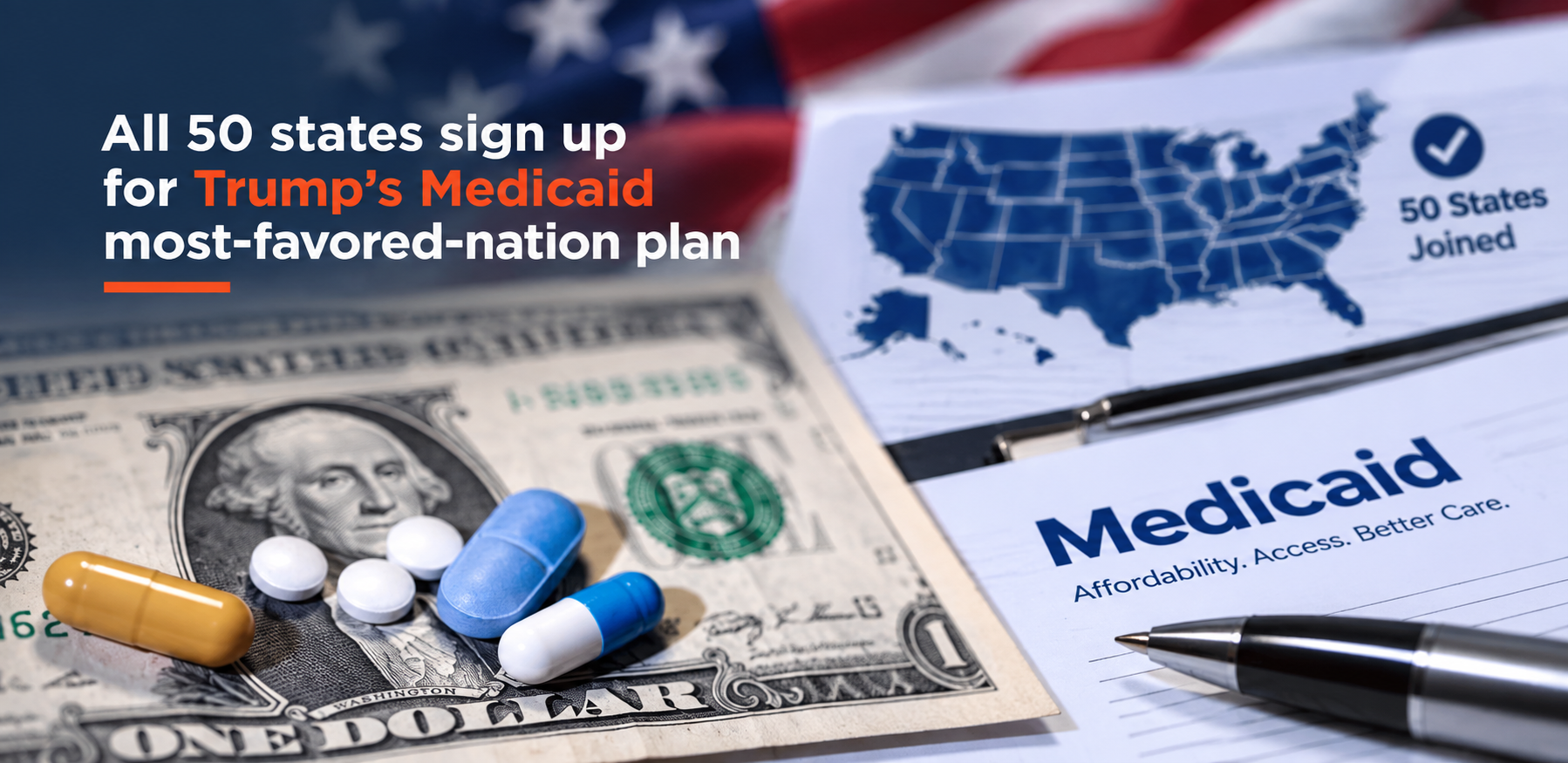
The Trump administration announced that all 50 states, along with Washington, D.C. and Puerto Rico, will participate in a federal Medicaid program designed to lower the prices of certain prescription drugs.
The program, known as the GENEROUS Model, uses most-favored-nation pricing. Under the model, participating drugmakers provide supplemental rebates so that the net price Medicaid pays for selected medicines is brought closer to prices paid in certain other countries.
The announcement expands a program that began in January 2026 and is scheduled to run for five years.
As of September 18, 40 states and Puerto Rico had already signed agreements, while the remaining states had until September 30 to finalize their participation.
What Is Most-Favored-Nation Pricing?
Most-favored-nation, or MFN, pricing is based on the idea that the United States should not pay significantly more for the same medicine than other wealthy countries.
Under the GENEROUS Model, prices for selected medicines are linked to prices paid in a group of other countries.
The program does not apply an international price to every prescription medicine in Medicaid. It applies to drugs from manufacturers participating in the program and selected by participating state Medicaid programs.
How the GENEROUS Model Works
The model involves CMS, state Medicaid programs and participating pharmaceutical manufacturers.
Manufacturers enter agreements with CMS covering eligible medicines. Participating states then enter supplemental rebate agreements with those manufacturers.
The additional rebates are designed to bring the Medicaid net price down to a level based on selected international prices. CMS will monitor the payments and pricing calculations.
The program also introduces standardized coverage criteria.
Manufacturers and CMS can negotiate coverage criteria that participating states will use for medicines included in the program. This is intended to reduce the need for manufacturers to negotiate separate supplemental coverage arrangements with every state.
Every State Has Applied
The nationwide participation is a major expansion of the model.
All 50 state Medicaid programs, the District of Columbia and Puerto Rico have applied to participate.
However, applying does not mean every state will use the model for every eligible medicine. States retain the ability to decide which covered drugs they want to purchase through the international-price arrangement.
States can consider their existing rebates, the price of competing medicines and their current agreements with manufacturers when making those decisions.
Medicaid Already Gets Significant Drug Discounts
The new program is being added to an existing Medicaid drug-rebate system.
Federal law already requires pharmaceutical manufacturers to provide rebates to Medicaid. Many states also negotiate additional supplemental rebates.
Despite those discounts, Medicaid's net prescription-drug spending reached about $60 billion in 2024, up $10 billion from 2022.
The GENEROUS Model is intended to push prices below what states might otherwise pay under those existing arrangements.
That means the relevant figure is the net price after rebates, rather than a drug's publicly listed price.
The Administration Estimates Billions in Savings
The federal government estimates that the model could save about $5.2 billion annually in taxpayer spending once fully implemented.
The White House Council of Economic Advisers has separately estimated around $27.6 billion in state savings and $36.6 billion in federal savings over 10 years, for a combined estimate of about $64.3 billion.
These are projections rather than savings already achieved.
The actual financial impact will depend on which medicines are included, which manufacturers participate and how much lower the international benchmark prices are compared with existing Medicaid net prices.
Major Drugmakers Are Participating
The initiative is connected to broader pricing agreements that the Trump administration has reached with major pharmaceutical manufacturers.
Companies including Pfizer, Eli Lilly and Novo Nordisk have agreed to provide lower prices under arrangements tied to international pricing.
CMS has also identified manufacturers including AstraZeneca, Pfizer and EMD Serono as participants in the GENEROUS framework once relevant terms are finalized.
The growing number of participating manufacturers means the program could eventually affect medicines across several major therapeutic categories.
Weight-Loss Medicines Are an Important Part of the Broader Pricing Push
Obesity medicines have been one of the most visible areas in the administration's pharmaceutical pricing negotiations.
Eli Lilly and Novo Nordisk are among the drugmakers involved in broader pricing agreements, and their weight-loss medicines have been a major focus of efforts to make these treatments more affordable.
However, the GENEROUS Model is broader than obesity drugs.
It is designed to cover eligible medicines from participating manufacturers across different therapeutic areas.
States Can Decide Which Drugs to Use
Nationwide participation does not mean a single list of medicines will automatically be covered under MFN pricing in every state.
States have flexibility to determine which eligible drugs they want to obtain at internationally benchmarked prices.
They can consider whether the GENEROUS price is actually lower than the price they already obtain through existing manufacturer rebates. They can also consider alternative medicines and the terms of existing contracts.
This means the impact of the program can differ across states and products.
The Model Is Voluntary for States and Manufacturers
The GENEROUS Model is voluntary.
States choose whether to participate, while manufacturers also choose whether to enter the program.
With all states now applying, the main remaining question is how extensively each state will use the model and how many manufacturers will participate across individual drug categories.
Manufacturers Receive Some Benefits Too
The program requires manufacturers to provide lower prices, but participating companies can receive other benefits.
One is greater consistency in coverage rules.
Instead of negotiating separate coverage criteria with every participating state, manufacturers can work with CMS to establish standardized criteria for drugs included in the model.
That could reduce some of the administrative burden associated with state-by-state negotiations.
For manufacturers, the trade-off is therefore lower Medicaid prices in exchange for broader participation in a standardized federal framework.
The Model Does Not Change Medicaid Best Price
One important feature is that the supplemental rebates provided through GENEROUS do not change Medicaid Best Price.
That also means the model does not change the ceiling prices available through the 340B Drug Pricing Program.
This creates a distinction between the additional discounts available through GENEROUS and the existing statutory pricing mechanisms used across Medicaid and 340B.
The Program Could Affect Government Spending More Than Patient Payments
Medicaid beneficiaries generally already receive substantial prescription-drug discounts through the program.
Because of that, the most direct financial impact of GENEROUS is expected to be on state and federal Medicaid spending, rather than on patients' out-of-pocket costs.
A lower Medicaid net price can reduce government spending without necessarily producing an equivalent reduction in what an individual patient pays.
Pharmaceutical Companies Face a New Pricing Benchmark
For drugmakers, the model adds another consideration to their U.S. pricing strategies.
Companies already manage different prices and rebates across Medicaid, Medicare, commercial insurers and international markets.
The MFN approach introduces another connection between those markets by using prices in selected countries as a benchmark for U.S. Medicaid pricing.
That could make international pricing strategy increasingly important for pharmaceutical companies.
The Policy Could Affect Market Access
The program is also intended to improve access to medicines.
CMS says standardized coverage criteria could make access more consistent across participating states while lower prices could make certain medicines more affordable for Medicaid programs.
However, lower prices do not automatically mean unrestricted coverage.
States and Medicaid plans will still have coverage policies and eligibility requirements, and states retain flexibility over which medicines they obtain through the model.
The Pharmaceutical Industry Has Raised Concerns
The pharmaceutical industry has criticized the administration's broader approach to drug pricing.
The industry's central concern is that significantly lower prices could reduce the money available for pharmaceutical research and development.
Industry representatives have also questioned whether government pricing policies could eventually affect the number of medicines being developed or the level of investment in new treatments.
The administration has taken the opposite position, arguing that U.S. patients and government programs should not pay substantially more for medicines than patients in comparable countries.
The Debate Goes Beyond Medicaid
The program is part of a much larger change in U.S. pharmaceutical pricing policy.
The administration has been using international prices as a benchmark in negotiations with major drugmakers and has linked pricing agreements to other policy measures.
That means the effects of GENEROUS could extend beyond Medicaid itself.
Drug manufacturers may need to consider how lower government prices interact with commercial pricing, international markets and future negotiations with other U.S. payers.
What Could Happen to State Budgets
If the projected savings are achieved, state Medicaid programs would have more resources available within their healthcare budgets.
CMS says states could potentially use those resources for other healthcare needs and services.
The actual savings will depend on utilization, existing rebates and the international benchmarks used for individual medicines.
States that already negotiate very large rebates could see different results from states where the international price represents a larger additional reduction.
What It Could Mean for Patients
For Medicaid beneficiaries, the potential benefit is primarily greater affordability and potentially broader access to medicines.
The program could make some high-cost medicines less expensive for Medicaid programs and could create more consistent coverage criteria.
But patients will not necessarily see a direct cash savings from the program.
The effect at the patient level will depend on which medicines are included and how each state's Medicaid program applies the new arrangements.
Why This Matters
The nationwide rollout makes the GENEROUS Model a significant development in U.S. pharmaceutical pricing.
All 50 states, Washington, D.C. and Puerto Rico have applied to participate, giving the program a potential reach across the entire Medicaid system.
It also establishes a new federal mechanism for connecting Medicaid drug prices to prices paid in other countries.
For pharmaceutical companies, this means international pricing is becoming increasingly relevant to U.S. government-market strategy.
For state Medicaid programs, the key issue will be whether the model produces meaningful savings beyond existing rebates while maintaining or improving access to medicines.
Looking Ahead
The immediate focus will shift from enrollment to implementation.
The remaining states have until September 30, 2026, to finalize their participation agreements.
The next important details will include which manufacturers participate, which medicines are included and how the international prices are calculated.
Over time, actual Medicaid spending will provide a clearer picture of whether the program reaches the government's savings projections.
The experience of individual states will also show whether internationally benchmarked prices can be integrated into existing Medicaid purchasing systems without creating significant disruption.
Key Takeaways
- All 50 states, Washington, D.C. and Puerto Rico have applied to participate in the GENEROUS Medicaid drug-pricing model.
- The model uses most-favored-nation pricing to align Medicaid prices for selected medicines more closely with prices in certain other countries.
- 40 states and Puerto Rico had already signed participation agreements as of September 18.
- The model launched in January 2026 and is scheduled to operate for five years.
- The federal government estimates around $5.2 billion in annual taxpayer savings, while the broader 10-year estimate is about $64.3 billion.
- The model applies to selected medicines from participating manufacturers, not every drug covered by Medicaid.
- States retain flexibility to decide which eligible medicines they want to obtain through the model.
- Medicaid already receives substantial mandatory and supplemental drug rebates, so GENEROUS adds another layer of negotiated savings.
- The additional GENEROUS rebates do not change Medicaid Best Price or 340B ceiling prices.
- Major pharmaceutical companies including Pfizer, Eli Lilly and Novo Nordisk are involved in the administration's broader MFN pricing agreements.
- The remaining states have until September 30, 2026, to finalize participation.