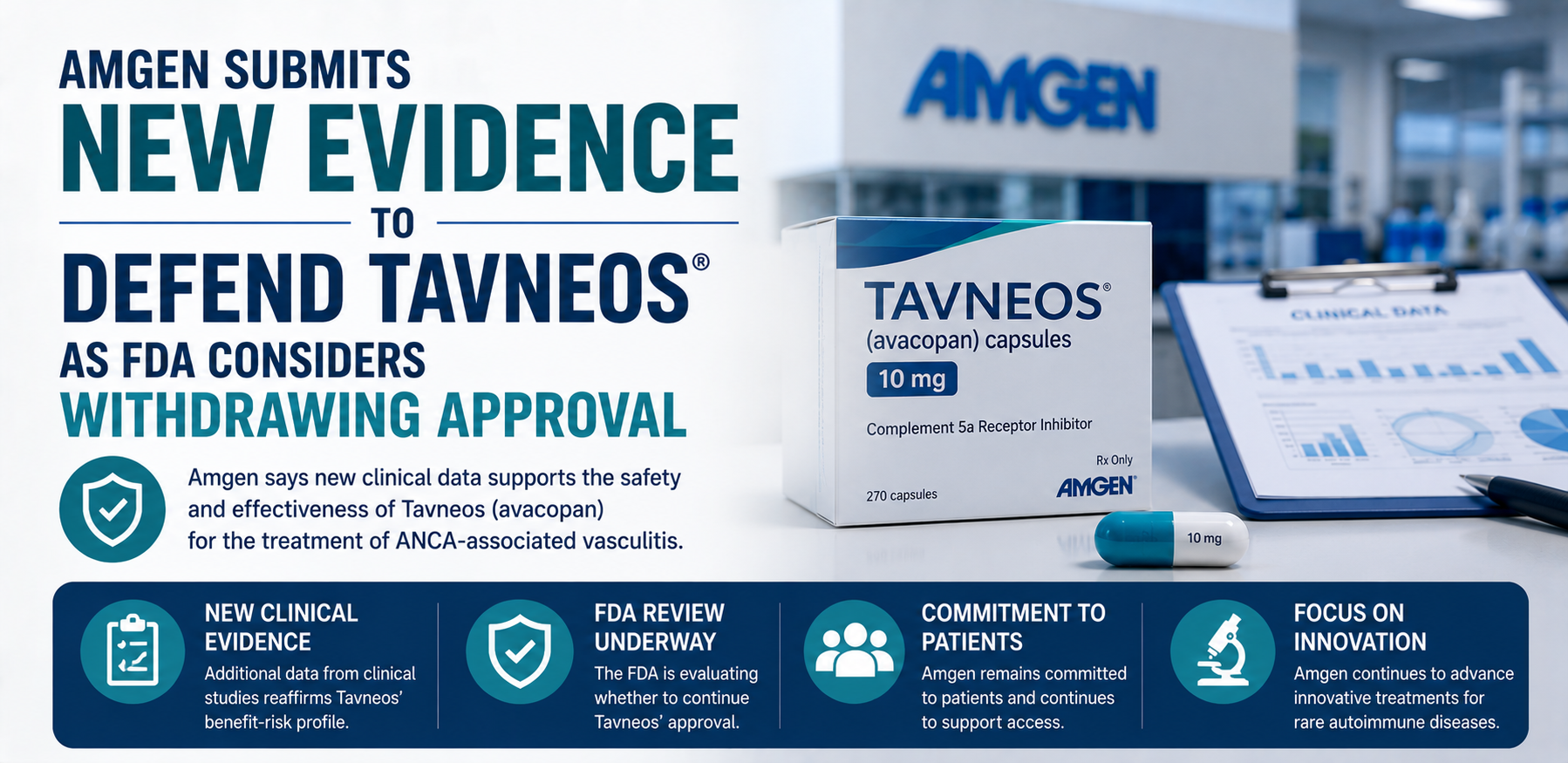
Amgen Submits New Evidence to Defend Tavneos as FDA Considers Withdrawing Approval
What's Happening
Amgen has submitted new clinical and scientific evidence to the U.S. Food and Drug Administration (FDA) in an effort to prevent the withdrawal of Tavneos (avacopan), a treatment for ANCA-associated vasculitis, a rare autoimmune disease that causes inflammation and damage to small blood vessels.
The submission is part of Amgen's formal request for an FDA hearing after the agency proposed withdrawing Tavneos from the U.S. market earlier this year. The FDA's proposal was based on concerns about the drug's effectiveness and allegations that the original marketing application contained false statements related to the pivotal clinical trial. Tavneos will remain available while the regulatory process continues and until the FDA reaches a final decision.
The dispute represents an unusual situation in which an already approved medicine faces the possibility of losing its approval because of questions surrounding the evidence used to support its original authorization rather than because of a newly discovered manufacturing problem or routine commercial decision.
What Is Tavneos?
Tavneos, also known by its generic name avacopan, is an oral medicine approved to treat adults with severe active anti-neutrophil cytoplasmic antibody (ANCA)-associated vasculitis when used alongside standard therapy.
ANCA-associated vasculitis is a rare autoimmune disease in which the immune system mistakenly attacks small blood vessels throughout the body.
The condition can affect multiple organs, including:
- Kidneys.
- Lungs.
- Sinuses.
- Skin.
- Eyes.
- Peripheral nerves.
Without prompt treatment, the disease may lead to permanent organ damage or become life-threatening.
Historically, treatment has relied heavily on corticosteroids and powerful immunosuppressive medicines. Tavneos was developed to help reduce inflammation while potentially decreasing long-term dependence on high-dose steroids, which are associated with significant side effects.
Its approval in 2021 was viewed as an important advancement for patients living with this rare disease.
Why the FDA Wants to Withdraw the Drug
Unlike many post-approval regulatory actions that focus primarily on newly identified safety concerns, the FDA's proposal centers largely on the strength and integrity of the evidence supporting the drug's approval.
Earlier this year, the FDA's Center for Drug Evaluation and Research proposed withdrawing Tavneos after concluding that:
- Available evidence no longer demonstrated substantial proof of effectiveness.
- The original application contained untrue statements of material fact.
- Questions surrounding the pivotal clinical trial required regulatory reconsideration.
These concerns emerged following an FDA investigation into the clinical trial that supported approval. The agency also cited reports of serious liver injuries associated with the medicine as part of its broader benefit-risk evaluation, although the central issue remains whether the original evidence adequately demonstrated clinical effectiveness.
Why Amgen Disagrees
Amgen strongly rejects the FDA's conclusions.
The company argues that Tavneos continues to demonstrate a favorable benefit-risk profile based on:
- Additional clinical analyses.
- Real-world patient outcomes.
- Updated scientific evidence.
- Independent reassessment of trial data.
The newly submitted evidence is intended to support Amgen's request for a formal hearing before the FDA decides whether approval should be withdrawn. According to the company, patients with ANCA-associated vasculitis continue to benefit from access to Tavneos, and removing the medicine from the market could reduce treatment options for individuals living with a rare, serious disease.
Why This Case Is Unusual
FDA approval withdrawals are relatively uncommon. When they do occur, they often involve:
- Serious newly identified safety risks.
- Manufacturing quality failures.
- Commercial discontinuation by manufacturers.
- Failure to complete required post-marketing studies.
The Tavneos case differs because it focuses on whether the original approval was supported by sufficiently reliable clinical evidence. The regulatory debate intensified after the medical journal that published the pivotal Tavneos clinical trial retracted the study following FDA findings that data involving several patients had been re-adjudicated after trial unblinding without disclosure. Those findings raised broader questions about the integrity of the evidence supporting approval.
As a result, regulators are now evaluating both the reliability of the original trial and newer evidence submitted after the drug entered clinical practice.
Industry Impact
- Rare Disease Patients: Patients currently receiving Tavneos face uncertainty while regulators review the evidence. Because the drug remains available during the hearing process, current treatment decisions will continue to be guided by physicians based on individual clinical circumstances.
- Healthcare Providers: Rheumatologists, nephrologists, and vasculitis specialists are closely monitoring the FDA review. Physicians may need to discuss alternative treatment strategies if regulatory decisions change in the future.
- Pharmaceutical Companies: The case highlights the growing importance of clinical data integrity throughout the drug development process. Sponsors may face increased regulatory scrutiny regarding trial conduct, data management, and post-approval evidence generation.
- Clinical Research Organizations: Organizations supporting clinical trials may encounter stronger expectations for independent oversight, transparent reporting, and documentation practices to maintain confidence in regulatory submissions.
Looking Ahead
The FDA has not yet made a final decision. The next stage involves reviewing Amgen's newly submitted evidence and determining whether the company should receive a formal hearing before any withdrawal becomes effective.
Possible outcomes include:
- The FDA maintains approval after reviewing the new evidence.
- The FDA modifies the drug's labeling or prescribing information.
- Additional studies are required.
- The agency ultimately withdraws approval if it concludes the evidence remains insufficient.
Regardless of the outcome, the case is likely to influence how regulators evaluate post-approval evidence, clinical trial integrity, and the standards required to maintain marketing authorization for medicines already in clinical use.
Why This Matters
The Tavneos review illustrates that regulatory oversight continues long after a medicine reaches the market. Drug approvals are not permanent guarantees. Regulatory agencies continuously evaluate new scientific evidence, safety reports, and clinical data to ensure that approved medicines continue to meet acceptable standards for effectiveness and patient benefit.
For the pharmaceutical industry, the case reinforces that maintaining approval depends not only on developing innovative therapies but also on preserving confidence in the quality and integrity of the evidence supporting those therapies. As healthcare increasingly relies on complex clinical trials and real-world evidence, transparent data management and scientific rigor will remain essential components of regulatory decision-making.
Key Takeaways
- Amgen has submitted new evidence to challenge the FDA's proposal to withdraw approval of Tavneos.
- The FDA previously proposed withdrawing the drug because of concerns about its effectiveness and issues involving the original marketing application.
- Tavneos is used to treat ANCA-associated vasculitis, a rare autoimmune disease affecting small blood vessels.
- The medicine will remain available while the FDA reviews the new evidence and determines the next steps.
- The case could influence future regulatory expectations regarding clinical trial integrity and post-approval evidence.
What This Means for Healthcare Marketers
The Tavneos case demonstrates that regulatory success extends well beyond obtaining FDA approval. Pharmaceutical companies must continue generating high-quality evidence, maintaining data integrity, and communicating transparently throughout a product's lifecycle. For healthcare marketers, organizations facing major regulatory reviews often increase investment in medical affairs, scientific communications, evidence generation, and stakeholder education. Monitoring these developments can help identify companies actively responding to regulatory challenges while reinforcing the importance of credibility and evidence-based messaging across the healthcare industry.