
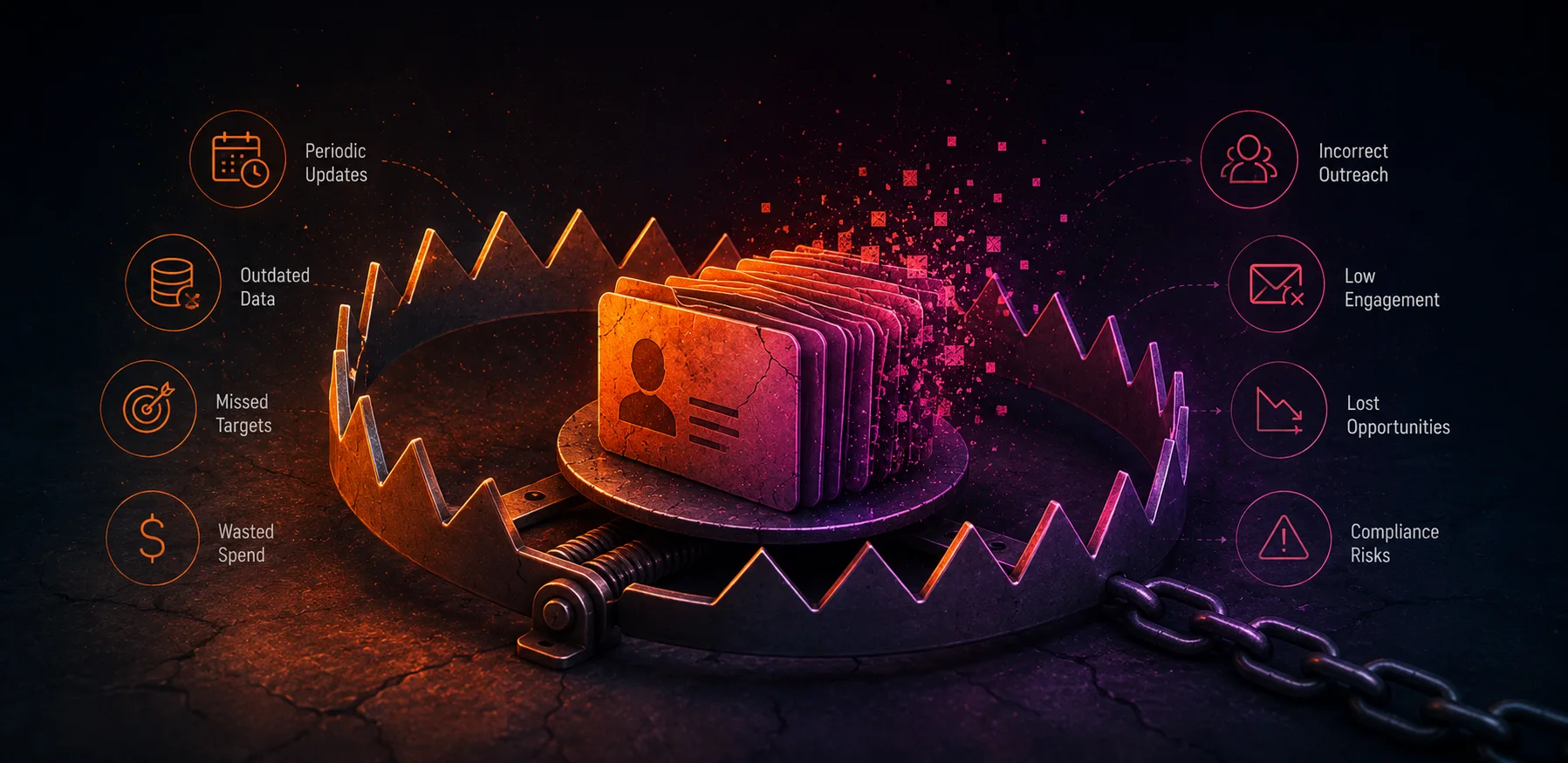
The danger isn't that annual refreshes are too slow. It's that they make everyone stop worrying for the eleven months in between.
Calling something a "trap" is a specific claim. It's not just a bad solution, it's a solution that looks safe enough that nobody keeps checking behind it. That's exactly what an annual data refresh does to a commercial team.
The real danger isn't the gap, it's the false confidence
An annual refresh doesn't just leave a gap in coverage. It manufactures a feeling of being covered, and that feeling is the actual problem.
The month right after a refresh, everyone treats the database as trustworthy, and rightly so. But that same trust doesn't expire on any visible schedule. It just quietly carries forward, month after month, while the data underneath it keeps drifting. Nobody's re-checking in month six, because as far as anyone remembers, the database was "just refreshed." A team with no refresh process at all might at least remain a little suspicious of their own data. A team that just paid for an annual refresh usually stops looking entirely, at precisely the point when looking matters most.
Why the cadence is a year in the first place
It's worth asking where "once a year" actually came from, because it wasn't derived from how quickly physicians move, practices change, or NPIs go inactive.
It came from how data refresh services have traditionally been packaged and sold: as an annual contract, billed once, delivered once, renewed once. That's a procurement rhythm, not a data-quality rhythm. Nothing about a physician's actual likelihood of changing practices lines up neatly with a calendar year. The cadence was built around convenient billing, not around how fast the underlying reality actually moves.
Check My Data Free →What the trap costs you specifically
Every cycle has a worst moment: the stretch right before the next scheduled refresh, when the most time has passed and the most drift has accumulated. That's also the moment least likely to get any extra scrutiny, because nothing on the calendar flags it as special. It just looks like any other week, right up until a campaign quietly underperforms and nobody can say exactly why.
The fix isn't a shorter cycle
It's tempting to think the answer is simply refreshing more often, quarterly instead of annually. That helps, but it doesn't remove the trap, it just shrinks it. There's still a worst moment in the cycle. There's still a stretch where confidence outpaces accuracy.
The only way out is dropping the cycle model entirely, in favor of continuous checking, so there's no such thing as "the moment right before the next refresh," because there's no next refresh waiting to happen. There's just an ongoing check that never lets confidence get ahead of reality in the first place.
Check My Data Free →