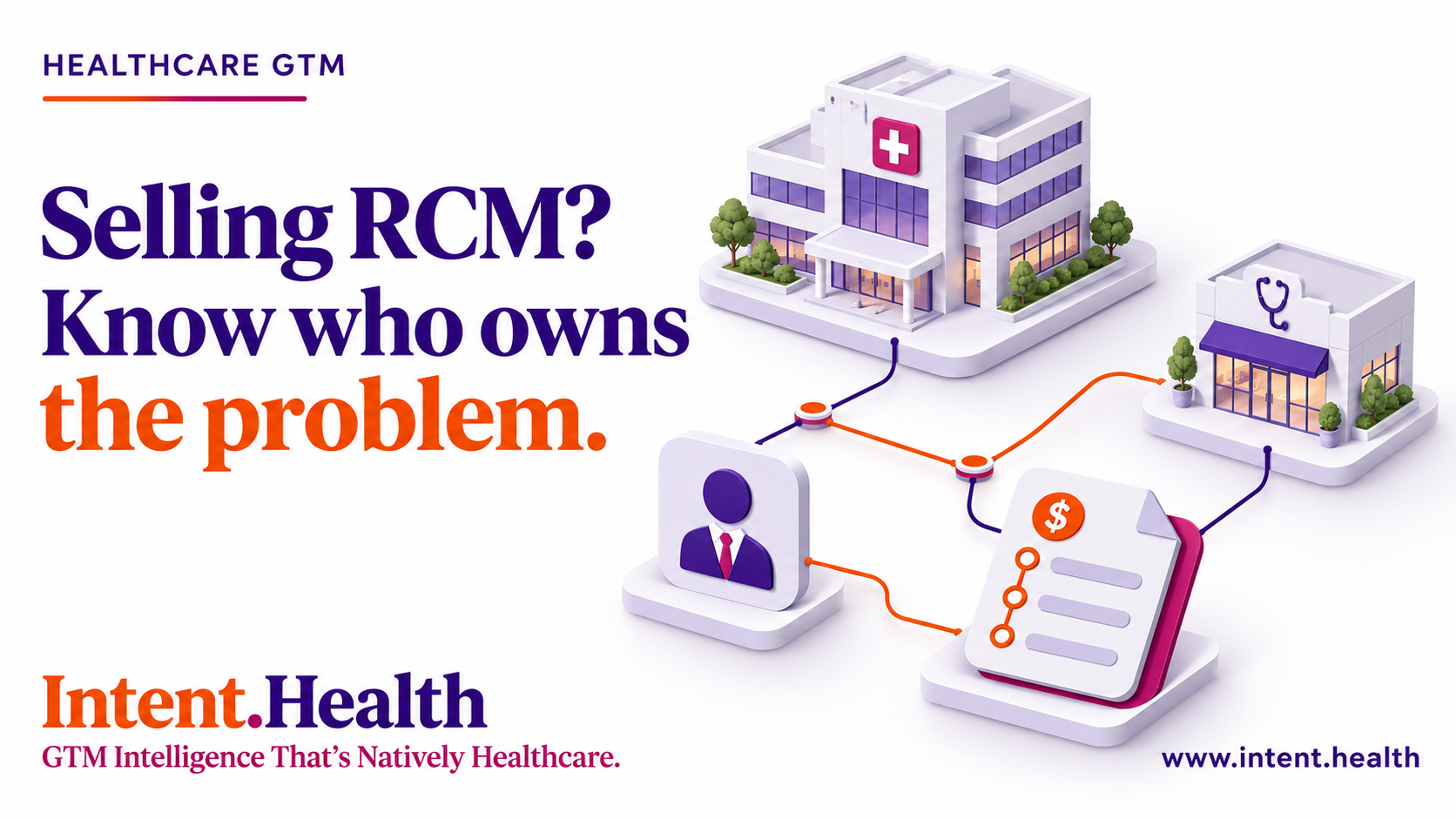
You found the head of revenue cycle. You have their email address. Your product could help reduce denials.
What do you actually know about the opportunity?
You may still need to establish where the denials originate, who controls that workflow, whether another company operates it, and who can approve a change.
Selling revenue cycle management solutions starts with understanding how the account works. A contact gives you someone to approach. The surrounding context helps you decide whether the conversation is worth having—and what to say.
- 01 / WORKFLOWWhere is the problem?Define the task you can improve.
- 02 / OWNERSHIPWho controls it?Trace operating and purchasing authority.
- 03 / PEOPLEWho must be involved?Understand implementation dependencies.
- 04 / TIMINGWhat has changed?Investigate the reason to act.
01 / Find the problem
Where does the revenue cycle problem actually sit?
“We help reduce denials” describes an outcome. Your prospect needs to understand which part of their operation you can improve.
An eligibility issue, missing authorization, incomplete documentation and coding error can require different interventions. They may involve different teams, systems and approval processes.
HFMA organizes revenue cycle performance measures across patient access, pre-billing, claims, account resolution and financial management. That breadth matters when defining your target market. Explore HFMA’s MAP Keys ↗
Choose a workflow
Potential roles are starting points for discovery. Responsibilities vary by organization.
A denial-management team may need better appeal prioritization. Another organization may need to prevent errors earlier in patient access. The same promise of fewer denials can conceal different requirements.
We help [specific team] improve [specific workflow] by changing [specific task or handoff], measured through [agreed operational result].
If this sentence remains vague, your targeting will probably be vague too.
02 / Follow the responsibility
Who controls that workflow?
The organization experiencing the problem may share control with other entities.
Consider a physician group that has acquired several practices. Local staff handle scheduling, a central team manages technology decisions, and an outsourced billing company handles claims and follow-up. A practice administrator might welcome your solution while having limited authority to change the process.
Illustrative Decision Network
Hypothetical relationships. Confirm the operating model for each account.
- Ownership. Is the practice independent, part of a physician group, owned by a health system or connected to a corporate parent?
- Operating responsibility. Which activities are handled locally, centrally or by an external partner?
- Purchasing authority. Who can approve the proposed software or service?
- Technology control. Who manages the EHR, practice management system and interfaces?
- Contract dependencies. Could an existing agreement affect the ability to introduce another provider?
An outsourced RCM company could be a customer, partner or incumbent whose responsibilities overlap with your offering. Establish which situation applies. Similarly, validate whether purchasing-network membership matters for this particular purchase.
Map the Decision Network around the opportunity
A useful Decision Network connects the facility to the organizations and people that influence a specific decision. Your research should answer one practical question.
If this contact wanted to move forward, whose involvement would they need?
03 / Understand adoption
Who needs the outcome, and who has to make it work?
A revenue cycle leader may want fewer manual touches. IT may need to assess integration effort. Finance may require a credible business case. Clinical teams may have to change how they provide documentation.
Each person evaluates a different part of the proposal. These roles are a starting point for discovery.
| Stakeholder | What they may need to understand |
|---|---|
| Revenue cycle leader | Which workflow improves, what changes for the team and how performance will be measured. |
| Finance leader or economic buyer | Cost, expected financial impact, assumptions and funding source. |
| Patient access or practice operations | Daily work, exceptions and staffing implications. |
| IT and security | System compatibility, data access, implementation effort and support responsibilities. |
| Clinical leadership or HCPs | Documentation, care delivery and administrative workload implications. |
| Procurement and legal | Commercial terms, contracting requirements and review processes. |
| External RCM partner | Fit with existing responsibilities, systems and contractual scope. |
Use this map to understand dependencies and tailor each conversation. An operations leader might respond to exception handling. Finance may want to understand the financial benefit of reduced rework. IT needs enough detail to assess implementation.
Make the business case specific
“Improve collections” is difficult to evaluate without a baseline. Work with the customer to establish the affected workflow and volume, current performance, the improvement you can influence, implementation costs, evaluation timeframe and the person who will validate the outcome.
Fewer minutes spent on a task can create capacity. Whether that produces cash savings depends on staffing, workload and how the organization uses the released time. Keep those assumptions visible.
04 / Interpret the timing
What has changed—and what does it mean?
An acquisition, new leader or EHR migration can make an account worth investigating. It can also make the organization harder to sell to.
A group integrating acquired practices may be reviewing inconsistent workflows. It may also have committed its available resources to integration. A new revenue cycle leader may need time to understand the operation before evaluating vendors.
| Observed change | What to investigate | Question to ask |
|---|---|---|
| Acquisition or expansion | Workflow, vendor and system standardization. | How is prior authorization handled across the practices you’ve acquired, and who owns standardizing it? |
| Leadership change | Current priorities and sequence of operational reviews. | Which workflows are you reviewing first? |
| EHR or system migration | Scope, capacity and compatibility requirements. | Is this workflow included in the migration or scheduled for review afterward? |
| RCM hiring | Growth, backlog, turnover or a changed operating model. | What is driving the additional capacity requirement? |
| Topic engagement | Education, research or an active initiative. | Is this connected to a current project your team is evaluating? |
Intent signals can help you identify a relevant topic. Buying readiness requires discovery. Confirm the source, date and attribution. Activity associated with an organization should not automatically be attributed to a named executive.
Propensity scoring helps prioritize investigation according to what the model measures. A high score does not establish funding, authority or implementation capacity.
Put the research to work
Build a short RCM account brief before outreach
Your brief should be short enough that a salesperson can use it immediately. Separate confirmed information from hypotheses and open questions. Record the source and date alongside important facts.
| Account brief field | What to record |
|---|---|
| Account and structure | Target organization, relevant parent entities and operating locations. |
| Workflow fit | The specific task or process your offering could improve. |
| Operating model | Internal team, external partner or a combination, where known. |
| People involved | Likely operational owner, sponsor, budget holder and implementation stakeholders. |
| Technology context | Relevant systems and known integration requirements. |
| Recent change | Dated evidence of an acquisition, appointment, migration or relevant development. |
| Working hypothesis | Why this account might benefit from a conversation. |
| Unknowns | What to validate before presenting a solution. |
| First question | One question that tests your hypothesis. |
| Next step | A proportionate action if the issue is relevant. |
A hypothetical acquisition example
A physician group has announced an acquisition.
Whether prior authorization is local or centralized, and whether standardization is planned.
The acquisition may create a reason to review differences between practice workflows.
“How is prior authorization handled across the practices you’ve acquired, and who owns standardizing that process?”
If standardization is a current priority, arrange a workflow discussion with the operational owner. The acquisition provides context. The customer’s response determines whether an opportunity exists.
Prepare the first conversation
Turn the research into a better first email
Connect an observed fact to a question your recipient can answer. Here is an example for the hypothetical acquisition scenario.
Hi [First Name],
I saw that [Group] recently acquired [Practice].
How is prior authorization handled across the group today, and who owns standardizing that process as new practices join?
We help [relevant team] improve [specific workflow]. If this is on your agenda, I’d be glad to compare approaches.
Is this something you oversee?
This gives the recipient a clear reason for the outreach and a manageable question. If the person redirects you, update the account brief and use the introduction to understand the decision process.
Measure whether targeting produces better opportunities
Track replies confirming a relevant problem, introductions to operational owners, engagement from required stakeholders, agreement on measurable outcomes and next steps the customer has agreed to take.
Also record why accounts do not progress. The workflow may be outsourced, implementation may exceed capacity, or your offering may overlap with an existing system. Use those findings to improve account selection.
Connected healthcare GTM intelligence
How Intent.Health supports RCM sales teams
Intent.Health connects organization, executive and HCP intelligence with affiliations, Decision Networks, intent signals, propensity mapping and Ishi contextual intelligence.
Select accounts
Identify healthcare organizations that fit your target segments.
Explore relationships
Investigate affiliations and organizational connections that may affect purchasing.
Identify stakeholders
Find relevant executives and HCPs and investigate their involvement.
Prioritize attention
Use available signals and propensity information to guide further research.
Prepare with Ishi
Interpret available account context and prepare relevant questions.
Customer conversations establish the current workflow, contractual responsibilities, purchasing authority and requirements.
Bring an account. Bring your RCM use case.
Explore how Intent.Health could support your research and outreach preparation.
Book a walkthrough ↗Common questions
FAQs about selling RCM solutions
How do you sell revenue cycle management solutions to healthcare organizations?
Start with the workflow your solution improves. Identify organizations that fit, investigate who operates and controls that workflow, map the stakeholders required for a purchase, and validate the problem through discovery. Build the business case around an agreed baseline, measurable outcomes and realistic implementation requirements.
Who buys revenue cycle management software?
Purchases may involve revenue cycle leadership, finance, practice management, operations, IT and procurement. The budget holder and approval process depend on the organization and proposed solution. A smaller practice may involve its owner or administrator. Larger groups and health systems may involve central teams.
Is the head of revenue cycle always the decision maker?
They may be an operational owner, sponsor or influential evaluator. Financial approval, technology review and contracting may sit elsewhere. Ask how a purchase of this kind would be evaluated and approved.
How do you identify the right accounts for an RCM solution?
Define the workflow, organization types, operating conditions and technology requirements that make your offering relevant. Then investigate each account’s structure, responsibilities and current priorities. A relevant job title alone provides limited evidence of account fit.
What is a Decision Network in healthcare sales?
A Decision Network maps the organizations and people connected to a particular decision. For RCM sales, it helps you investigate relationships among a facility, parent organization, central management team and external service providers.
How do you sell to a practice that outsources its revenue cycle?
Establish which activities are outsourced and which remain with the practice. Determine who can change the workflow and whether your offering complements or overlaps with the external provider’s responsibilities. The relevant buyer or partner may be the practice, its parent organization or the RCM company.
Do healthcare intent signals mean an organization is ready to buy an RCM solution?
Signals can suggest that a topic deserves investigation. They do not establish an approved project, available budget or purchase timeline. Use them to prepare relevant questions, then qualify the opportunity directly.
What should an RCM sales account brief include?
Include account structure, workflow fit, operating model, stakeholders, technology context, recent changes and unanswered questions. Distinguish verified facts from hypotheses, and finish with a clear opening question.
How can Intent.Health help RCM sales teams?
Intent.Health connects healthcare organization, executive and HCP intelligence with relationship context, intent signals, propensity mapping and Ishi contextual intelligence. This helps teams research accounts, identify stakeholders, prioritize attention and prepare relevant outreach.