Bristol Myers Squibb Becomes First Drugmaker to Deploy NVIDIA's Latest AI Supercomputer for Drug Discovery
What's Happening
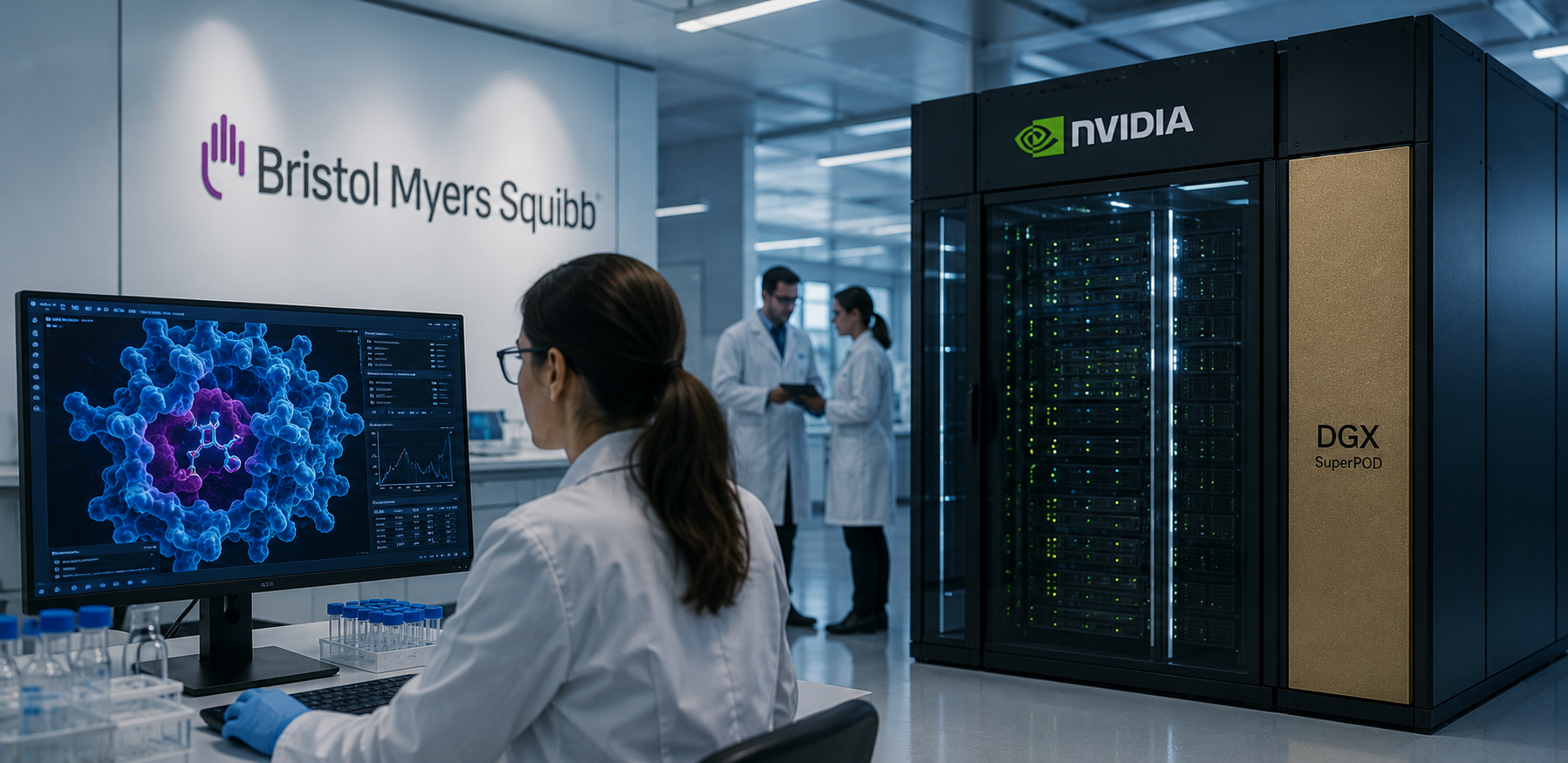
Bristol Myers Squibb (BMS) is significantly expanding its artificial intelligence capabilities by becoming the first life sciences company to purchase NVIDIA's newest DGX SuperPOD built on the company's next-generation Vera Rubin architecture.
The advanced AI computing system will support Bristol Myers' growing use of artificial intelligence across drug discovery and development, enabling researchers to analyze larger datasets, evaluate more potential drug candidates, and accelerate the creation of new medicines. Financial terms of the investment were not disclosed.
The announcement reflects the pharmaceutical industry's accelerating investment in dedicated AI infrastructure as companies compete to shorten research timelines, improve clinical success rates, and reduce the cost of bringing new therapies to market.
What Is the NVIDIA DGX SuperPOD?
The NVIDIA DGX SuperPOD is a high-performance artificial intelligence computing platform designed to train and run extremely large AI models.
Unlike conventional data centers, AI supercomputers can process enormous volumes of scientific information simultaneously, making them particularly valuable for complex biomedical research.
The new system purchased by Bristol Myers is based on NVIDIA's Vera Rubin architecture, the company's newest generation of AI infrastructure.
Compared with previous systems, Vera Rubin offers:
- Significantly greater computing power.
- Higher processing efficiency.
- Faster AI model training.
- Lower energy consumption per unit of computation.
- Support for much larger foundation models.
According to Bristol Myers executives, the new infrastructure delivers roughly ten times more computing capacity per watt than the company's earlier AI platform, allowing researchers to scale increasingly sophisticated AI workloads without a proportional increase in energy costs.
How AI Is Transforming Drug Discovery
Developing a new medicine traditionally takes more than a decade and requires screening millions of potential molecules before identifying a promising drug candidate.
Artificial intelligence is changing that process by helping researchers:
- Identify promising biological targets.
- Predict how molecules behave.
- Design new compounds.
- Analyze genomic and clinical data.
- Prioritize candidates for laboratory testing.
- Improve clinical trial planning.
Instead of relying primarily on trial-and-error experimentation, AI enables scientists to simulate and evaluate thousands of possibilities before conducting laboratory research.
This allows companies to focus resources on the most promising drug candidates much earlier in development.
Bristol Myers Is Already Seeing Results
According to Bristol Myers' research leadership, artificial intelligence has already reduced the time required to create medicines for clinical testing by 20% to 30%, with the potential for reductions approaching 50% as AI models continue improving.
The company also revealed that one of its experimental treatments for sickle cell disease, currently in early-stage clinical development, likely would not have been discovered without AI-assisted research.
Executives expect the expanded computing infrastructure to dramatically increase the number of potential drug candidates researchers can evaluate during the earliest stages of development.
Rather than examining only a limited number of molecules, scientists expect to analyze many more possible candidates before selecting those most likely to succeed.
Why Pharmaceutical Companies Are Investing in AI Infrastructure
Artificial intelligence has become one of the pharmaceutical industry's largest areas of investment.
Companies are increasingly building dedicated AI computing systems because modern drug discovery depends on processing enormous amounts of information, including:
- Genomic sequencing.
- Protein structures.
- Medical imaging.
- Clinical trial data.
- Electronic health records.
- Real-world evidence.
- Molecular simulations.
As AI models become larger and more sophisticated, traditional computing infrastructure often cannot meet growing computational demands.
Owning dedicated AI infrastructure allows companies to develop proprietary models while maintaining greater control over sensitive research data.
A Growing Industry Trend
Bristol Myers is not alone in expanding AI infrastructure.
Across the pharmaceutical industry, companies are investing heavily in artificial intelligence to improve research productivity, reduce development costs, and increase the likelihood that experimental medicines successfully reach patients.
Rather than viewing AI as an experimental technology, many pharmaceutical companies now consider it an essential component of future research operations.
Industry leaders increasingly expect AI to influence nearly every stage of medicine development, from target discovery through clinical trials and manufacturing.
Industry Impact
- Pharmaceutical Companies: The investment demonstrates how major drugmakers are shifting from using AI as a research tool to building large-scale computing infrastructure capable of supporting enterprise-wide drug discovery.
- Biotechnology Companies: Smaller biotechnology firms may increasingly seek partnerships with AI-enabled pharmaceutical companies that possess advanced computational capabilities and extensive research datasets.
- Researchers: Scientists will gain access to significantly greater computing power, enabling more sophisticated modeling and faster evaluation of potential therapies.
- Patients: Faster identification of promising medicines could shorten development timelines and accelerate the availability of new treatments for diseases with significant unmet medical needs.
Why This Matters
Bristol Myers' investment marks another milestone in the transformation of pharmaceutical research through artificial intelligence.
Rather than simply automating administrative tasks, AI is becoming deeply integrated into scientific discovery itself. High-performance computing systems now enable researchers to analyze biological data at unprecedented scale, helping identify promising drug candidates more efficiently than traditional approaches.
The announcement also reflects a broader shift toward AI-first research strategies across the pharmaceutical industry. As companies continue investing in dedicated AI infrastructure, computational science is becoming just as important as laboratory experimentation in the development of future medicines.
Key Takeaways
- Bristol Myers Squibb will become the first life sciences company to deploy NVIDIA's latest DGX SuperPOD based on the Vera Rubin architecture.
- The AI system will support drug discovery and development across the company's research organization.
- Bristol Myers says AI has already reduced certain drug development timelines by 20% to 30%, with further improvements expected.
- The new platform provides approximately ten times greater computing capacity per watt than the company's earlier AI infrastructure.
- The investment reflects the pharmaceutical industry's accelerating adoption of large-scale artificial intelligence infrastructure.
What This Means for Healthcare Marketers
Bristol Myers' investment illustrates how artificial intelligence is rapidly evolving from a supporting technology into a foundational capability for pharmaceutical research. Competitive advantage is increasingly being driven not only by scientific expertise but also by computational infrastructure capable of analyzing vast biological datasets. Organizations that combine AI, high-performance computing, and proprietary clinical data are likely to accelerate innovation and strengthen their positions across drug discovery and development.
For healthcare marketers, the announcement highlights the growing importance of communicating technological leadership alongside scientific innovation. AI infrastructure is becoming a meaningful differentiator for pharmaceutical companies seeking research partnerships, attracting scientific talent, and demonstrating long-term innovation capabilities.
For healthcare intelligence teams, investments in AI computing infrastructure are valuable indicators of future research priorities. Monitoring these investments can reveal where pharmaceutical companies are concentrating resources, which therapeutic areas may advance more rapidly, and how artificial intelligence is reshaping the competitive landscape of drug development.