What's Happening
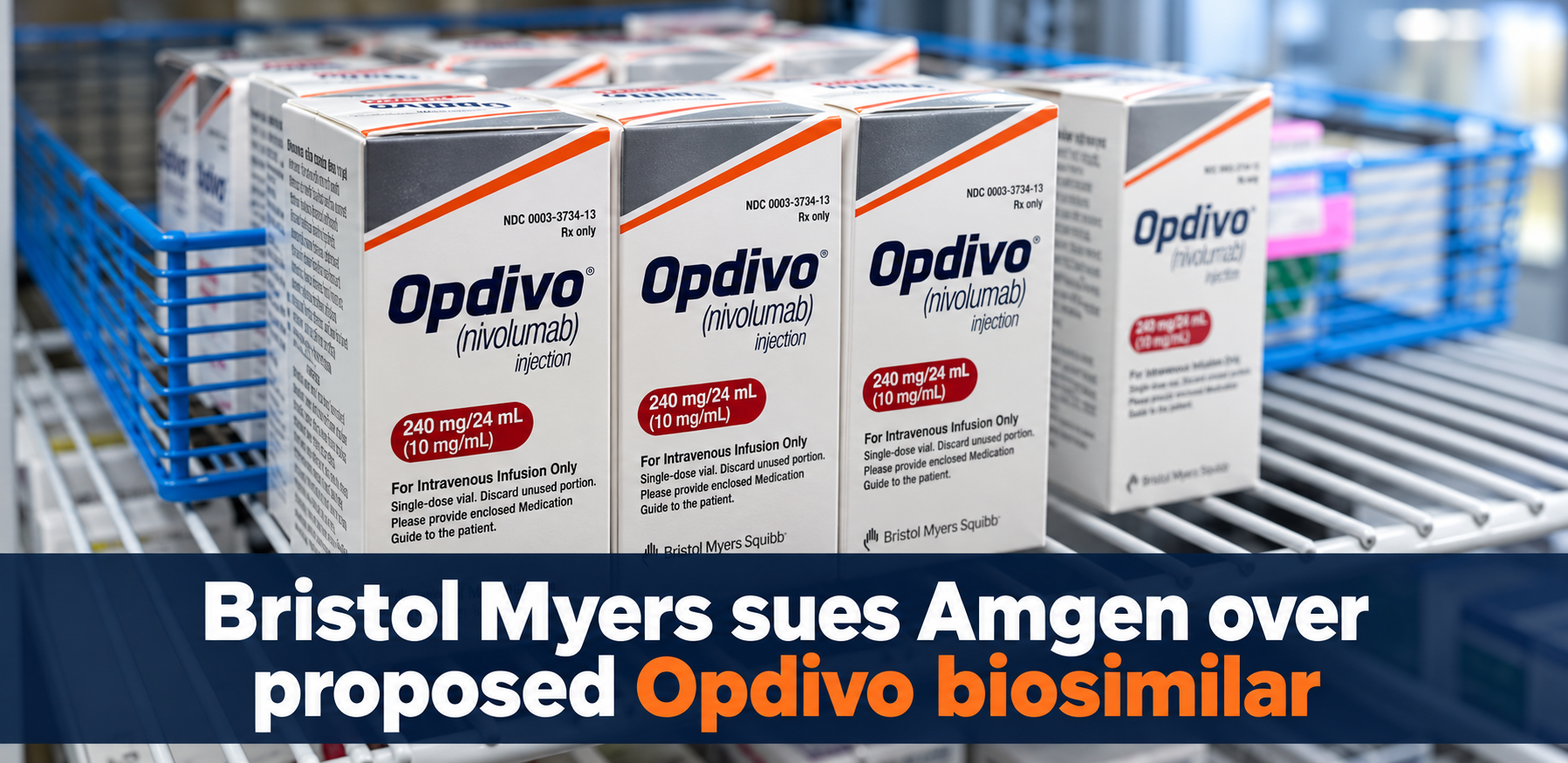
Bristol Myers Squibb and its Japanese partner Ono Pharmaceutical have sued Amgen in U.S. federal court to prevent Amgen from launching a proposed biosimilar version of their blockbuster cancer immunotherapy Opdivo (nivolumab).
The lawsuit was filed in the U.S. District Court for the District of Delaware and centers on Amgen's investigational biosimilar ABP 206. Bristol Myers and Ono allege that ABP 206 would infringe seven patents covering Opdivo. (Reuters)
The complaint was initially filed under seal on September 8, 2026, and a redacted version was subsequently made public as Bristol-Myers Squibb Co. v. Amgen Inc., No. 1:26-cv-01134. (Justia Dockets & Filings)
The lawsuit is part of a broader battle over how long branded biologic medicines can remain protected from biosimilar competition through additional patents covering specific uses, dosing or treatment methods.
Why Opdivo Matters to Bristol Myers
Blockbuster oncology revenues drive the need for intellectual-property defense
Opdivo is one of Bristol Myers Squibb's largest products, generating approximately $10.05 billion in worldwide revenue in 2025, including $5.90 billion in the United States where revenue increased 10% from 2024. (SEC)
As a PD-1 inhibitor approved across numerous cancers—including lung, kidney, melanoma, bladder, colorectal, head and neck, liver, stomach, esophageal, and certain blood cancers—biosimilar competition could potentially affect a significant portion of Bristol Myers' oncology business. (SEC)
What Amgen Is Developing
Expanding a biosimilar portfolio targeting major biologic medicines
Amgen is developing ABP 206 as a biosimilar to nivolumab, conducting comparative clinical studies such as a Phase 3 study evaluating ABP 206 against Opdivo in untreated, unresectable or metastatic melanoma. (Amgen)
Amgen is also developing other biosimilars, including ABP 234 (targeting Merck's Keytruda) and ABP 692 (targeting Roche's Ocrevus), part of a broader strategy to target major biologic medicines. (Amgen)
The Patent Dispute
Asserting seven later-expiring patents covering specific aspects and uses
The lawsuit focuses on patent rights rather than regulatory testing, alleging that ABP 206 infringes seven patents listed in the federal court record, including U.S. Patent Nos. 8,008,449; 9,856,320; 10,072,082; 12,479,917; 12,590,153; 12,590,154; and 12,624,107. (Justia Dockets & Filings)
Bristol Myers' strategy relies on later-expiring patents associated with particular aspects or uses of the medicine, rather than relying only on the foundational patent protecting Opdivo itself. (Bloomberg Law)
Why Later Patents Matter
Additional protections extend market exclusivity beyond foundational patent expirations
A biologic can have multiple patents covering different components of the product and its use, meaning the expiration of an original foundational patent does not automatically clear the path for biosimilar entry.
Drug manufacturers can hold additional patents involving formulation, dosing, administration, treatment combinations, and specific indications to defend market exclusivity and create uncertainty for biosimilar developers. (Bloomberg Law)
The U.S. Biosimilar Market
Balancing lower-cost alternatives with substantial development and legal investments
Biosimilars offer lower-cost alternatives to expensive biologic therapies as exclusivity periods end, but development requires substantial clinical, manufacturing, and regulatory investment.
Commercialization success depends on receiving FDA approval and successfully resolving patent disputes with original manufacturers.
The Role of the Biosimilar Approval Pathway
BPCIA framework builds patent litigation into abbreviated regulatory processes
Developed through the BPCIA framework, biosimilar pathways allow developers to rely partly on existing scientific information from the reference biologic while embedding information exchange and federal court patent disputes into the process. (AI Lab)
Why Amgen Wants to Enter the Market
Capturing a share of a massive multi-billion-dollar immuno-oncology market
Opdivo's $5.9 billion in 2025 U.S. sales demonstrates a massive commercial opportunity for Amgen to participate in one of the largest U.S. oncology markets, subject to FDA approval, patent resolution, pricing, and adoption. (SEC)
Why Bristol Myers Is Defending Opdivo
Protecting a core growth franchise against revenue and market share erosion
With worldwide revenue reaching approximately $10 billion in 2025, protecting Opdivo's intellectual-property position is directly connected to Bristol Myers' ability to maintain revenue, net pricing, market share, and future oncology forecasts. (Bristol Myers Squibb)
The Broader Oncology Competition
Crowded immuno-oncology markets brace for multi-tumor biosimilar entry
As Opdivo competes with immunotherapies like Merck's Keytruda, and developers like Amgen advance multiple biosimilar programs, the industry is moving toward a future where branded immunotherapies and biosimilars compete across multiple tumor types. (Amgen)
What the Lawsuit Means for Patients
Long-term access and potential pricing competition depend on legal outcomes
Because ABP 206 remains investigational, patients are not currently being switched from Opdivo, but future regulatory approval and market entry could eventually introduce treatment options and pricing competition.
What Happens Next
Navigating parallel tracks of FDA review and federal patent litigation
The Delaware litigation will determine whether Amgen can launch without infringing asserted patents, running parallel to ongoing clinical and regulatory development where regulatory approval alone does not guarantee immediate market-entry rights.
Why This Matters
The dispute highlights that FDA approval and patent freedom to operate are separate hurdles in the U.S. biologics market, where Opdivo's multi-billion-dollar scale makes intellectual property defense and biosimilar entry high-stakes concerns for all stakeholders. (SEC)
Looking Ahead
Clarifying the effectiveness of secondary patent barriers in high-revenue biologics
Outcomes from the Delaware patent case and Amgen's regulatory work will clarify how effectively additional patents can delay biosimilar competition, signaling that future pharmaceutical competition will heavily feature patent litigation alongside biosimilar development.
Key Takeaways
- Bristol Myers Squibb and Ono Pharmaceutical sued Amgen in Delaware over its proposed Opdivo biosimilar, ABP 206. (Reuters)
- The lawsuit alleges that ABP 206 infringes seven Opdivo-related patents. (Bloomberg Law)
- The case was filed on September 8, 2026, with public filings emerging later as Case No. 1:26-cv-01134. (Justia Dockets & Filings)
- Opdivo generated $10.05 billion globally and $5.90 billion in the U.S. in 2025, serving as one of Bristol Myers' largest growth products. (SEC)
- Amgen is conducting Phase 3 comparative research of ABP 206 in treatment-naive unresectable or metastatic melanoma. (Amgen)
- The dispute illustrates how additional patents covering uses or other aspects of a biologic affect biosimilar market entry even after foundational protections become less restrictive. (Bloomberg Law)
What This Means for Healthcare Marketers
For pharmaceutical marketers, the case shows why loss-of-exclusivity planning cannot focus only on a single patent expiration date, requiring a complete view of intellectual-property landscapes, clinical programs, FDA filings, litigation activity, and potential launch timing.
For payers and healthcare organizations, an eventual Opdivo biosimilar could create new opportunities for cost management and formulary strategy, while Bristol Myers must maintain physician confidence and communicate clinical value as competition approaches.
For healthcare intelligence teams, tracking patent filings, biosimilar trial progress, FDA activity, litigation milestones, and payer behavior provides an earlier view of when major biologic franchises may face competitive pressure.