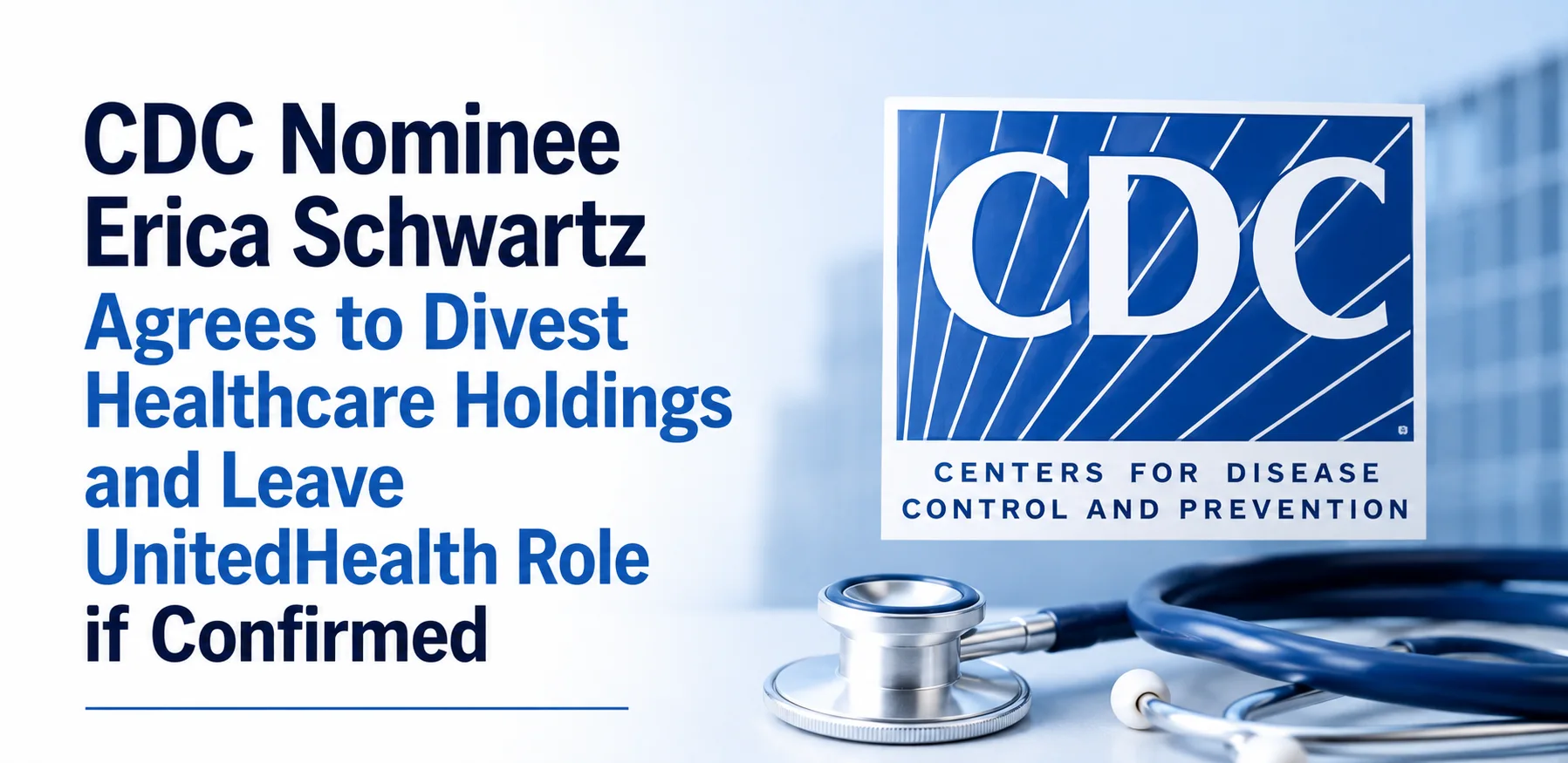
CDC Nominee Erica Schwartz Agrees to Divest Healthcare Holdings and Leave UnitedHealth Role if Confirmed
What's Happening
Dr. Erica Schwartz, President Donald Trump's nominee to lead the U.S. Centers for Disease Control and Prevention (CDC), disclosed plans to leave her position at UnitedHealth Group, resign from multiple healthcare company board roles, and sell certain healthcare-related investments if confirmed by the Senate.
The commitments were outlined in an ethics agreement submitted to the Department of Health and Human Services (HHS) as part of the federal confirmation process.
According to the disclosure, Schwartz's employment with UnitedHealth would end upon confirmation. She also agreed to resign from the boards of Butterfly Network and Aveanna Healthcare, divest related stock holdings within 90 days, and recuse herself from specific government matters involving former employers and clients for a designated period.
The disclosures are intended to address potential conflicts of interest before she assumes leadership of one of the nation's most influential public health agencies.
Why Federal Nominees Must Make These Disclosures
Senior government officials are required to undergo ethics reviews before taking office.
The purpose is to ensure that public officials make decisions based on the public interest rather than personal financial interests.
Federal agencies such as the CDC frequently make decisions that can affect:
- Health insurers
- Pharmaceutical companies
- Medical device manufacturers
- Hospitals and health systems
- Healthcare technology companies
- Public health programs
Because these decisions can have significant financial consequences, nominees are often required to sell certain investments, resign outside positions, or limit their involvement in matters connected to former employers.
The process is designed to maintain public trust and ensure government decisions remain independent.
Schwartz's Connections to the Healthcare Industry
Before her nomination, Schwartz held positions across several healthcare organizations.
Her role at UnitedHealth Group, one of the largest health insurers in the United States, drew particular attention because the company operates across multiple areas of healthcare, including insurance, care delivery, data analytics, and pharmacy services.
The ethics disclosure states that she will end her employment relationship with the company if confirmed and comply with restrictions regarding future involvement in matters directly affecting UnitedHealth.
She also agreed to step down from board positions at Butterfly Network, a medical imaging technology company, and Aveanna Healthcare, a provider of home healthcare services.
Such resignations are common when individuals move from the private sector into senior government positions.
Why Recusal Requirements Matter
A key part of the ethics agreement involves recusal obligations.
Recusal means a government official must avoid participating in decisions that could directly affect former employers, clients, business partners, or financial interests.
These requirements help prevent situations where government decisions could create the appearance of favoritism.
For example, if a federal agency is reviewing a matter involving a former employer, an official with prior ties may be required to remove themselves from discussions and decision-making.
Recusal policies are a standard part of ethics agreements across federal agencies.
The goal is not only to prevent actual conflicts of interest but also to maintain confidence in the fairness of government actions.
Why the CDC Director Position Is Important
The CDC is one of the most influential public health organizations in the world.
The agency is responsible for:
- Monitoring disease outbreaks
- Conducting public health research
- Supporting state and local health departments
- Developing health guidance
- Coordinating emergency responses
- Managing disease surveillance programs
The CDC's recommendations often influence healthcare providers, insurers, employers, schools, and public health agencies throughout the country.
As a result, leadership decisions at the CDC can have far-reaching implications across the healthcare ecosystem.
The person leading the agency plays a critical role in shaping priorities related to infectious diseases, chronic disease prevention, emergency preparedness, and public health policy.
What Happens Next?
Schwartz must still complete the Senate confirmation process before officially assuming the role.
Lawmakers will review her qualifications, policy positions, leadership experience, and ethics disclosures during confirmation proceedings.
If confirmed, the commitments outlined in her ethics agreement would take effect, including:
- Ending her employment with UnitedHealth
- Resigning board memberships
- Divesting specified healthcare holdings
- Following recusal requirements
The review process is designed to ensure nominees can serve independently and without conflicts that could affect agency decision-making.
Why This Matters
While ethics disclosures may not receive the same attention as major healthcare policy announcements, they play an important role in federal governance.
Public confidence in agencies such as the CDC depends heavily on trust, transparency, and accountability.
The disclosures provide insight into how federal officials separate private-sector interests from public service responsibilities.
They also highlight the increasing movement of executives and healthcare leaders between industry and government roles, making ethics oversight more important than ever.
For healthcare organizations, leadership changes at federal agencies are closely watched because they can influence regulatory priorities, public health initiatives, and future policy direction.
Key Takeaways
- CDC nominee Erica Schwartz agreed to leave UnitedHealth if confirmed.
- She will resign from the boards of Butterfly Network and Aveanna Healthcare.
- She pledged to divest certain healthcare-related investments and comply with recusal requirements.
- The disclosures were made as part of the federal ethics review process.
- The Senate must still confirm her nomination before she can assume leadership of the CDC.
What This Means for Healthcare Marketers
Leadership appointments at major federal health agencies are important signals for healthcare organizations, even when the immediate news focuses on ethics disclosures rather than policy.
For healthcare marketers, agency leadership often influences future priorities related to public health programs, disease prevention initiatives, healthcare funding, and regulatory oversight. While ethics agreements themselves do not change policy, they help establish the independence and credibility of officials who may later shape important healthcare decisions.
The story also highlights the close relationship between government and the healthcare industry. Many senior healthcare leaders move between private-sector organizations and public service roles, making transparency and conflict-of-interest safeguards increasingly important.
For healthcare intelligence teams, leadership transitions can provide early insight into future areas of focus within federal agencies. Monitoring these developments may help organizations anticipate changes in public health priorities, stakeholder engagement strategies, and healthcare policy discussions over time.