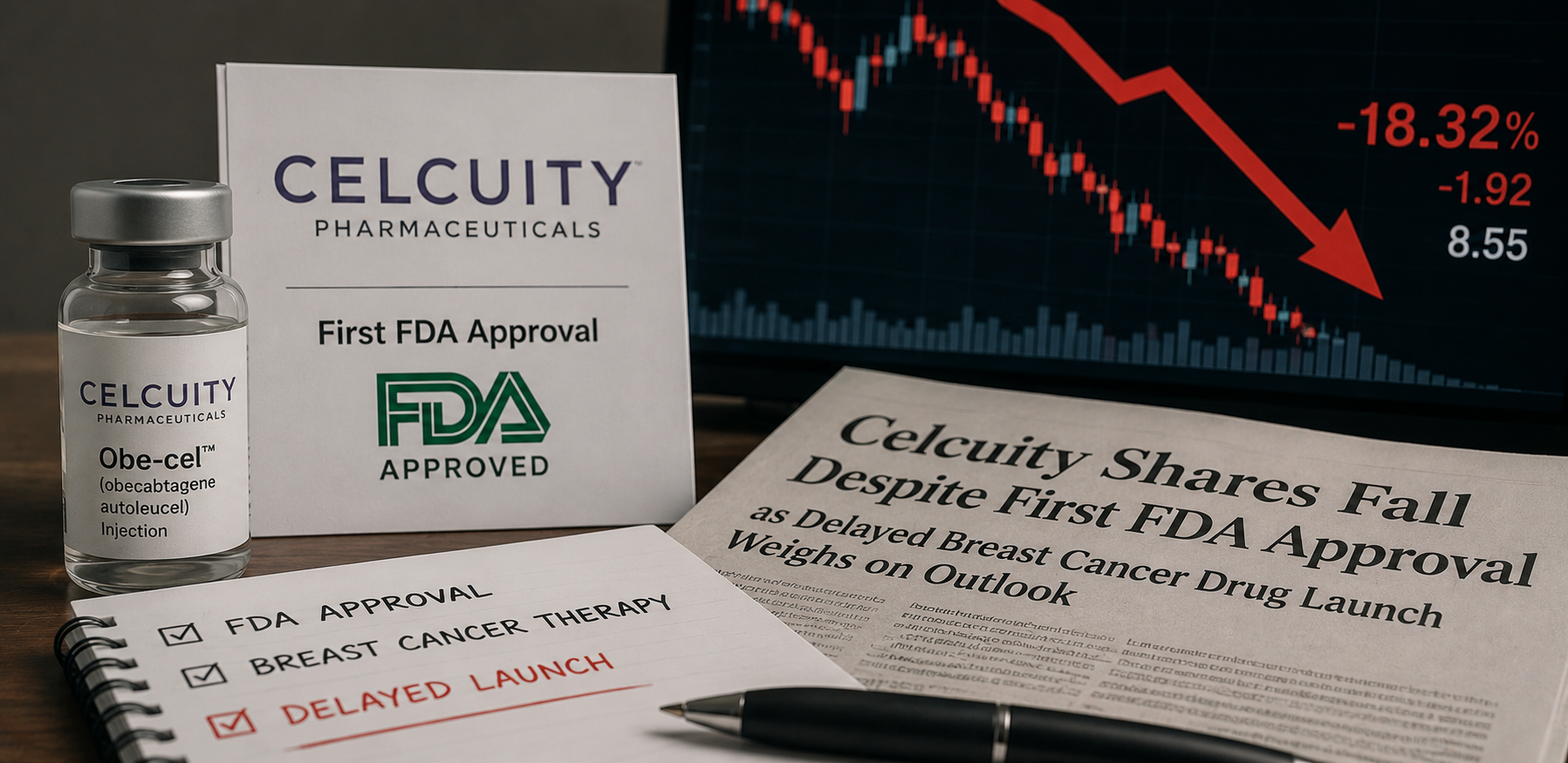
Celcuity Shares Fall Despite First FDA Approval as Delayed Breast Cancer Drug Launch Weighs on Outlook
What's Happening
Shares of Celcuity fell after the company announced that the commercial launch of its newly approved breast cancer treatment would be delayed, overshadowing the company's first-ever U.S. Food and Drug Administration (FDA) approval.
While receiving FDA approval marked a major milestone for the biotechnology company, investors focused on the delayed market launch and its potential impact on future revenue. The postponement means patients and healthcare providers may have to wait longer before the treatment becomes commercially available.
The development illustrates that regulatory approval is only one step in bringing a new medicine to patients, with manufacturing, commercialization, reimbursement, and distribution all playing important roles in a successful product launch.
Why FDA Approval Is a Major Milestone
Receiving FDA approval confirms that a medicine has met the agency's standards for safety and effectiveness for its intended use.
Before approval, new therapies typically undergo:
- Laboratory research.
- Preclinical testing.
- Phase 1 clinical trials.
- Phase 2 clinical trials.
- Phase 3 clinical trials.
- FDA regulatory review.
The process often takes many years and requires significant scientific and financial investment.
For biotechnology companies, a first FDA approval is particularly significant because it validates years of research and can establish the company as a commercial-stage organization.
Why Drug Launches Sometimes Get Delayed
Even after FDA approval, companies may postpone commercial launches for several reasons.
These include:
- Manufacturing readiness.
- Supply chain preparation.
- Distribution logistics.
- Product inventory.
- Reimbursement planning.
- Commercial strategy.
- Market access negotiations.
A delay does not necessarily reflect concerns about the medicine's safety or effectiveness.
Instead, companies often postpone launches to ensure healthcare providers and patients can access the treatment smoothly once it becomes available.
Understanding Breast Cancer Innovation
Breast cancer remains one of the most commonly diagnosed cancers worldwide.
Treatment options continue expanding through advances in:
- Targeted therapies.
- Hormone therapies.
- Immunotherapy.
- Precision medicine.
- Personalized treatment approaches.
Many newer medicines are designed to target specific genetic or molecular characteristics of tumors, helping physicians select treatments that are more likely to benefit individual patients.
These advances have contributed to improved survival and better quality of life for many patients.
Why Investors React to Launch Delays
For biotechnology companies, commercial launches represent the transition from research to product revenue.
Delays may affect:
- Revenue expectations.
- Market adoption.
- Investor confidence.
- Cash flow projections.
- Future business planning.
Because many biotechnology companies rely heavily on a limited number of products, the timing of a new launch can have a significant impact on financial performance.
As a result, investors often react strongly to changes in commercialization timelines.
Challenges Beyond Regulatory Approval
Successfully bringing a medicine to market involves much more than obtaining regulatory clearance.
Companies must also prepare for:
- Large-scale manufacturing.
- Product distribution.
- Physician education.
- Insurance reimbursement.
- Patient support programs.
- Supply chain management.
Strong commercial execution is essential to ensuring that newly approved medicines reach patients efficiently after approval.
Industry Impact
- Biotechnology Companies: The development highlights the importance of commercialization planning alongside clinical and regulatory success.
- Healthcare Providers: Physicians may experience a delay before the newly approved treatment becomes available for eligible patients.
- Investors: Commercial launch timing remains a key factor influencing the valuation of emerging biotechnology companies.
- Patients: Although FDA approval expands future treatment options, availability depends on successful manufacturing and market launch.
Why This Matters
Celcuity's experience demonstrates that FDA approval is not the final step in the journey from scientific discovery to patient care.
Commercial readiness, including manufacturing capacity, distribution networks, and market access, is equally important in ensuring patients can benefit from new therapies.
The case also reflects the unique challenges faced by smaller biotechnology companies transitioning from research-focused organizations to fully commercial pharmaceutical businesses.
Successfully navigating this transition will remain critical as more innovative cancer therapies enter the market.
Key Takeaways
- Celcuity's shares declined after a delayed commercial launch overshadowed the company's first FDA approval.
- FDA approval represents a major scientific and regulatory milestone but does not guarantee immediate product availability.
- Drug launches may be delayed because of manufacturing, supply chain, reimbursement, or commercialization planning.
- Breast cancer treatment continues evolving through targeted therapies and precision medicine.
- Successful commercialization is essential for ensuring newly approved medicines reach patients.
What This Means for Healthcare Marketers
Celcuity's announcement highlights that successful commercialization extends well beyond regulatory approval. Launch readiness depends on coordinated planning across manufacturing, market access, reimbursement, supply chain management, and physician education. Even highly anticipated therapies can face commercial challenges if operational preparations are not fully aligned with regulatory milestones.
For healthcare marketers, the case reinforces the importance of integrated launch strategies. Preparing healthcare providers, payers, patient support programs, and commercial teams before product availability is essential to achieving successful adoption once a therapy reaches the market. Companies that effectively coordinate scientific communication with commercial execution are better positioned to maximize the impact of new product launches.
For healthcare intelligence teams, launch delays offer valuable insight into the operational realities of bringing innovative medicines to market. Monitoring commercialization timelines, manufacturing readiness, reimbursement developments, and competitive launches can help organizations better anticipate market dynamics and identify potential opportunities across the oncology landscape.