Cigna Says AI Has Saved Customers $200 Million in Medical Costs While Expanding Personalized Care
What's Happening
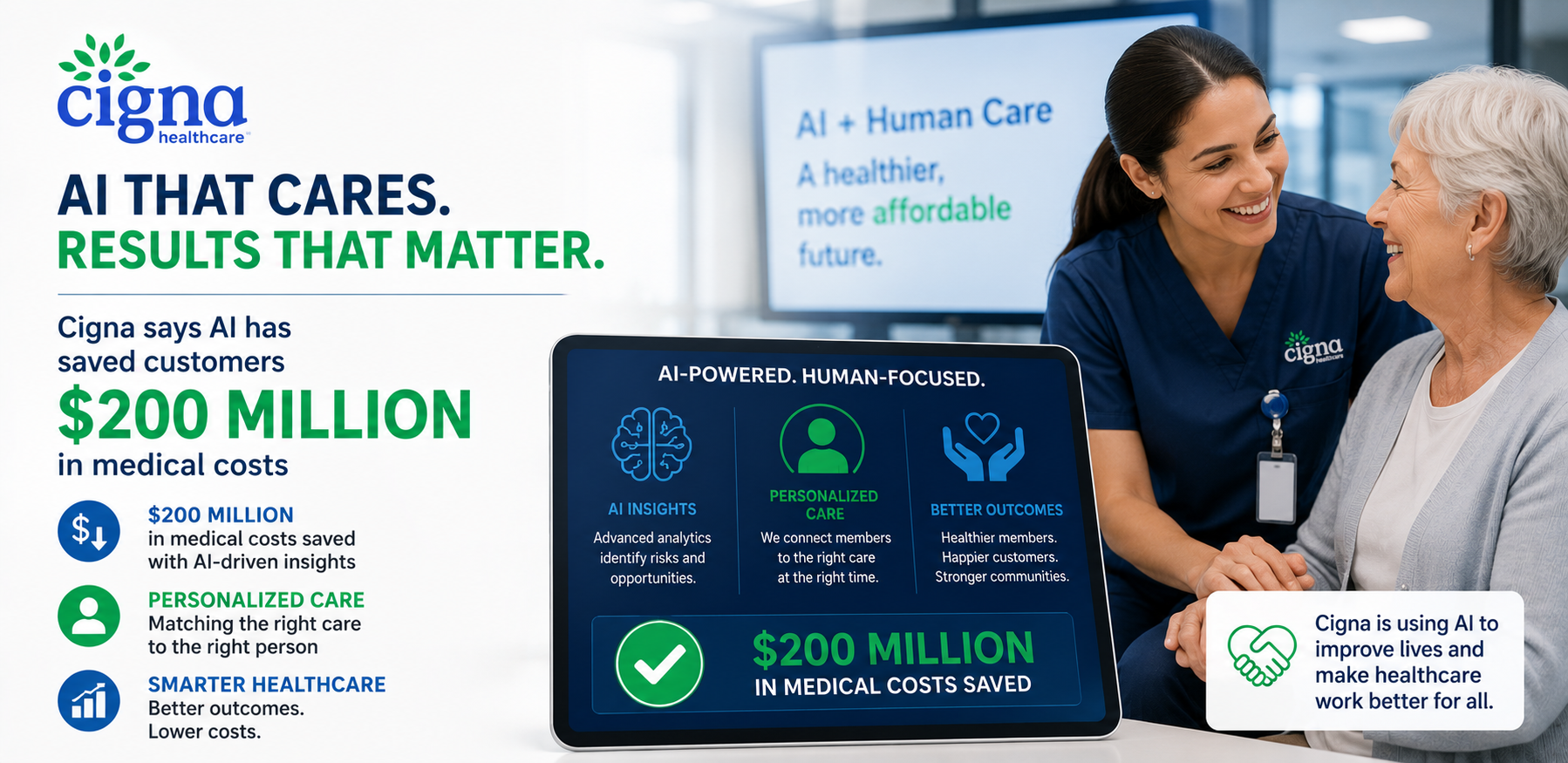
Cigna says its artificial intelligence (AI) tools have helped customers avoid more than $200 million in medical expenses over the past three years, highlighting how health insurers are increasingly using AI to improve care while reducing unnecessary healthcare spending.
According to the company, its AI-powered technologies analyze large volumes of clinical and claims data to identify opportunities for earlier intervention, recommend more appropriate care pathways, and connect members with lower-cost, high-quality treatment options. Rather than replacing clinicians, the company says these tools are designed to support care teams by providing data-driven insights that can improve healthcare decisions.
The announcement reflects a broader shift across the U.S. healthcare industry, where insurers, providers, and technology companies are investing heavily in AI to improve efficiency, enhance patient outcomes, and control rising medical costs.
How AI Is Being Used in Health Insurance
Artificial intelligence has rapidly evolved from a back-office automation tool into a core component of healthcare operations.
Health insurers are increasingly applying AI across multiple areas of the patient journey, including:
- Identifying patients who may be at risk of developing serious health conditions.
- Detecting gaps in preventive care.
- Recommending evidence-based treatment pathways.
- Matching patients with in-network providers and lower-cost care settings.
- Supporting care managers with real-time clinical insights.
- Reducing administrative tasks such as claims processing and documentation.
By analyzing millions of historical claims, medical records, pharmacy data, and healthcare utilization patterns, AI systems can identify trends that would be difficult for humans to detect on their own.
The goal is not simply to reduce costs, but to intervene earlier so patients receive the right care before conditions become more serious and expensive to treat.
Why Healthcare Costs Continue to Rise
The United States spends more on healthcare than any other country, yet costs continue to increase each year.
Several factors are contributing to this trend, including:
- Rising Chronic Disease: Conditions such as diabetes, heart disease, obesity, and cancer require ongoing monitoring and treatment, leading to higher long-term healthcare spending.
- Delayed Care: Many patients postpone routine screenings or primary care visits, resulting in more advanced illnesses that require costly hospitalizations or emergency treatment.
- Administrative Complexity: Healthcare remains one of the most administratively complex industries. Prior authorizations, claims reviews, provider networks, and care coordination all contribute to operational costs that ultimately affect patients and employers.
- Increasing Demand for Specialty Care: Advances in medicine have expanded treatment options, but many innovative therapies, specialty drugs, and complex procedures also carry significantly higher costs.
Because of these pressures, insurers are increasingly looking to AI as a way to improve efficiency without compromising quality of care.
AI Is Becoming a Clinical Decision Support Tool
Healthcare organizations are moving beyond using AI solely for automation.
Today, AI is increasingly being integrated into clinical workflows to support physicians, nurses, pharmacists, and care coordinators.
Examples include:
- Predicting which patients are likely to require hospitalization.
- Identifying medication adherence issues.
- Detecting patients who may benefit from preventive screenings.
- Recommending care management programs.
- Supporting value-based care initiatives.
- Improving population health analytics.
Importantly, these systems are intended to assist healthcare professionals rather than make independent medical decisions.
Many organizations continue to emphasize that final treatment decisions remain with clinicians and patients.
Industry Impact
- Health Insurers: Cigna's reported savings demonstrate how AI is becoming an important strategic investment for insurers seeking to improve member outcomes while controlling medical costs. Similar initiatives are being expanded across the insurance industry as companies compete on both affordability and care quality.
- Healthcare Providers: Hospitals and physician groups increasingly receive AI-generated insights that help prioritize high-risk patients, coordinate care, and identify opportunities for earlier intervention. As payer-provider collaboration grows, data sharing will become even more important.
- Employers: Large employers, who fund healthcare coverage for millions of Americans, continue looking for ways to reduce healthcare spending while improving employee health. AI-supported care management programs may help lower long-term healthcare costs without reducing access to care.
- Digital Health Companies: The announcement highlights growing demand for AI platforms capable of analyzing healthcare data at scale. Companies specializing in predictive analytics, clinical decision support, and population health technologies are likely to see continued investment as insurers modernize their operations.
The Growing Debate Around AI in Healthcare
While AI offers significant opportunities, it has also raised important questions around transparency, fairness, and accountability.
Consumer advocates and policymakers have called for greater oversight of how insurers use AI, particularly when algorithms influence utilization management, prior authorization, or claims decisions.
Healthcare organizations are therefore under increasing pressure to ensure that AI systems are:
- Transparent.
- Clinically validated.
- Free from unintended bias.
- Used to support rather than replace human judgment.
- Consistent with evolving regulatory expectations.
Organizations that can demonstrate responsible AI governance are likely to build greater trust among patients, providers, and regulators.
Why This Matters
Artificial intelligence is rapidly becoming one of healthcare's most influential technologies.
Rather than focusing solely on administrative efficiency, insurers are increasingly using AI to identify health risks earlier, improve care coordination, and guide patients toward more effective and affordable treatment options.
Cigna's reported cost savings illustrate how predictive analytics can generate measurable financial benefits while supporting better health outcomes. As healthcare continues shifting toward value-based care, AI is expected to become an increasingly important tool for improving quality, reducing waste, and personalizing patient care.
For the broader healthcare industry, the focus is no longer whether AI will be adopted, but how organizations can deploy it responsibly, transparently, and at scale.
Key Takeaways
- Cigna says its AI tools have helped customers avoid more than $200 million in medical expenses over the past three years.
- The company uses AI to identify care opportunities, improve care coordination, and support more cost-effective treatment decisions.
- Health insurers are increasingly investing in AI to improve patient outcomes while managing rising healthcare costs.
- Responsible AI governance remains essential as regulators and consumers seek greater transparency around algorithmic decision-making.
- AI is becoming a foundational technology supporting value-based care, population health, and personalized healthcare delivery.
What This Means for Healthcare Marketers
Cigna's announcement highlights how AI is evolving from an operational efficiency tool into a strategic driver of healthcare transformation. Organizations offering predictive analytics, clinical decision support, care management platforms, and healthcare AI solutions have growing opportunities to partner with payers and providers seeking measurable improvements in outcomes and cost management. For healthcare marketers, demonstrating real-world value, clinical validation, interoperability, and responsible AI practices will be critical as decision-makers evaluate technologies that promise to improve both patient care and financial performance.