
Cipla and Qilu Partner to Launch Keytruda Biosimilar in the U.S.
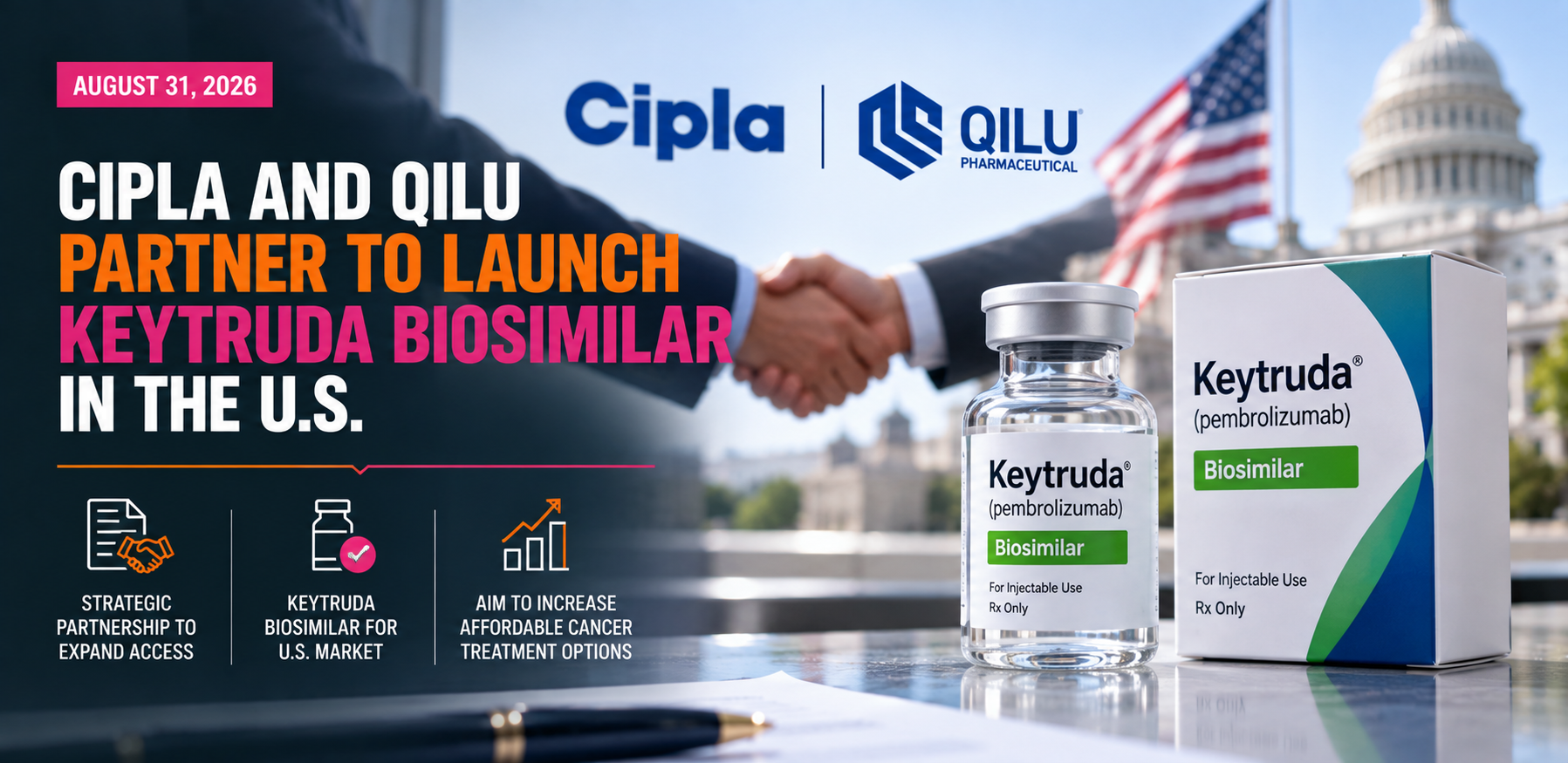
What's Happening
India's Cipla and China's Qilu Pharmaceutical have entered into an exclusive partnership to bring a biosimilar version of Merck's blockbuster cancer drug Keytruda to the U.S. market.
Under the agreement, Qilu Pharmaceutical will take responsibility for the development, regulatory approvals, manufacturing and supply of the biosimilar, known as QL2107. Cipla USA will handle commercialization and sales in the United States. (Reuters)
The partnership positions the two companies to compete in the U.S. oncology market as Keytruda approaches the loss of patent protection. Merck is expected to lose U.S. patent protection for Keytruda in 2028, opening the door to biosimilar competition. (Reuters)
The Partnership Combines Development and Commercial Strengths
Qilu will handle development and manufacturing
Qilu will be responsible for the scientific and operational side of QL2107.
That includes:
- Development of the biosimilar
- Regulatory submissions and approvals
- Manufacturing
- Supply
This gives Qilu control over the product's development and production pipeline. (Reuters)
Cipla will commercialize the product
Cipla USA will be responsible for commercialization and sales in the U.S.
That division of responsibilities allows the companies to combine Qilu's research and manufacturing capabilities with Cipla's existing U.S. commercial infrastructure. Cipla said the arrangement supports its strategy of expanding its oncology-focused biosimilar portfolio. (Reuters)
This type of partnership can be especially useful when a manufacturer has strong drug-development capabilities but wants a partner with established access to the target market.
QL2107 Is Designed to Replicate Keytruda
The product is a biosimilar version of pembrolizumab
QL2107 is being developed as a biosimilar version of Merck's Keytruda.
The companies said the product is intended to provide patients with a more affordable treatment option while matching the original therapy's safety and efficacy profile. (Reuters)
Biosimilars are not traditional generic copies because biologic medicines are significantly more complex than conventional small-molecule drugs.
Instead, biosimilar developers must demonstrate that their product is highly similar to the reference biologic and does not have clinically meaningful differences in safety or effectiveness.
Keytruda Is One of the World's Most Important Cancer Drugs
The drug has an enormous oncology footprint
Keytruda has been one of the world's best-selling medicines and, until recently, was the top-selling drug globally. (Reuters)
Its large commercial footprint makes it one of the most attractive targets for biosimilar competition.
Keytruda is used across 20 different types of tumors and 45 types and stages of cancer, according to Reuters. (Reuters)
That breadth means a successful biosimilar could potentially be used across a very large number of cancer-treatment pathways rather than being limited to one narrow disease.
The 2028 Patent Expiration Is Driving the Strategy
Companies are preparing before exclusivity ends
Merck is expected to lose patent protection for Keytruda in 2028. (Reuters)
That creates an opportunity for biosimilar developers to prepare products, manufacturing capacity and commercial relationships ahead of the eventual market opening.
The timing is strategically important.
A company that waits until patent protection expires to begin building its biosimilar business could find itself behind competitors that already have regulatory, manufacturing and commercial infrastructure in place.
Cipla and Qilu's agreement therefore represents a preparation-for-entry strategy rather than an immediate challenge to Keytruda's current U.S. exclusivity.
Why Keytruda Is Such an Attractive Biosimilar Target
A massive addressable oncology market
Keytruda's use across numerous cancers gives a biosimilar developer access to a potentially very large patient population.
The drug is an immune checkpoint inhibitor that has become a core therapy across oncology.
That makes the eventual U.S. biosimilar market strategically important to manufacturers looking to expand their presence in oncology.
Affordability is a central opportunity
The companies are explicitly positioning QL2107 as a more affordable option.
When biosimilars enter large biologic markets, their commercial opportunity often comes from offering healthcare systems and payers an alternative to the reference product.
Lower-cost competition can create potential savings for insurers and healthcare systems while increasing treatment access for patients.
The extent of those savings will depend on pricing, contracting, reimbursement and competition among multiple biosimilar manufacturers.
Cipla Is Expanding Its Oncology Biosimilar Portfolio
Cipla said the agreement supports its strategy to expand its oncology-focused biosimilars portfolio. (Reuters)
That is significant because oncology is one of the pharmaceutical industry's most important areas for biologic medicines.
Cancer treatment increasingly relies on complex biologic therapies, many of which command high prices.
As patents and regulatory exclusivities expire, biosimilar manufacturers have opportunities to enter these markets and compete on affordability.
For Cipla, the Keytruda partnership fits directly into that long-term strategy.
Qilu Brings Development and Manufacturing Capabilities
Qilu's role reflects the growing importance of Asian pharmaceutical manufacturers in the global biologics market.
The company will provide the research and manufacturing infrastructure required to develop and supply QL2107.
For Cipla, partnering rather than building the entire development and production operation internally can provide a potentially more efficient way to expand its oncology portfolio.
For Qilu, Cipla provides a route into the U.S. commercial market.
The U.S. Is the Critical Commercial Market
The United States is especially important for this deal because of the enormous size of its oncology market and the scale of Keytruda's existing use.
Cipla USA will have responsibility for bringing QL2107 to U.S. customers, meaning its commercial capabilities will become an important part of the product's eventual success.
That includes building relationships across the healthcare ecosystem, potentially involving:
- Oncologists
- Hospitals
- Cancer centers
- Specialty pharmacies
- Insurers and pharmacy benefit stakeholders
- Healthcare distributors
Because Keytruda is already deeply established in clinical practice, the challenge for a biosimilar will not simply be generating awareness. It will be convincing healthcare organizations that switching or using the alternative offers sufficient economic value while maintaining confidence in clinical performance.
Competition Could Become Intense
Multiple manufacturers are preparing for biologic patent expirations
Keytruda's scale makes it likely to attract multiple biosimilar developers as the relevant intellectual-property protections expire.
More competition generally creates greater potential for price reductions, but it can also make commercialization more difficult for individual manufacturers.
A biosimilar company therefore needs more than regulatory approval.
It needs sufficient manufacturing capacity, reliable supply, payer relationships, physician confidence and a commercial strategy capable of winning market share.
Biosimilars Can Reshape Oncology Economics
Lower-cost alternatives can change treatment access
The arrival of a lower-cost alternative to a major cancer biologic can have implications throughout the healthcare system.
For payers, biosimilars can potentially lower spending.
For hospitals and oncology practices, lower acquisition costs can affect treatment economics and margins.
For patients, lower-cost treatment can potentially reduce financial barriers, depending on insurance coverage and reimbursement structures.
For pharmaceutical companies, biosimilar entry can fundamentally change the economics of a product that previously benefited from market exclusivity.
The Market Transition Will Not Happen Overnight
Even after regulatory approval, a biosimilar does not automatically replace the reference medicine.
Doctors and health systems may initially continue using the original product because of familiarity, clinical experience, contracts and reimbursement arrangements.
Payers may use formularies and pricing incentives to encourage biosimilar adoption.
As more competitors enter, these commercial dynamics can become increasingly important.
That means Cipla and Qilu will need to compete not only on the scientific similarity of QL2107 but also on price, supply reliability and market access.
Why This Matters
The partnership is important because it combines three major forces in the U.S. pharmaceutical market:
- Patent expiration: Keytruda's U.S. patent protection is expected to end in 2028.
- Biosimilar competition: Companies are preparing alternatives to one of the world's biggest cancer drugs.
- Affordability pressure: The new product is explicitly being positioned as a more affordable treatment option. (Reuters)
The eventual arrival of QL2107 could therefore contribute to a major shift in the economics of cancer treatment.
For Merck, biosimilar competition represents an approaching challenge to one of its most important products.
For Cipla and Qilu, it represents an opportunity to establish themselves in a lucrative U.S. oncology market.
For healthcare systems, the biggest potential benefit is increased competition around the cost of cancer treatment.
Looking Ahead
The next major milestones will be QL2107's development, regulatory submission and FDA review.
The agreement gives Qilu responsibility for those activities, while Cipla prepares to commercialize the product in the United States. (Reuters)
The critical longer-term milestone is 2028, when Merck is expected to lose patent protection for Keytruda.
As that date approaches, additional manufacturers may announce their own biosimilar programs, potentially creating a highly competitive market.
For Cipla and Qilu, the challenge will be ensuring that QL2107 reaches the market with the regulatory approval, manufacturing capacity and commercial infrastructure necessary to compete effectively once the opportunity opens.
Key Takeaways
- Cipla USA and Qilu Pharmaceutical have entered an exclusive partnership to bring a Keytruda biosimilar to the U.S. market. (Reuters)
- The biosimilar is called QL2107.
- Qilu will manage development, regulatory approvals, manufacturing and supply.
- Cipla USA will handle U.S. commercialization and sales. (Reuters)
- QL2107 is intended to provide a more affordable alternative to Keytruda while matching its safety and efficacy profile.
- Keytruda is used against 20 types of tumors and 45 types and stages of cancer. (Reuters)
- Keytruda was until recently the world's top-selling drug.
- Merck is expected to lose U.S. patent protection in 2028. (Reuters)
- Cipla said the partnership supports its strategy of expanding its oncology biosimilars portfolio.
- The deal could eventually increase competition and create greater pressure on the cost of cancer treatment in the U.S.
- Commercial success will depend on more than FDA approval, including pricing, payer access, physician adoption and reliable supply.
What This Means for Healthcare Marketers
This is a clear example of how patent timelines can serve as early market-intelligence signals.
The biggest commercial shift is not happening in 2028 itself. It is beginning now, as manufacturers prepare development programs, manufacturing capacity and U.S. commercial strategies ahead of the loss of exclusivity.
For healthcare marketers, the signal is to track the full sequence of patent expiry → biosimilar development → regulatory filing → approval → payer strategy → provider adoption.
That sequence can reveal where major changes in healthcare purchasing, pricing and competitive behavior are likely to emerge well before the market actually changes.