
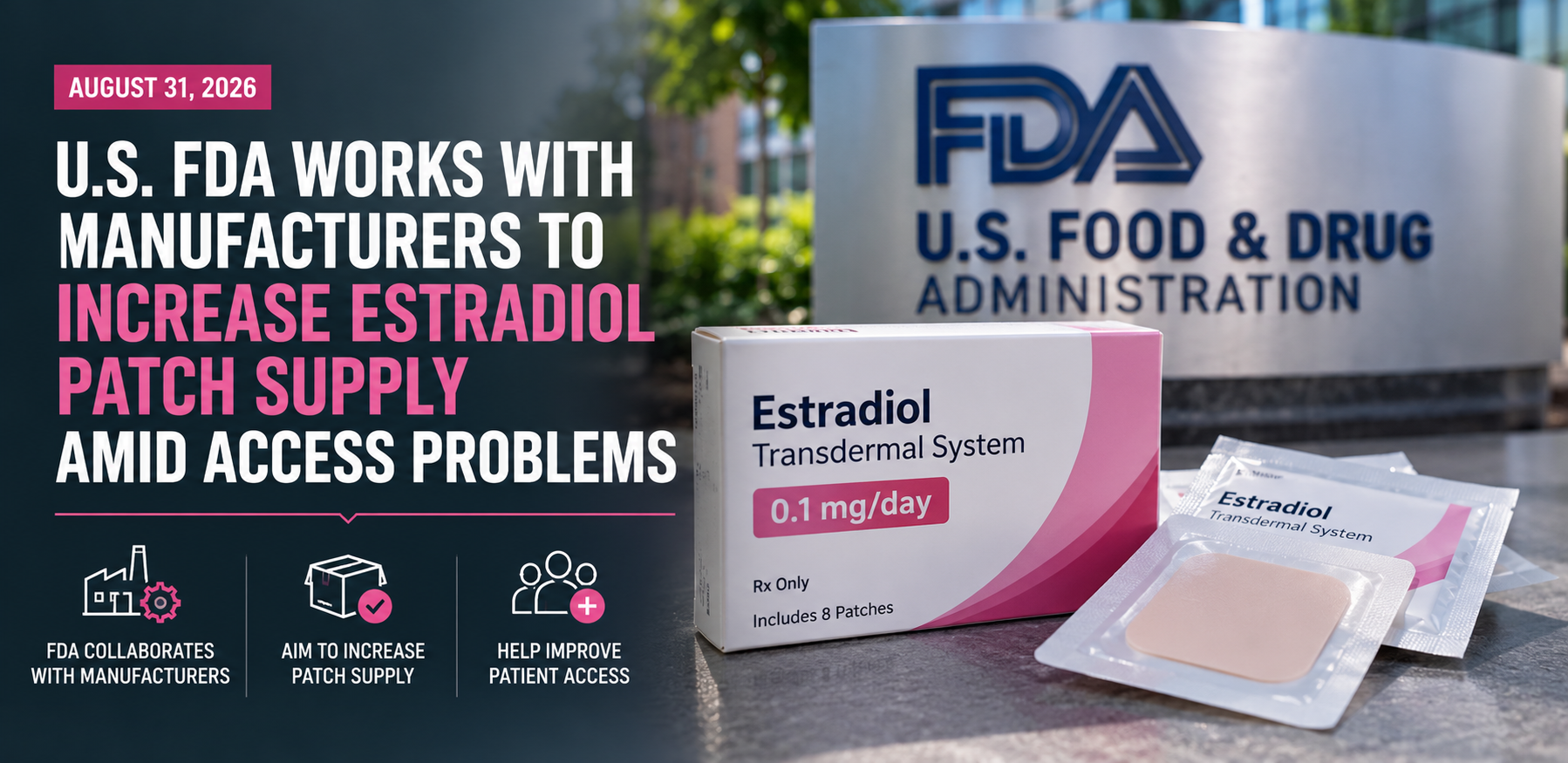
U.S. FDA Works With Manufacturers to Increase Estradiol Patch Supply Amid Access Problems
What's Happening
The U.S. Food and Drug Administration (FDA) said it is working with all six manufacturers of estradiol transdermal patches to increase supplies after patients across the United States reported difficulty finding the products at pharmacies.
Estradiol patches are used as hormone therapy to treat symptoms associated with menopause, including hot flashes, mood changes and sleep disturbances. The FDA said on September 3 that demand has surged enough to strain supplies, prompting some women to search multiple pharmacies, change brands, switch forms of therapy or alter their doses. (Reuters)
The FDA has not officially designated estradiol patches as being in shortage, but availability varies by product, pharmacy and geographic location. The agency said the products remain available overall while manufacturers work to increase production. (Reuters)
Demand for Estradiol Patches Has Increased Sharply
A growing menopause-treatment market
More than 1 million U.S. women enter menopause each year, creating a large and recurring population that may seek treatment for symptoms associated with declining estrogen levels. (Reuters)
Demand for transdermal estrogen has increased following the FDA's removal of the long-standing boxed warning associated with hormone therapy. That warning had highlighted potential risks including cardiovascular disease, breast cancer and probable dementia.
The change has contributed to renewed interest in hormone replacement therapy and appears to have increased demand for products such as estradiol patches. (Reuters)
The patch delivers estrogen through the skin
Estradiol transdermal patches release estrogen through the skin directly into the bloodstream.
For women who use hormone therapy for menopausal symptoms, patches offer a different delivery method from oral estrogen and other formulations.
That means a supply problem with patches can be particularly disruptive for patients who have chosen or been prescribed this specific form of therapy.
The FDA Says It Is Working With All Six Manufacturers
The agency is actively addressing supply
The FDA said it is working with all six manufacturers of estradiol transdermal patches to improve availability.
The agency said manufacturers are taking several measures to expand supply, including:
- Adding manufacturing shifts
- Increasing production capacity
- Increasing batch sizes
- Adding specialized equipment and manufacturing lines
- Prioritizing production of estradiol patches (Reuters)
The FDA is also monitoring supply levels and providing assistance to manufacturers seeking to increase production.
Where appropriate, the regulator said it can expedite reviews of submissions related to increasing supply. (Reuters)
Some Brands Are Already Listed as in Shortage
Availability differs across manufacturers
Although the FDA has not formally designated the overall category as being in shortage, data from the American Society of Health-System Pharmacists show that patches from Sandoz, Viatris, Noven and Zydus are in shortage. (Reuters)
That distinction explains why patients may struggle to obtain a particular prescription even while regulators say estradiol patches remain available nationally.
A woman may find one brand unavailable at her local pharmacy while another manufacturer still has inventory.
This creates an uneven supply picture rather than a complete national disappearance of the therapy.
Patients Are Already Changing Their Treatment Behavior
Pharmacy-hopping has become part of the problem
Reuters reported that some women have been pharmacy-hopping in an effort to find estradiol patches.
Others are:
- Switching brands
- Changing to another type of hormone therapy
- Reducing or changing dosages
- Searching across different locations for inventory (Reuters)
These workarounds demonstrate how a supply issue can affect treatment decisions even without an official national shortage declaration.
For patients using hormone therapy consistently, changing formulation or dosage can also create additional conversations with clinicians and pharmacists.
Manufacturers Say the Product Is Difficult to Scale Quickly
Transdermal patches are technically complex
The supply challenge is not necessarily something manufacturers can solve simply by running factories harder.
A spokesperson for Sandoz said hormone replacement therapy patches are highly complex to manufacture, making it difficult to rapidly increase capacity. (Reuters)
The company said it has nevertheless allocated additional quantities to U.S. states to help meet increased demand.
The combination of rising demand and technically complex manufacturing creates a difficult supply equation.
Even if manufacturers recognize the increase in demand quickly, adding manufacturing capacity, equipment and production lines can take time.
Why the FDA Has Not Declared a Formal Shortage
The situation illustrates an important distinction in pharmaceutical supply management.
A drug can be difficult for patients to find locally without necessarily meeting the FDA's criteria for a formal national shortage.
The FDA said estradiol transdermal patches remain available, although availability can vary by pharmacy and location. (Reuters)
That means the current problem is more accurately described as constrained and uneven supply rather than an officially recognized nationwide shortage.
For patients, however, the distinction can feel less important when they cannot fill their prescription.
Menopause Treatment Has Become a Larger Healthcare Market
Hormone therapy is receiving renewed attention
The increase in demand comes within a broader shift in how menopause and hormone therapy are being discussed in U.S. healthcare.
The removal of the boxed warning changed the risk communication surrounding menopausal hormone therapy and contributed to increased consumer interest.
That has implications for the entire menopause-care ecosystem, including:
- Gynecology
- Primary care
- Women's health clinics
- Telehealth
- Pharmacies
- Hormone-therapy manufacturers
- Diagnostic and monitoring services
The estradiol patch supply issue demonstrates how increased awareness and demand can create downstream pressure on pharmaceutical manufacturing.
The Supply Problem Could Affect Treatment Continuity
Switching products is not always frictionless
Patients who cannot find their usual patch may need to change manufacturers, formulations or delivery methods.
Even when alternatives are clinically available, the process can require a clinician or pharmacist to confirm the appropriate product, strength and dosing approach.
That can create additional administrative and clinical work.
For healthcare systems, higher demand for alternative products can also produce knock-on effects in pharmacy inventory management and prescribing patterns.
Pharmacies Are Becoming a Critical Signal Point
The current situation also highlights the importance of pharmacy-level data.
National production may appear adequate while individual pharmacies experience stockouts.
That creates a gap between what the manufacturer or regulator sees at the national level and what a patient experiences at the point of care.
For healthcare organizations, identifying that gap quickly can be important because localized shortages can become visible in patient behavior before they show up in formal national shortage classifications.
The FDA Is Trying to Increase Supply Before the Problem Gets Worse
The agency is intervening early
The FDA's decision to work directly with manufacturers suggests the agency is attempting to increase supply before constrained availability becomes a more severe or prolonged problem.
The agency is not simply waiting for manufacturers to resolve the issue themselves. It is monitoring supplies, helping manufacturers expand production and offering expedited regulatory review where appropriate. (Reuters)
That approach could help reduce the risk that localized access problems develop into a more widespread shortage.
Manufacturing Capacity Is the Immediate Bottleneck
The manufacturers' planned actions suggest the supply response will depend heavily on how quickly additional production can be brought online.
Adding shifts can increase output relatively quickly.
Adding specialized equipment, new production lines and expanded facilities is a longer-term process.
That means supply may improve gradually rather than all at once.
Sandoz's comment that patch manufacturing is particularly complex reinforces why the response may take time even with regulatory support. (Reuters)
Why This Matters
The estradiol patch situation demonstrates how rapidly changing patient demand can expose weaknesses in pharmaceutical supply chains.
A regulatory change that increases confidence in a treatment can produce a substantial increase in demand. If manufacturing capacity does not expand at the same pace, patients can begin experiencing access problems even before a formal shortage is declared.
It also shows why healthcare availability cannot be measured solely by whether a drug is technically “on the market.” A medication can remain approved and commercially available while patients still struggle to find the specific formulation they need.
For menopause care, where more than a million U.S. women enter menopause each year, continued growth in demand could keep supply capacity under pressure. (Reuters)
Looking Ahead
The near-term priority is for manufacturers to increase production and redistribute inventory to areas experiencing the greatest constraints.
The FDA will continue monitoring supply and working with manufacturers on measures to expand capacity. (Reuters)
The bigger question is whether the recent increase in demand represents a temporary surge or a sustained structural expansion of the U.S. menopause-treatment market.
If demand remains elevated, manufacturers may need to make longer-term investments in production capacity rather than relying only on additional shifts and larger batches.
For patients, improvement will ultimately be measured not by whether regulators classify the market as being in shortage, but by whether prescriptions can be reliably filled at pharmacies.
Key Takeaways
- The FDA is working with all six estradiol patch manufacturers to increase U.S. supply. (Reuters)
- Demand has surged, creating localized access problems and forcing some women to search multiple pharmacies or change therapies. (Reuters)
- The FDA has not formally declared an overall shortage, saying the patches remain available even though availability varies by pharmacy and location.
- Estradiol patches are used for menopause symptoms including hot flashes, mood swings and sleep disturbances. (Reuters)
- More than 1 million U.S. women enter menopause each year.
- Demand increased after the FDA removed the long-standing boxed warning associated with menopausal hormone therapy. (Reuters)
- ASHP data show shortages involving products from Sandoz, Viatris, Noven and Zydus. (Reuters)
- Manufacturers are adding production shifts, capacity, equipment, manufacturing lines and larger batches to increase supply. (Reuters)
- Sandoz said estradiol patches are highly complex to manufacture, making rapid capacity expansion difficult. (Reuters)
- The FDA is monitoring the market and can expedite relevant manufacturing-supply submissions when appropriate. (Reuters)
What This Means for Healthcare Marketers
This is a strong example of why demand growth and supply availability need to be tracked together.
A treatment category can suddenly accelerate after a regulatory change, shifts in public perception or increased patient awareness. But if manufacturers cannot expand production at the same pace, the resulting access problems can change prescribing behavior, pharmacy demand and patient preferences.
For healthcare marketers, the valuable signals are not just prescription volumes. Pharmacy availability, brand switching, dosage changes, treatment substitutions and geographic differences in access can reveal that a market is under supply pressure before the problem becomes a formal national shortage.
In this case, the growth of menopause-care demand is creating a new market signal: more patients are seeking treatment, but manufacturing capacity is struggling to keep pace.