FDA Advisers Consider Broader Access to Three Additional Peptides Amid Growing Demand for Personalized Therapies
What's Happening
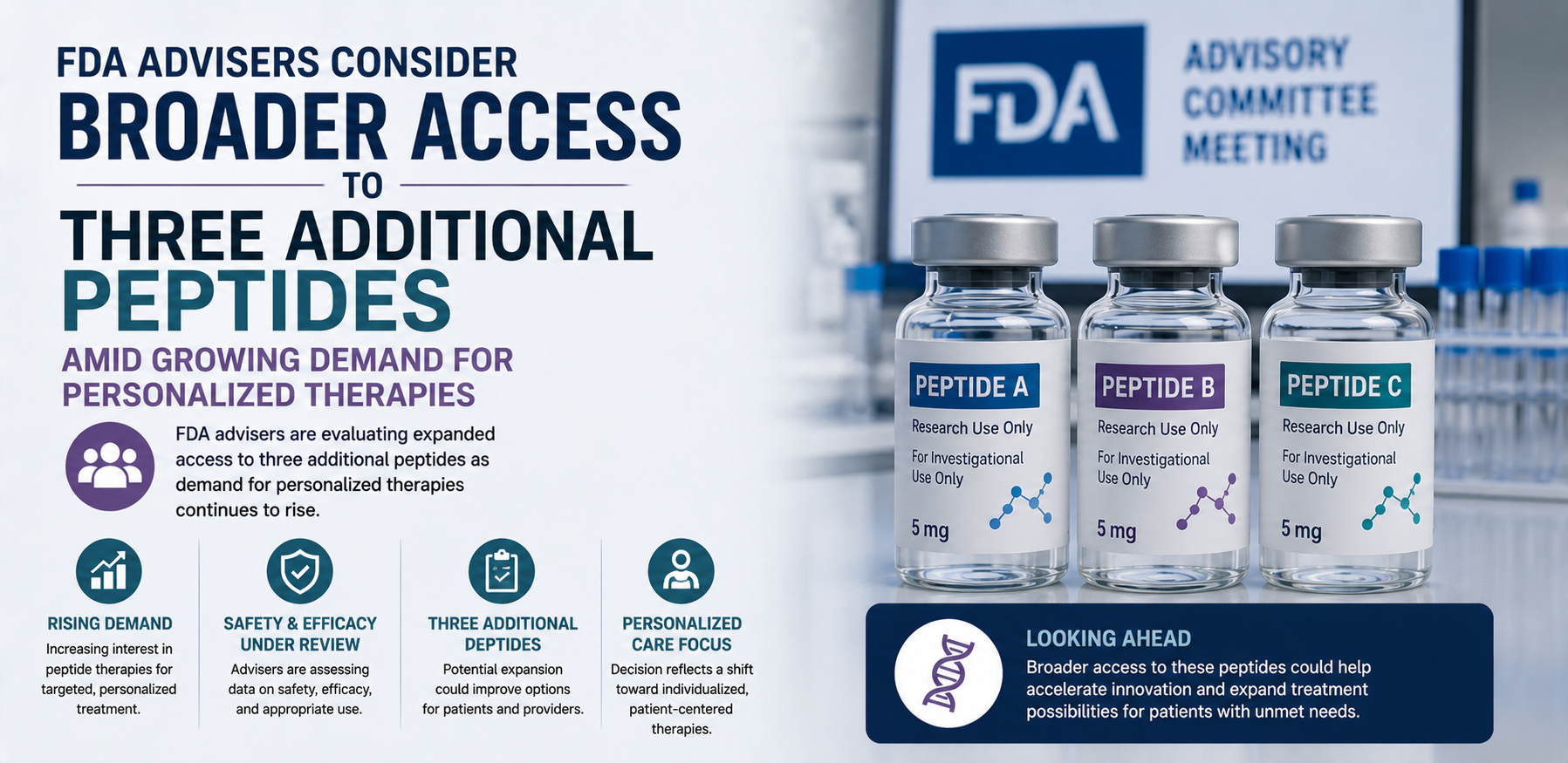
An advisory committee to the U.S. Food and Drug Administration (FDA) spent the second day of a closely watched meeting reviewing whether restrictions should be relaxed for three additional peptides: Emideltide, Semax, and Epitalon.
The meeting followed the committee's recommendation the previous day to support broader pharmacy compounding for four other peptides. By the end of the two-day review, advisers recommended allowing Semax and Epitalon to be added to the FDA's 503A Bulks List, while recommending against adding Emideltide. The FDA will now evaluate the committee's recommendations before making final regulatory decisions.
Although the discussions focused on just three compounds, the broader implications extend far beyond individual peptides. The meeting represents one of the most significant regulatory reviews of peptide therapies in recent years and reflects growing demand for personalized medicine, regenerative treatments, and wellness-focused healthcare.
Why Peptides Have Become a Major Healthcare Topic
Peptides are short chains of amino acids that naturally occur in the body and help regulate numerous biological processes, including hormone signaling, immune responses, tissue repair, metabolism, and neurological function.
Researchers have long studied peptides as potential treatments because they can target specific biological pathways with greater precision than many traditional medications.
In recent years, peptides have gained popularity far beyond academic research.
Interest has expanded rapidly through:
- Longevity and healthy aging clinics.
- Sports medicine providers.
- Functional and integrative medicine practices.
- Telehealth platforms.
- Online wellness communities.
- Social media influencers promoting performance and recovery therapies.
Many consumers have become familiar with peptide-based medicines because of the success of GLP-1 drugs for diabetes and obesity. While GLP-1 therapies are FDA-approved prescription medications, many other peptides remain experimental or are available only through limited compounding pathways.
This surge in public awareness has created pressure for regulators to clarify how these products should be accessed and regulated.
Understanding the Peptides Under Review
Semax: Semax is a synthetic peptide that has been used in some countries for neurological conditions and has been promoted for improving cognitive function, memory, focus, and recovery after brain injury. Supporters believe it may have neuroprotective properties, while FDA reviewers have noted that available evidence remains limited under U.S. regulatory standards. The advisory committee ultimately recommended adding Semax to the FDA's compounding list.
Epitalon: Epitalon has attracted attention primarily because of claims related to healthy aging and longevity. Some laboratory studies have explored whether the peptide influences cellular aging and telomere biology, although clinical evidence in humans remains limited. The committee voted to recommend broader compounding access while acknowledging that more research is needed.
Emideltide: Emideltide, also known as Delta Sleep-Inducing Peptide (DSIP), has been investigated for potential use in treating insomnia, narcolepsy, and opioid withdrawal. Unlike the other two peptides, advisers concluded that available evidence was insufficient to justify broader pharmacy compounding and voted against recommending its inclusion.
What Is the FDA's 503A Bulks List?
A central point of confusion during the peptide debate is the purpose of the FDA's 503A Bulks List.
The committee was not deciding whether these peptides should become FDA-approved drugs.
Instead, members were evaluating whether licensed compounding pharmacies should be permitted to use these substances when preparing customized medications for individual patients.
Compounded medications are different from FDA-approved pharmaceuticals because:
- They are prepared for specific patient needs.
- They do not complete the FDA's traditional drug approval pathway.
- They are typically used when commercially available medications are not appropriate.
- They remain subject to pharmacy compounding regulations rather than full pharmaceutical approval requirements.
Being added to the 503A Bulks List does not mean a substance has been proven safe and effective through large clinical trials.
Rather, it establishes that licensed pharmacies may compound the ingredient under defined regulatory conditions.
This distinction is particularly important as growing public interest in peptide therapies creates confusion between compounded products and FDA-approved medicines.
Why Regulators Are Facing New Challenges
The peptide market has expanded much faster than the scientific evidence supporting many of the compounds.
Today, numerous peptides are marketed online for purposes such as:
- Muscle recovery.
- Anti-aging.
- Cognitive enhancement.
- Sleep improvement.
- Weight management.
- Athletic performance.
- Inflammation reduction.
Many of these products are sold through online retailers or wellness clinics despite not having FDA approval.
Supporters of expanded pharmacy compounding argue that regulated access through licensed pharmacies is safer than leaving patients to purchase products from unregulated online vendors, where manufacturing quality and ingredient purity may be uncertain.
FDA scientists have expressed a different concern.
They argue that expanding access before sufficient clinical evidence exists could unintentionally lead patients to believe these compounds have been proven safe and effective, potentially increasing inappropriate use.
The committee's recommendations reflect an effort to balance growing consumer demand with the need for scientific oversight.
Industry Impact
- Compounding Pharmacies: The recommendations could significantly expand the range of peptide therapies available through licensed compounding pharmacies if adopted by the FDA. Pharmacies specializing in personalized medicine may experience increased demand as patients seek regulated alternatives to products sold through the gray market.
- Healthcare Providers: Physicians practicing neurology, functional medicine, sports medicine, endocrinology, and integrative healthcare will closely monitor the FDA's final decisions. Greater regulatory clarity may influence prescribing practices and patient discussions regarding peptide therapies.
- Telehealth Companies: Digital healthcare providers have shown increasing interest in peptide therapies as demand for personalized treatment continues growing. Industry analysts estimate that a legitimized peptide compounding market could eventually reach $2 billion to $3 billion, creating new opportunities for telehealth platforms focused on preventive and personalized care.
- Pharmaceutical Industry: Traditional pharmaceutical companies may view expanding peptide compounding with caution, while biotechnology firms developing peptide-based medicines may see increased public awareness as an opportunity to accelerate future innovation.
Looking Ahead
The advisory committee's recommendations are only one step in the regulatory process.
The FDA will independently review the committee's conclusions before deciding whether to officially add the recommended peptides to the 503A Bulks List.
Regardless of the agency's final decisions, the meeting marks an important moment in the evolution of peptide regulation.
Healthcare regulators are increasingly being asked to address therapies that have already gained widespread popularity before completing the traditional pathway of large-scale clinical development.
Future decisions involving peptides are likely to influence broader discussions around personalized medicine, regenerative therapies, telehealth, and pharmacy compounding for years to come.
Why This Matters
The FDA's review of these peptides highlights the growing tension between innovation and evidence in modern healthcare.
Patients are increasingly interested in therapies that promise improved performance, longevity, or disease prevention, while regulators remain responsible for ensuring products entering the healthcare system are supported by reliable scientific data.
The committee's recommendations demonstrate that regulators are willing to evaluate peptides individually rather than treating the category as a whole.
Some compounds may gain broader access through pharmacy compounding, while others may remain restricted until stronger evidence becomes available.
As personalized medicine continues expanding, similar regulatory debates are likely to become increasingly common across healthcare.
Key Takeaways
- FDA advisers reviewed three additional peptides: Semax, Epitalon, and Emideltide.
- Advisers recommended broader pharmacy compounding access for Semax and Epitalon but rejected Emideltide.
- The recommendations relate to the FDA's 503A Bulks List and do not constitute FDA drug approval.
- Growing demand for peptide therapies is reshaping discussions around personalized medicine and pharmacy compounding.
- The FDA will make the final regulatory decisions after reviewing the advisory committee's recommendations.
What This Means for Healthcare Marketers
The FDA's peptide review illustrates how rapidly personalized medicine is moving from niche healthcare segments into mainstream commercial interest. Organizations involved in pharmacy compounding, telehealth, longevity medicine, neurology, biotechnology, and precision therapeutics should closely monitor these regulatory developments, as they may reshape future treatment pathways and patient demand. For healthcare marketers, the expanding peptide landscape creates opportunities to educate providers and patients while emphasizing evidence-based communication and regulatory transparency, particularly as the distinction between compounded therapies and FDA-approved medicines becomes increasingly important.