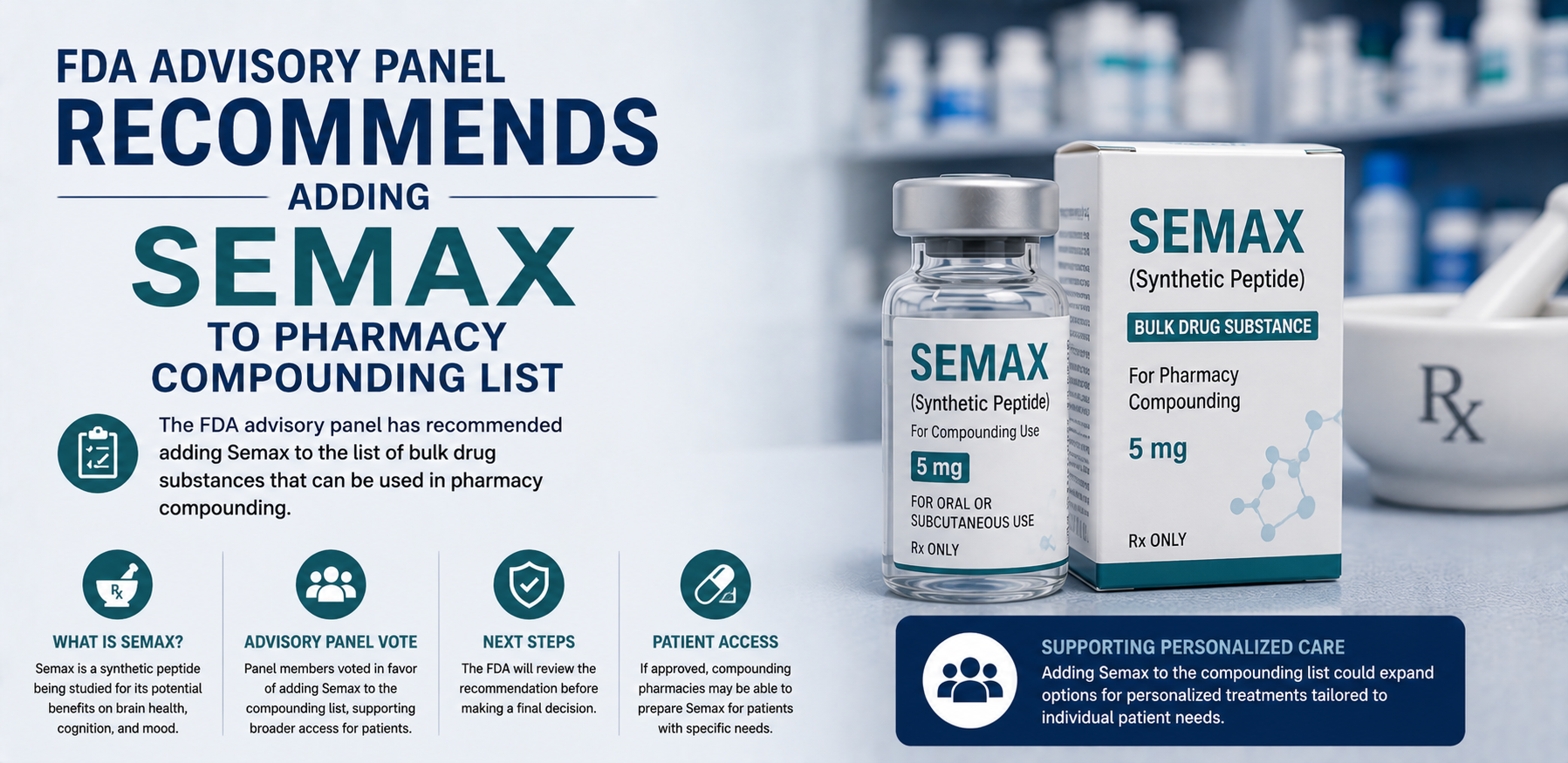
FDA Advisory Panel Recommends Adding Semax to Pharmacy Compounding List
What's Happening
An advisory committee to the U.S. Food and Drug Administration (FDA) has voted to recommend adding Semax, an unapproved peptide, to the agency's 503A Bulks List, a move that could allow licensed compounding pharmacies to prepare customized formulations of the substance for patients with valid prescriptions.
The recommendation passed by an 8-5 vote, with one abstention, making Semax the sixth peptide supported by the committee during a closely watched two-day meeting reviewing seven peptide compounds. The FDA is not required to follow the committee's recommendation, and the agency will make the final decision after evaluating the panel's findings and other available evidence.
The decision is part of a broader reassessment of peptide regulation in the United States as demand for regenerative medicine, wellness therapies, and personalized healthcare continues to grow.
What Is Semax?
Semax is a synthetic peptide originally developed in Russia and has been used in some countries to support neurological conditions such as cerebral ischemia and to treat migraines. It has also attracted attention within wellness and longevity communities for claims that it may improve cognitive performance, memory, focus, and recovery after neurological injury.
Supporters have promoted Semax for potential benefits including:
- Cognitive enhancement.
- Improved attention and concentration.
- Migraine management.
- Neuroprotection following brain injury.
- Recovery after stroke.
- Mental performance under stress.
However, Semax is not approved by the FDA for any medical indication in the United States.
While laboratory studies and limited international clinical experience suggest potential therapeutic applications, FDA reviewers have maintained that available evidence remains insufficient to establish the peptide's safety and effectiveness under U.S. regulatory standards.
Understanding the FDA's 503A Bulks List
The committee's vote does not approve Semax as a prescription drug.
Instead, it concerns whether Semax should be added to the FDA's 503A Bulks List, which identifies bulk drug substances that may be used by state-licensed compounding pharmacies when preparing customized medications for individual patients.
Compounded medications differ from FDA-approved drugs in several important ways:
- They are prepared for individual patient needs.
- They do not undergo the FDA's full drug approval process.
- They are generally used when commercially available medicines cannot meet a patient's specific medical requirements.
- They remain subject to pharmacy compounding regulations and quality standards.
Adding a substance to the 503A Bulks List allows compounding under certain circumstances, but it does not establish that the substance has been proven safe or effective through the FDA approval process.
This distinction is particularly important because many patients mistakenly assume that compounded products receive the same level of regulatory review as approved pharmaceuticals.
Why Peptide Regulation Has Become a National Debate
Semax is one of several peptides currently under review as regulators respond to rapidly increasing demand for peptide-based therapies.
Over the past several years, peptides have become widely available through:
- Wellness clinics.
- Longevity practices.
- Functional medicine providers.
- Telehealth platforms.
- Online retailers operating in regulatory gray markets.
Many of these products are marketed for anti-aging, recovery, athletic performance, and cognitive enhancement despite limited clinical evidence supporting many of those claims.
Supporters of expanded compounding argue that regulated pharmacy access would be safer than forcing patients to purchase peptides from unregulated online sources, where product quality and manufacturing standards may be uncertain.
FDA scientists, however, have expressed concern that broader availability without stronger clinical evidence could expose patients to unnecessary risks while creating confusion about whether these substances have received FDA approval.
Industry Impact
- Compounding Pharmacies: If the FDA adopts the committee's recommendation, pharmacies specializing in personalized medicine could gain access to another peptide that has generated significant consumer interest. This may expand treatment options offered by compounding pharmacies while increasing demand for quality assurance and regulatory compliance.
- Healthcare Providers: Clinicians practicing neurology, pain management, functional medicine, sports medicine, and integrative healthcare will closely monitor the FDA's decision. Providers may eventually have another regulated option available for patients seeking customized therapies, although clinical evidence will remain an important consideration before recommending treatment.
- Telehealth and Wellness Companies: Telehealth providers offering personalized wellness programs could benefit from greater regulatory clarity surrounding peptide therapies. Industry analysts estimate that a more formal peptide market could eventually be worth $2 billion to $3 billion, particularly as consumer interest in personalized medicine continues to grow.
- Regulators: The FDA's final decision will help define how emerging peptide therapies are regulated in the future. The agency must balance increasing public demand with its responsibility to ensure that compounded products meet appropriate standards for safety, quality, and patient protection.
Looking Ahead
The advisory committee's recommendation represents only one step in the regulatory process.
The FDA will independently review the committee's recommendations before determining whether Semax should officially be added to the 503A Bulks List. If the agency agrees, the decision would provide licensed compounding pharmacies with a legal pathway to prepare Semax under federal compounding regulations.
Regardless of the outcome, the review illustrates a broader shift occurring across healthcare.
Personalized medicine, regenerative therapies, and peptide-based treatments are attracting growing interest from both clinicians and patients. At the same time, regulators are facing increasing pressure to establish clear rules that encourage innovation while maintaining scientific rigor and protecting public health.
The decisions made during these peptide reviews may influence future regulatory approaches to other emerging therapies that currently exist in similar regulatory gray areas.
Why This Matters
The FDA's review of Semax is about more than a single peptide.
It reflects a larger debate over how healthcare should evaluate promising but incompletely studied therapies that have already gained widespread public interest.
As personalized medicine continues expanding, regulators will increasingly face situations where patient demand outpaces traditional clinical development timelines.
Finding the right balance between innovation, access, and evidence will shape how new therapies enter clinical practice over the coming decade.
For healthcare organizations, pharmaceutical companies, compounding pharmacies, and digital health providers, these decisions may influence future investment strategies, clinical adoption, and patient education efforts.
Key Takeaways
- An FDA advisory committee voted 8-5, with one abstention, to recommend adding Semax to the FDA's 503A Bulks List.
- Semax is a synthetic peptide promoted for neurological and cognitive applications but is not FDA approved for any medical use in the United States.
- The recommendation concerns pharmacy compounding eligibility rather than FDA drug approval.
- The FDA will make the final decision after reviewing the committee's recommendations.
- The outcome could further shape the evolving regulatory framework for peptide-based therapies and personalized medicine.
What This Means for Healthcare Marketers
The FDA's ongoing peptide reviews highlight the growing commercial and clinical interest in personalized medicine, neurological therapies, and regenerative healthcare. Organizations involved in pharmacy compounding, neurology, digital health, cognitive care, and precision therapeutics should monitor these regulatory developments closely, as they may influence prescribing behavior, patient demand, and investment priorities. For healthcare marketers, understanding the distinction between FDA approval and pharmacy compounding will be essential when communicating with providers and patients about emerging peptide therapies, helping build trust through evidence-based, transparent messaging.