FDA Advisory Panel Votes Against Adding Emideltide to Pharmacy Compounding List
What's Happening
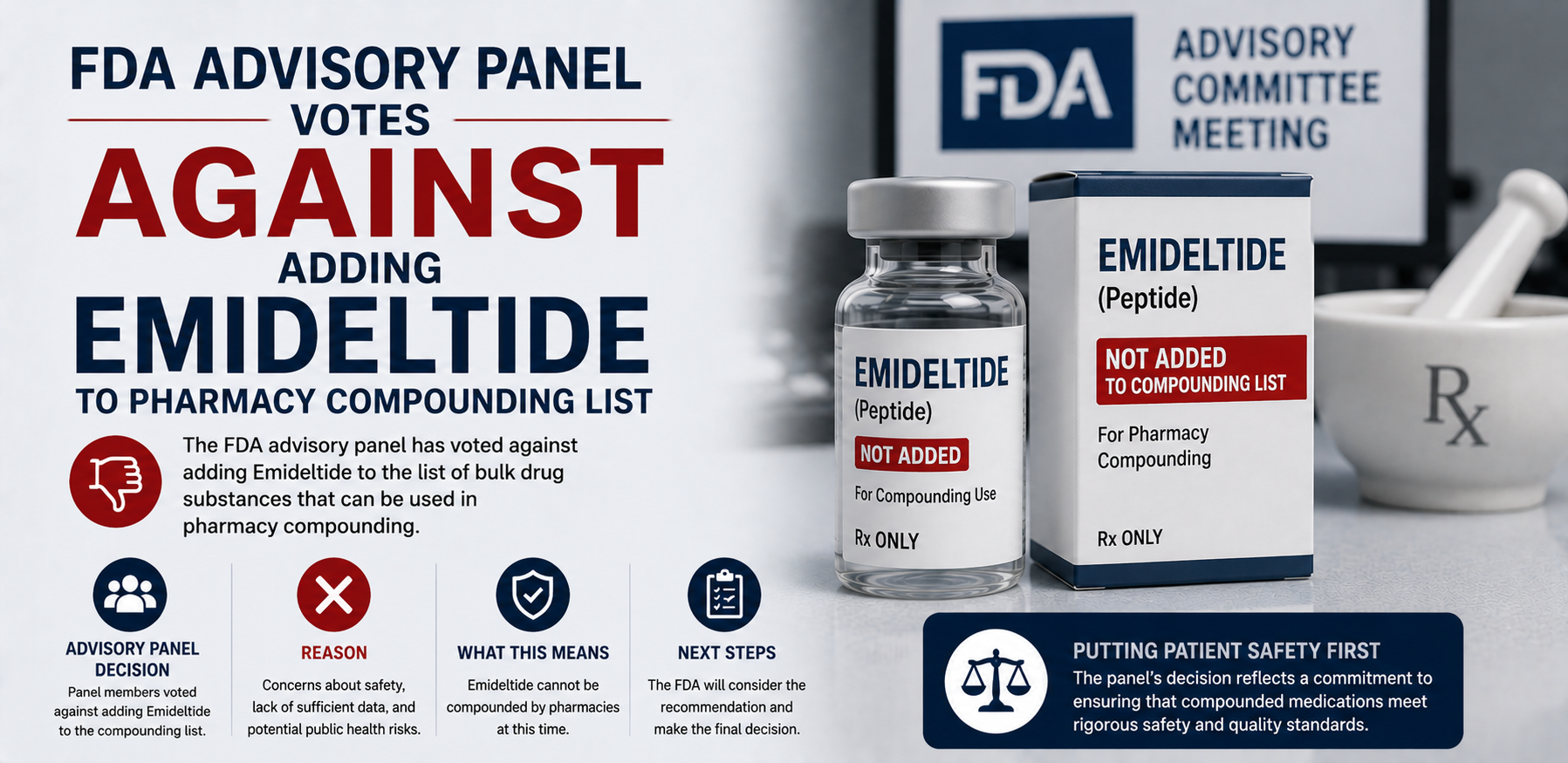
An advisory committee to the U.S. Food and Drug Administration (FDA) has voted against recommending Emideltide for inclusion on the agency's 503A Bulks List, making it the only peptide rejected during a two-day meeting that evaluated seven peptides for potential pharmacy compounding.
The committee voted 7-6 against, with one abstention, concluding that the available evidence did not support allowing licensed compounding pharmacies to prepare customized formulations of Emideltide. The FDA will make the final decision and is not obligated to follow the committee's recommendation.
The vote stood in contrast to the committee's recommendations for six other peptides, including BPC-157, TB-500, KPV, MOTS-c, Semax, and Epitalon, all of which received majority support during the meeting.
What Is Emideltide?
Emideltide, also known as Delta Sleep-Inducing Peptide (DSIP), is a synthetic peptide that has been studied for decades for its potential effects on sleep and neurological function.
During the FDA review, the peptide was evaluated for three proposed medical uses:
- Chronic insomnia.
- Narcolepsy.
- Opioid withdrawal.
Although Emideltide has generated interest within wellness and peptide communities, it has never been approved by the FDA for any therapeutic indication in the United States.
Supporters have suggested the peptide could help regulate sleep patterns and improve neurological function. However, FDA reviewers concluded that the available scientific evidence remains limited, inconsistent, and insufficient to demonstrate safety and clinical effectiveness for the proposed uses.
Understanding the FDA's 503A Bulks List
The committee was not deciding whether Emideltide should become an FDA-approved drug.
Instead, members were evaluating whether it should be added to the FDA's 503A Bulks List, which identifies bulk drug substances that licensed compounding pharmacies may use when preparing patient-specific medications.
Compounded medications differ from FDA-approved products in several important ways:
- They are customized for individual patients.
- They do not undergo the FDA's full premarket approval process.
- They are generally prepared when commercially available medicines cannot meet a patient's medical needs.
- They remain subject to pharmacy compounding regulations rather than traditional pharmaceutical approval requirements.
Placement on the 503A Bulks List allows pharmacies to compound a substance under certain circumstances, but it does not mean the FDA has determined that the substance is safe or effective.
This distinction has become increasingly important as growing numbers of consumers seek peptide-based therapies marketed through wellness clinics and online platforms.
Why Emideltide Was Different
Unlike several of the other peptides reviewed during the meeting, Emideltide failed to secure majority support from the advisory committee.
Committee members considered whether sufficient evidence existed to justify broader access through pharmacy compounding.
The concerns discussed during the review included:
- Limited clinical evidence.
- Questions surrounding therapeutic effectiveness.
- Uncertainty regarding safety.
- Lack of robust human studies supporting the proposed indications.
Ultimately, the committee concluded that the available data did not justify recommending inclusion on the compounding list.
The narrow vote illustrates the challenges regulators face when evaluating substances that have attracted public interest but lack the level of scientific evidence typically expected for broader clinical use.
The Growing Debate Around Peptide Therapies
Peptides have become one of the fastest-growing areas of interest within personalized medicine.
Over the past several years, many peptide products have been promoted for:
- Anti-aging.
- Athletic recovery.
- Cognitive enhancement.
- Weight management.
- Sleep improvement.
- Inflammation reduction.
- Hormonal optimization.
Many of these compounds are sold through wellness clinics or online vendors despite having limited clinical evidence and no FDA approval.
Supporters argue that allowing licensed pharmacies to compound peptides creates a safer alternative to purchasing products from unregulated sources.
Critics counter that expanded access may unintentionally lead patients to believe these compounds have been fully evaluated by the FDA, potentially creating confusion about their benefits and risks.
The Emideltide vote demonstrates that the advisory committee is willing to distinguish between peptides based on the strength of available scientific evidence rather than treating them as a single category.
Industry Impact
- Compounding Pharmacies: If the FDA follows the committee's recommendation, Emideltide would remain unavailable for routine compounding under the proposed pathway. Pharmacies focusing on personalized medicine may instead concentrate on peptides that received favorable recommendations.
- Healthcare Providers: Physicians interested in peptide-based therapies will likely continue relying on established sleep treatments while awaiting additional research on Emideltide. The decision reinforces the importance of evidence-based prescribing when considering emerging therapies.
- Wellness and Telehealth Companies: Companies marketing peptide therapies may face increased scrutiny regarding scientific claims. The committee's decision highlights that growing consumer demand alone is not sufficient to overcome regulatory concerns about safety and effectiveness.
- Regulators: The vote demonstrates that advisory committees continue to evaluate each peptide independently. Rather than broadly expanding access to all peptide therapies, regulators appear willing to approve some candidates while rejecting others when supporting evidence is weaker.
Looking Ahead
Although the advisory committee recommended against adding Emideltide to the 503A Bulks List, the FDA will conduct its own review before issuing a final decision.
Future clinical research could still influence the regulatory outlook.
If larger, well-designed human studies demonstrate meaningful benefits and acceptable safety, sponsors could submit new evidence supporting either future compounding consideration or traditional drug development.
For now, the decision underscores that scientific evidence remains central to regulatory decision-making, even as interest in personalized medicine and peptide therapies continues to expand.
Why This Matters
The Emideltide decision highlights the balance regulators must strike between expanding access to promising therapies and protecting patients from treatments that have not been adequately studied.
As peptide medicines receive increasing attention from healthcare providers, wellness companies, and consumers, regulatory agencies will continue facing pressure to determine which compounds have sufficient evidence to justify broader clinical availability.
The committee's recommendation shows that while regulators may support greater access to certain peptides, each substance will continue to be evaluated on its own scientific merits rather than through a one-size-fits-all approach.
Key Takeaways
- An FDA advisory committee voted 7-6, with one abstention, against recommending Emideltide for the FDA's 503A Bulks List.
- Emideltide was the only peptide rejected during the committee's two-day review of seven peptide compounds.
- The peptide was evaluated for chronic insomnia, narcolepsy, and opioid withdrawal.
- The committee concluded that available evidence was insufficient to support broader pharmacy compounding.
- The FDA will make the final decision after reviewing the committee's recommendation.
What This Means for Healthcare Marketers
The FDA's recommendation on Emideltide demonstrates that peptide regulation is increasingly evidence-driven. Organizations involved in sleep medicine, neurology, pharmacy compounding, digital health, and peptide research should closely monitor these decisions, as they will influence future prescribing patterns, commercial opportunities, and patient demand. For healthcare marketers, understanding the distinction between FDA approval, advisory committee recommendations, and pharmacy compounding remains essential for developing accurate, compliant messaging that builds credibility with healthcare professionals and patients.