FDA Advisory Panel Votes Against Capricor's Duchenne Muscular Dystrophy Heart Therapy
What's Happening
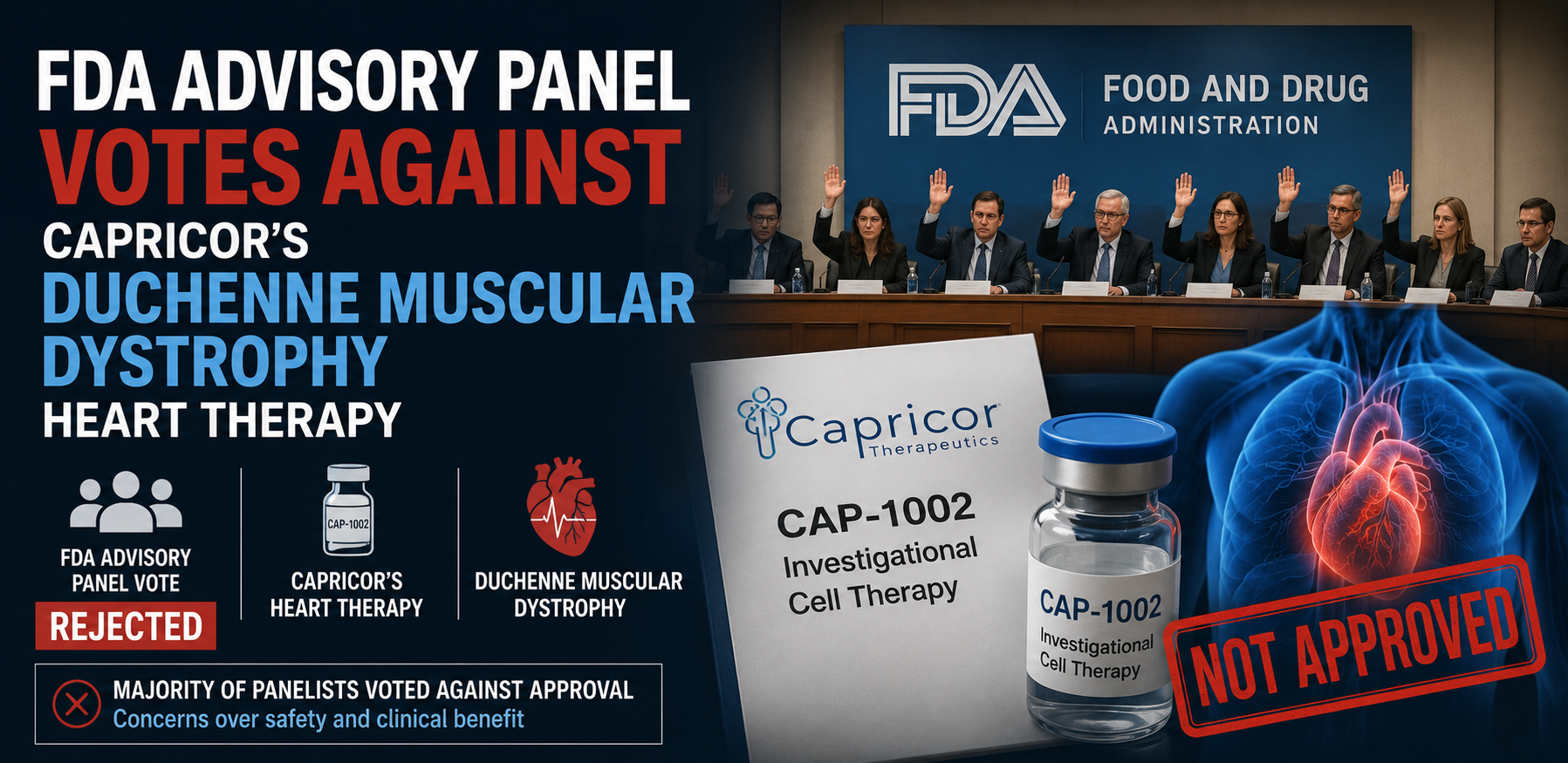
An independent advisory committee to the U.S. Food and Drug Administration (FDA) has voted against recommending approval of Capricor Therapeutics' experimental therapy designed to treat cardiac complications associated with Duchenne muscular dystrophy (DMD).
The committee concluded that the available clinical evidence did not sufficiently demonstrate the therapy's effectiveness, raising concerns about whether the data supported approval at this stage.
Although the FDA is not legally required to follow the recommendation of its advisory committees, it often gives significant weight to their scientific assessments when making final regulatory decisions.
For Capricor, the vote represents a significant regulatory setback, while patients, caregivers, and clinicians await the FDA's final decision on the therapy.
Understanding Duchenne Muscular Dystrophy
Duchenne muscular dystrophy is a rare, inherited genetic disorder that causes progressive muscle degeneration.
The disease is caused by mutations in the dystrophin gene, which normally produces a protein essential for maintaining healthy muscle cells.
Without sufficient dystrophin, muscles gradually weaken over time.
DMD primarily affects boys and typically begins during early childhood.
Early symptoms often include:
- Difficulty walking.
- Frequent falls.
- Trouble climbing stairs.
- Delayed motor development.
- Progressive muscle weakness.
As the disease advances, patients often lose the ability to walk and eventually require assistance with breathing and other daily activities.
Although skeletal muscle weakness is the most visible aspect of the disease, damage to the heart is one of its leading causes of serious complications and premature death.
Why Heart Disease Is So Important in DMD
Over time, Duchenne muscular dystrophy weakens the heart muscle in much the same way it affects skeletal muscles.
This can lead to cardiomyopathy, a condition in which the heart becomes less able to pump blood effectively.
Potential complications include:
- Heart failure.
- Abnormal heart rhythms.
- Reduced exercise tolerance.
- Fluid retention.
- Progressive decline in cardiac function.
Thanks to advances in respiratory care, many people with DMD are living longer than in previous decades.
As survival improves, managing heart disease has become an increasingly important part of long-term treatment.
Developing therapies that specifically protect cardiac function remains a major unmet need in Duchenne muscular dystrophy.
What Is an FDA Advisory Committee?
Before approving certain medicines, particularly those involving complex scientific questions or serious diseases, the FDA may ask an independent advisory committee to review the available evidence.
These committees typically include:
- Physicians.
- Clinical researchers.
- Biostatisticians.
- Patient representatives.
- Disease specialists.
Committee members examine:
- Clinical trial results.
- Safety data.
- Treatment benefits.
- Potential risks.
- Overall quality of evidence.
After discussion, members vote on whether the available evidence supports approval.
Their recommendations are advisory, meaning the FDA makes the final regulatory decision independently.
However, advisory committee votes frequently influence the agency's final determination.
Why the Committee Voted Against Approval
According to the advisory committee's discussion, members were not convinced that the available clinical evidence clearly demonstrated meaningful benefit for patients.
Key concerns included:
- Limited evidence of effectiveness.
- Questions regarding the strength of the clinical data.
- Uncertainty about whether observed improvements would translate into meaningful patient outcomes.
For therapies targeting rare diseases such as Duchenne muscular dystrophy, clinical trials are often conducted in relatively small patient populations.
While regulators recognise these challenges, medicines must still demonstrate sufficient evidence that their benefits outweigh potential risks before approval.
The committee concluded that additional evidence would likely be needed to establish the therapy's effectiveness.
Why Rare Disease Drug Development Is Challenging
Developing medicines for rare diseases presents unique scientific and regulatory challenges.
Researchers often face:
- Small patient populations.
- Limited understanding of disease progression.
- Difficulty recruiting participants.
- Complex clinical trial design.
- Lack of established biomarkers.
- Long periods needed to measure treatment benefit.
Because relatively few patients are available worldwide, generating large datasets comparable to those used for common diseases can be difficult.
Regulators therefore must carefully balance the urgent need for new therapies with the requirement to ensure medicines provide meaningful clinical benefit.
This balance is particularly important in progressive diseases where patients and families have few treatment options.
Industry Impact
- Patients and Families: The advisory committee's vote is disappointing for many families affected by Duchenne muscular dystrophy, particularly those hoping for additional therapies targeting heart disease. Existing standards of care will remain the primary approach while regulatory review continues.
- Biotechnology Companies: The decision highlights the importance of generating robust clinical evidence in rare disease drug development. Companies developing advanced therapies may face increasing expectations for well-designed studies demonstrating clear patient benefit.
- Healthcare Providers: Neurologists, cardiologists, and specialists treating Duchenne muscular dystrophy will continue relying on existing treatment strategies while monitoring future regulatory developments involving emerging therapies.
- Investors: Advisory committee outcomes often influence biotechnology company valuations because they provide insight into how regulators view clinical evidence and the likelihood of eventual approval.
Looking Ahead
The FDA will now review the advisory committee's recommendations before making its final decision on the therapy.
Several outcomes remain possible:
- The FDA could follow the committee's recommendation and decline approval.
- The agency could request additional clinical data before reconsidering the application.
- The FDA could approve the therapy despite the negative vote, although this occurs relatively infrequently.
Capricor may conduct additional studies to strengthen the evidence supporting future regulatory submissions.
Regardless of the final outcome, research into Duchenne muscular dystrophy continues across multiple therapeutic approaches, including gene therapies, cell therapies, exon-skipping medicines, and novel cardiac treatments.
Key Takeaways
- An FDA advisory committee voted against recommending approval of Capricor's experimental therapy for cardiac complications associated with Duchenne muscular dystrophy.
- Committee members concluded that the available evidence did not sufficiently demonstrate the therapy's effectiveness.
- The FDA will make the final regulatory decision independently, although advisory committee recommendations often influence approvals.
- Heart disease remains one of the leading causes of serious complications in Duchenne muscular dystrophy.
- The decision underscores the challenges of developing and evaluating treatments for rare diseases with limited patient populations.
What This Means for Healthcare Marketers
The advisory committee's decision highlights the growing importance of strong clinical evidence in rare disease drug development. Biotechnology companies, rare disease specialists, clinical research organisations, patient advocacy groups, and pharmaceutical manufacturers continue investing heavily in therapies for Duchenne muscular dystrophy and other genetic disorders. For healthcare marketers, organisations advancing orphan drugs, gene therapies, and specialised neuromuscular treatments represent high-intent opportunities as they expand clinical development, physician education, regulatory engagement, and patient support initiatives.