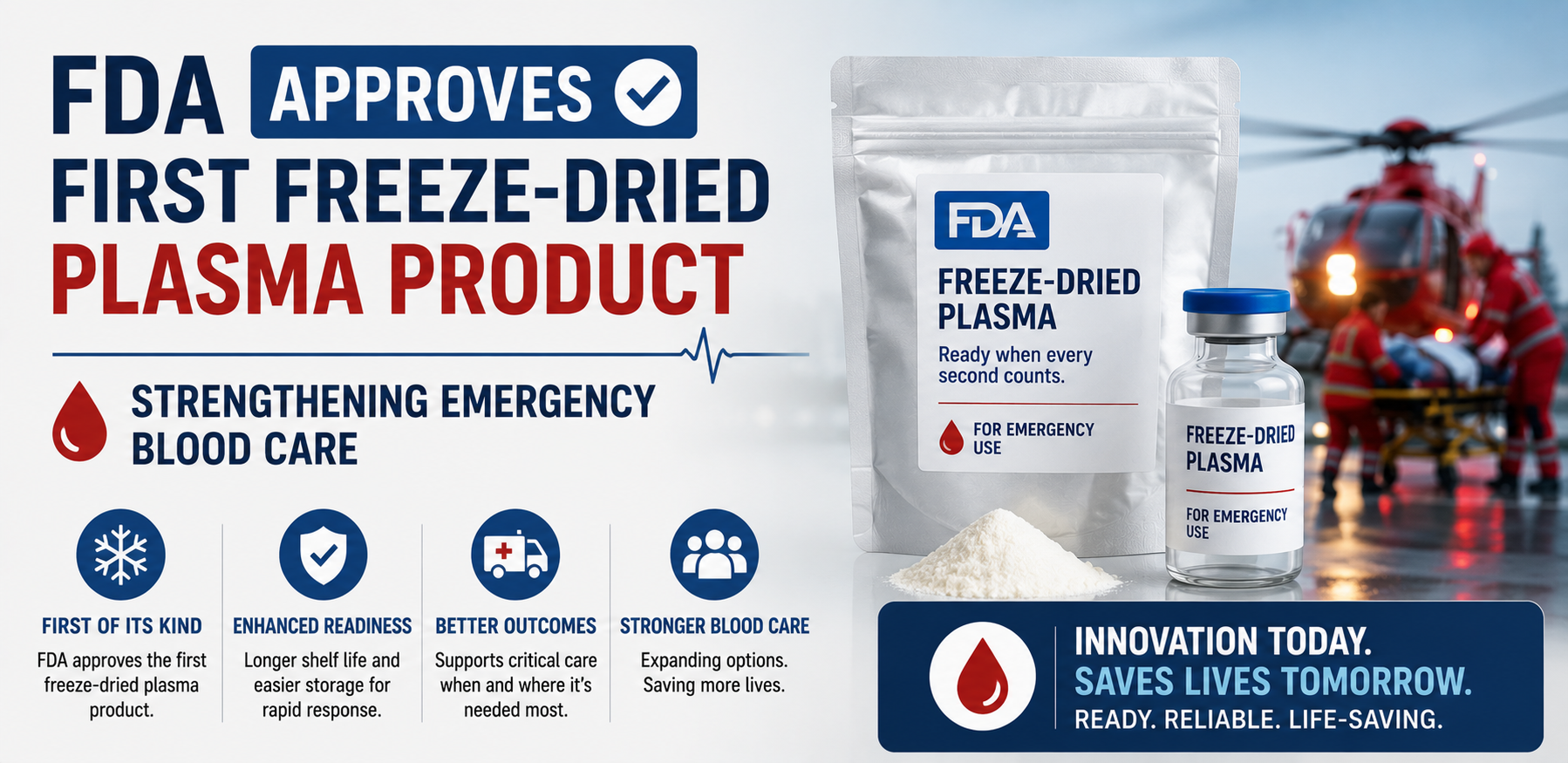
FDA Approves First Freeze-Dried Plasma Product, Strengthening Emergency Blood Care
What's Happening
The U.S. Food and Drug Administration (FDA) has approved the first freeze-dried plasma product for use in the United States, introducing a significant advancement in emergency medicine and trauma care.
Unlike conventional plasma, which must be stored frozen and thawed before use, freeze-dried plasma can be stored at room temperature and rapidly reconstituted with sterile water when needed. This allows healthcare providers to administer plasma much faster during medical emergencies where every minute matters.
The approval is expected to improve access to plasma in trauma centres, rural hospitals, military healthcare, emergency medical services, disaster response operations, and other settings where maintaining frozen blood products can be challenging.
What Is Freeze-Dried Plasma?
Plasma is the liquid component of blood that contains clotting factors, proteins, antibodies, electrolytes, and other substances essential for normal body function.
When patients experience severe blood loss due to trauma, surgery, burns, or certain medical conditions, plasma transfusions help replace clotting factors and restore the body's ability to control bleeding.
Traditionally, plasma must be frozen soon after donation to preserve these clotting factors. Before it can be administered, healthcare providers must thaw the plasma, a process that takes time and requires specialised storage equipment.
Freeze-dried plasma undergoes a process called lyophilisation, which removes water while preserving the important proteins within the plasma. When needed, clinicians simply add sterile water to restore the plasma, allowing it to be administered within minutes.
This approach significantly improves the speed and flexibility of emergency transfusion care.
Why This Approval Is Important
One of the biggest challenges in emergency medicine is delivering blood products quickly enough to patients experiencing life-threatening bleeding.
In trauma care, severe blood loss can rapidly lead to shock, organ failure, and death if clotting factors are not replaced promptly.
Traditional frozen plasma is highly effective but depends on freezer storage and thawing equipment. In rural healthcare facilities, military operations, ambulances, helicopters, or disaster zones, these requirements may delay treatment.
Freeze-dried plasma removes many of these logistical barriers by providing a product that is easier to transport, easier to store, and much faster to prepare.
As healthcare increasingly focuses on improving emergency response times, innovations that reduce treatment delays can have a meaningful impact on patient survival.
Benefits Across Healthcare
- Trauma Centres: Major trauma centres frequently treat patients suffering from serious injuries caused by road accidents, workplace incidents, falls, and violence. Rapid access to plasma allows clinicians to begin massive transfusion protocols more quickly and stabilise patients during the most critical stages of care.
- Rural Hospitals: Many rural healthcare facilities operate with smaller blood banks and limited storage infrastructure. A room-temperature plasma product improves emergency preparedness while reducing dependence on specialised freezer capacity.
- Emergency Medical Services: Advanced ambulance services continue expanding the treatments they provide before patients reach hospital. Portable plasma products may support future pre-hospital transfusion programmes, allowing emergency teams to begin life-saving care much earlier.
- Military Medicine: Military medical teams often provide care in environments where conventional blood storage is impossible. Freeze-dried plasma has long been recognised as a valuable solution for battlefield medicine because it can be transported easily and prepared rapidly under demanding conditions.
- Disaster Response: Natural disasters and mass casualty incidents frequently disrupt electricity, transportation, and healthcare infrastructure. Medical teams responding to these emergencies benefit from blood products that remain stable without continuous refrigeration, allowing them to deliver critical care even in challenging environments.
Industry Impact
The FDA approval represents an important step forward for transfusion medicine and emergency healthcare.
Healthcare organisations continue investing in technologies that improve not only clinical outcomes but also operational efficiency.
Products that simplify storage, transportation, and administration allow providers to respond more effectively during emergencies while expanding access to life-saving treatments.
The approval may also encourage further innovation in blood product development, portable medical technologies, trauma care solutions, and emergency preparedness programmes.
Hospitals evaluating improvements to trauma services may begin reviewing their transfusion protocols and emergency blood inventories to determine where freeze-dried plasma can complement existing blood management strategies.
Looking Ahead
The introduction of freeze-dried plasma is expected to support continued innovation across emergency medicine and critical care.
Future investment may focus on:
- Expanded pre-hospital transfusion programmes.
- Modernisation of trauma response systems.
- Improved blood inventory management.
- Military and disaster medicine innovations.
- Portable critical care technologies.
- Faster emergency treatment protocols.
- Advanced blood product development.
As healthcare systems continue prioritising emergency preparedness, products that improve flexibility and reduce treatment delays are likely to see growing adoption.
Why This Matters
Healthcare innovation is often associated with breakthrough drugs or advanced medical devices.
However, improvements in how existing treatments are delivered can be equally important.
Freeze-dried plasma addresses a longstanding operational challenge by making one of the most critical blood products easier to store, transport, and administer during emergencies.
By improving access to plasma outside traditional hospital settings, the approval has the potential to strengthen trauma care, emergency response, and disaster preparedness while helping clinicians deliver faster treatment when patients need it most.
Key Takeaways
- The FDA has approved the first freeze-dried plasma product for use in the United States.
- Freeze-dried plasma can be stored at room temperature and rapidly reconstituted before administration.
- The approval improves access to plasma across trauma care, rural healthcare, military medicine, emergency medical services, and disaster response.
- Faster plasma availability may reduce treatment delays for patients experiencing severe bleeding.
- The approval reflects continued innovation in transfusion medicine and emergency preparedness.
What This Means for Healthcare Marketers
The approval highlights growing investment in trauma care, emergency medicine, blood management, and healthcare preparedness. Hospitals, trauma centres, rural health systems, emergency medical service providers, military healthcare organisations, blood banks, and disaster response agencies may begin evaluating new transfusion technologies alongside broader emergency care infrastructure. For healthcare marketers, organisations expanding trauma capabilities, upgrading blood management systems, or investing in emergency preparedness represent high-intent opportunities for medical devices, hospital technology, clinical logistics solutions, critical care equipment, and healthcare innovation partnerships.