FDA Says Taylor Farms Cyclospora Test Was a False Positive, but Investigation Continues
What's Happening
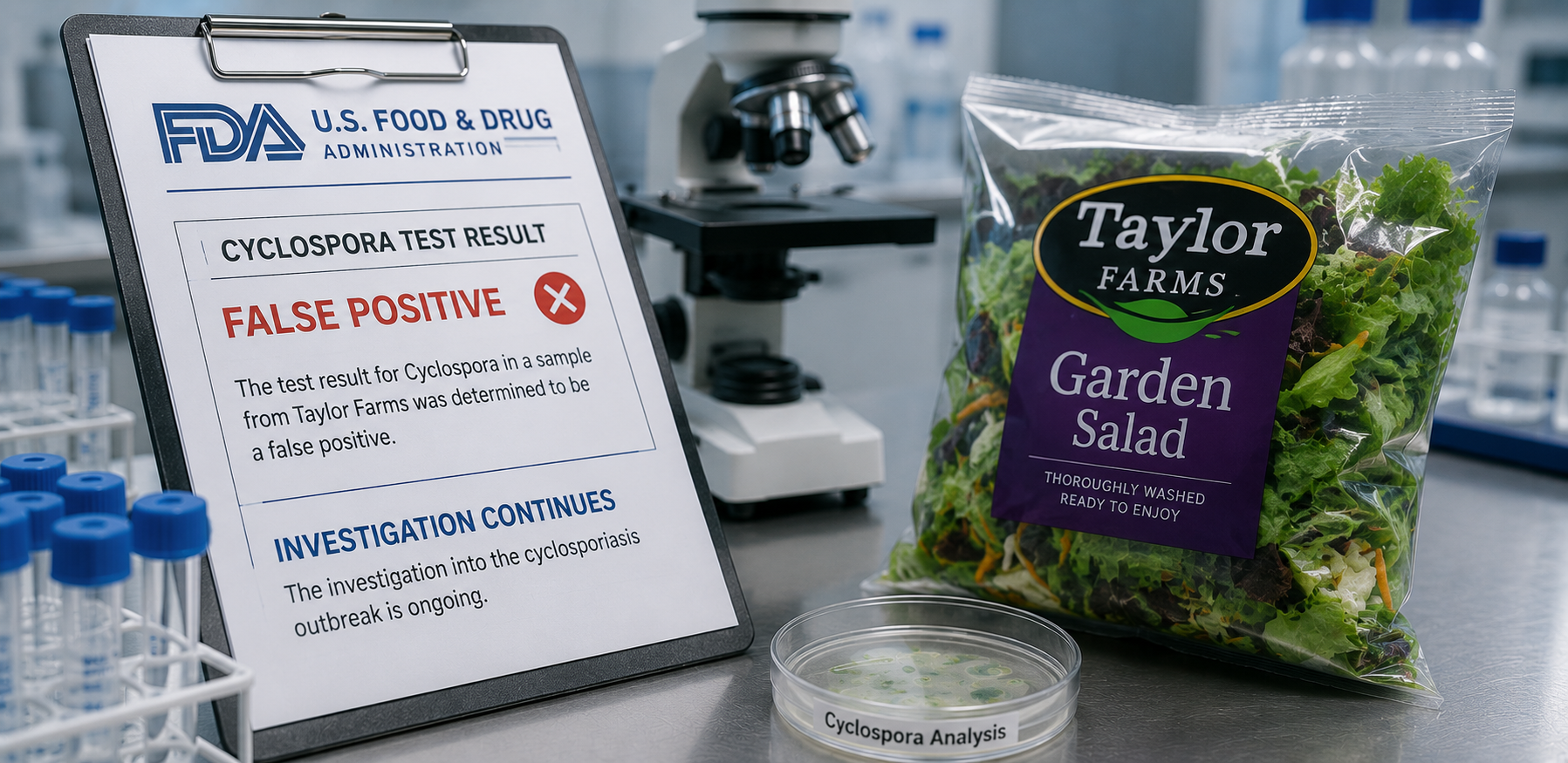
The U.S. Food and Drug Administration (FDA) has announced that a laboratory result indicating Cyclospora contamination in a sample of Taylor Farms shredded iceberg lettuce was a false positive after experts re-examined the test.
However, the agency emphasized that this revised laboratory finding does not change its ongoing investigation into one of the largest cyclospora outbreaks in recent U.S. history. The FDA says epidemiological evidence and traceback investigations continue to point to shredded iceberg lettuce supplied by Taylor Farms' operations in central Mexico as the likely source of the outbreak.
The clarification comes after Taylor Farms voluntarily recalled affected lettuce products and several restaurant chains removed lettuce from their menus as a precaution.
What Changed?
A few days earlier, the FDA had reported that a lettuce sample collected during the investigation tested positive for Cyclospora cayetanensis, the parasite responsible for cyclosporiasis.
After conducting additional quality-control reviews, FDA laboratory experts concluded that the initial laboratory result should instead be classified as a false positive.
The agency stated that:
- The laboratory sample did not contain confirmed Cyclospora.
- There are currently no laboratory-confirmed positive food samples associated with the outbreak.
- The traceback investigation remains unchanged.
- The voluntary recall of implicated lettuce products continues.
Why Doesn't a False Positive End the Investigation?
Many people assume that laboratory testing alone determines the source of a foodborne outbreak.
In reality, public health investigations combine multiple forms of evidence, including:
- Patient interviews.
- Restaurant purchase records.
- Food distribution data.
- Supplier information.
- Laboratory testing.
- Epidemiological analysis.
In this outbreak, the FDA says the overall evidence—not just one laboratory test—continues to indicate that shredded iceberg lettuce supplied by Taylor Farms is associated with the illnesses.
Why Cyclospora Is Difficult to Detect
Cyclospora is one of the most challenging foodborne parasites to investigate.
Unlike bacteria such as Salmonella or E. coli, Cyclospora cannot currently be grown in laboratory culture.
Scientists instead rely on detecting tiny amounts of genetic material, making testing significantly more complicated.
Additional challenges include:
- Extremely low parasite concentrations.
- Complex laboratory analysis.
- Difficulty confirming contamination in food samples.
- Long delays between exposure and illness.
- Perishable food that is often consumed before testing begins.
Because of these factors, epidemiological investigations frequently become more important than laboratory confirmation during Cyclospora outbreaks.
Taylor Farms' Response
Taylor Farms said it was informed that the FDA had made a testing error and welcomed the agency's clarification.
The company noted that:
- The laboratory result was determined to be a false positive.
- It had already completed a voluntary recall of iceberg lettuce sourced from central Mexico.
- The recall was initiated out of an abundance of caution after earlier information from regulators.
Despite the revised laboratory finding, the recalled products remain off the market while investigators continue evaluating the outbreak.
Why Traceback Investigations Matter
When laboratory confirmation is unavailable or inconclusive, investigators use traceback analysis to identify common links among patients.
This process involves determining:
- Where infected individuals ate.
- Which restaurants served them.
- Which suppliers delivered ingredients.
- Whether the same distributor supplied multiple locations.
When independent investigations repeatedly converge on the same supplier, regulators may recommend recalls even without a laboratory-confirmed contaminated product.
This approach is widely used during investigations involving highly perishable foods such as leafy greens and fresh produce.
Industry Impact
- Food Producers: The incident highlights the importance of strong quality assurance systems while also illustrating the scientific challenges involved in investigating parasitic contamination.
- Restaurant Chains: Restaurants continue relying on supplier traceability systems that allow them to quickly remove potentially affected products before investigations conclude.
- Public Health Agencies: The FDA's correction demonstrates the importance of transparency during outbreak investigations while reinforcing that scientific conclusions may evolve as additional evidence becomes available.
- Consumers: Although the laboratory finding changed, public health officials continue recommending caution regarding products included in the voluntary recall while the investigation proceeds.
Why This Matters
The FDA's announcement illustrates an important principle of public health investigations: laboratory testing is only one piece of the evidence.
Cyclospora outbreaks are especially difficult to investigate because the parasite is notoriously challenging to detect in food, symptoms often appear days after exposure, and contaminated produce is frequently consumed before testing begins.
Rather than relying on a single laboratory result, investigators combine epidemiology, traceback analysis, and scientific testing to determine the most likely source of an outbreak. The revised test result therefore changes one aspect of the investigation but does not eliminate the broader evidence that continues to connect the outbreak to a specific supply chain.
The incident also demonstrates the importance of transparent communication by regulators. Acknowledging laboratory errors while explaining why broader evidence still supports ongoing public health actions helps maintain confidence in outbreak investigations.
Key Takeaways
- The FDA determined that a laboratory result indicating Cyclospora in Taylor Farms lettuce was a false positive after additional review.
- The agency says the revised laboratory finding does not change its investigation into the multistate outbreak.
- No laboratory-confirmed positive food samples have been identified so far.
- Epidemiological and traceback evidence continue to point toward shredded iceberg lettuce supplied from Taylor Farms' operations in central Mexico.
- The voluntary recall remains in effect while investigators continue tracing the outbreak.
What This Means for Healthcare Marketers
The FDA's clarification highlights the complexity of modern public health investigations and the importance of communicating scientific findings accurately as evidence evolves. Organizations operating in healthcare, diagnostics, food safety, and life sciences increasingly need to explain uncertainty without undermining public confidence. Transparent communication during evolving investigations has become a critical component of organizational credibility.
For healthcare marketers, the story underscores the importance of balancing speed with scientific accuracy. Early findings may change as additional data become available, making clear, evidence-based messaging essential for maintaining trust among providers, regulators, customers, and the public.
For healthcare intelligence teams, the incident demonstrates why laboratory data should always be interpreted alongside epidemiological evidence, supply chain information, and regulatory updates. Monitoring these multiple sources together provides a more complete understanding of emerging public health risks and helps organizations respond more effectively to rapidly evolving situations.