FDA Staff Says Data May Support Moderna's Flu Vaccine for Older Adults
What's Happening
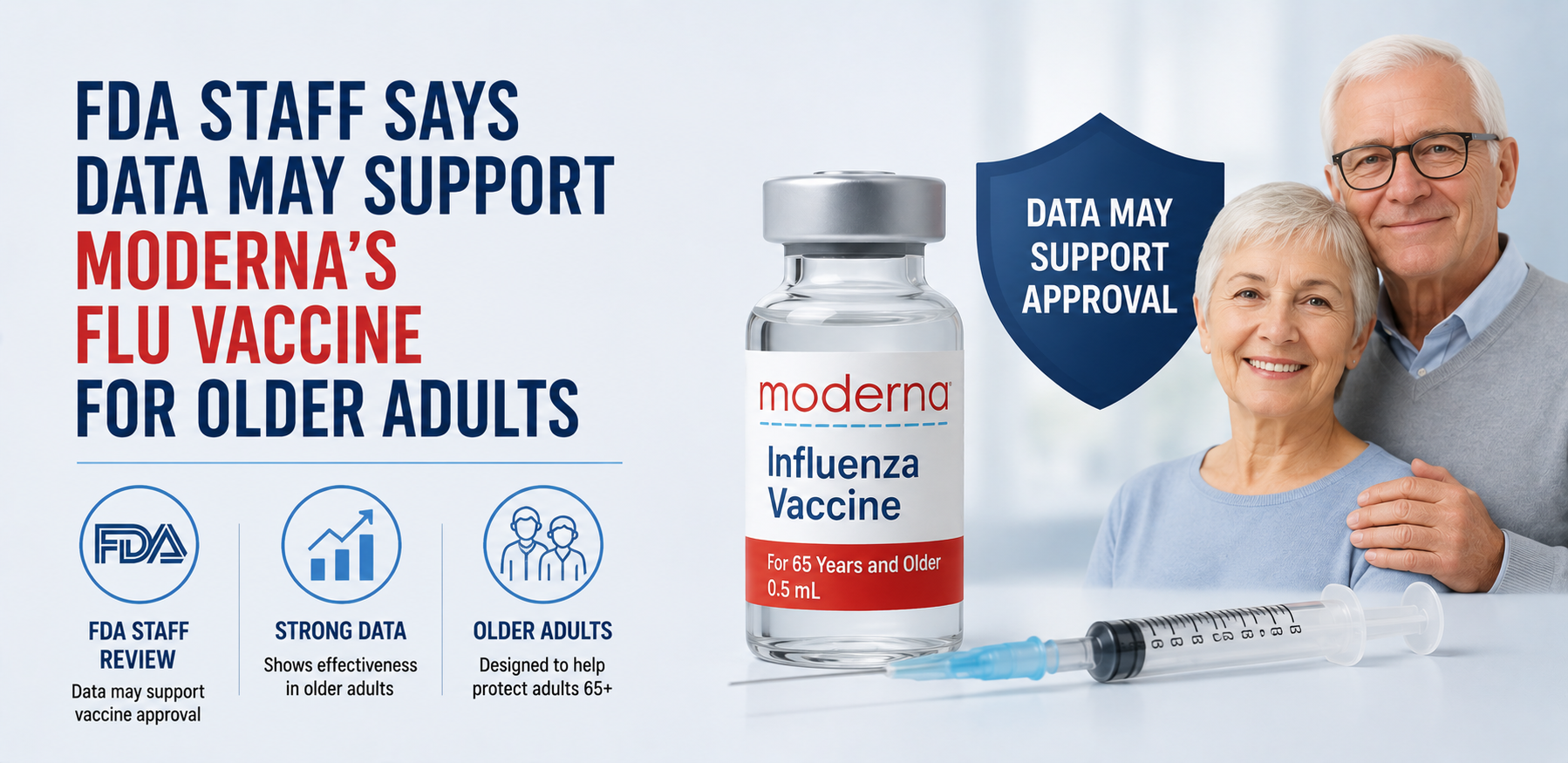
FDA staff reviewers said new data from Moderna's experimental flu vaccine appears to support its effectiveness in adults aged 65 and older, an important development for a vaccine that has faced an unusually complicated regulatory journey over the past several months. The assessment was published ahead of a meeting of independent vaccine advisers who will review the evidence and vote on whether the vaccine's benefits outweigh its risks for adults aged 50 and above.
The vaccine, called mFlusiva, uses mRNA technology—the same platform that helped Moderna become a major player during the COVID-19 pandemic. If approved, it would become the first mRNA-based seasonal flu vaccine available in the United States. FDA staff noted that the vaccine demonstrated stronger effectiveness than a standard-dose flu shot in adults aged 50 to 64, while data in adults aged 65 and older suggested it could also be effective in that higher-risk population.
The announcement sent Moderna's shares higher because investors viewed the FDA staff assessment as more favorable than many had expected.
Why This Review Is Important
Influenza remains one of the most significant seasonal public health challenges in the United States.
Every year, flu infections lead to millions of illnesses, hundreds of thousands of hospitalizations, and tens of thousands of deaths. Older adults face the greatest risk because immune systems generally become less effective with age, making it harder to fight off infections.
This is why vaccine effectiveness in adults over 65 is such an important issue.
Traditional flu vaccines have helped reduce illness, but their effectiveness varies significantly from year to year depending on how well vaccine strains match the viruses circulating in the community.
Researchers have long searched for ways to build more effective flu vaccines, particularly for older adults who experience the highest rates of severe disease and hospitalization.
How mRNA Flu Vaccines Are Different
Most flu vaccines currently available are produced using methods that have been refined over decades.
Many rely on growing virus material in eggs or cell-based manufacturing systems before producing the final vaccine.
mRNA vaccines work differently.
Instead of introducing pieces of the virus itself, they provide genetic instructions that help the body produce proteins capable of triggering an immune response.
Supporters of mRNA technology believe it offers several advantages:
- Faster vaccine development
- Greater manufacturing flexibility
- More precise strain matching
- Faster adaptation when viruses change
The success of mRNA COVID vaccines accelerated interest in applying the same technology to influenza, RSV, cancer vaccines, and other diseases.
For Moderna, a successful flu vaccine would help diversify revenue as demand for COVID vaccines continues to decline.
The Regulatory Challenges Moderna Faced
The path to this point has not been straightforward.
Earlier this year, the FDA initially refused to review Moderna's flu vaccine application, arguing that the company used the wrong comparison vaccine in parts of its clinical trial involving older adults. Regulators believed Moderna should have compared its vaccine against higher-dose flu shots commonly recommended for seniors rather than standard-dose vaccines.
The decision surprised investors and healthcare observers because Moderna had previously discussed trial design with regulators.
After additional discussions, the FDA reversed course and agreed to review a revised application. Moderna also agreed to conduct additional studies in older adults if approval is granted.
The dispute became one of the most visible examples of the changing vaccine-review environment under current FDA leadership.
What FDA Staff Found
The newly released briefing documents suggest FDA reviewers believe the available data may support effectiveness in older adults.
However, they also highlighted several limitations.
The vaccine has only been studied across a single influenza season, meaning researchers still have limited information about how consistently it performs across different years and different circulating flu strains.
FDA reviewers also noted that some important high-risk populations were not fully represented in the studies, including very frail older adults and immunocompromised individuals. As a result, questions remain about how well the vaccine performs in those groups.
Even with those concerns, the overall assessment was viewed positively because regulators did not identify major deficiencies that would prevent continued review.
Why Older Adults Are the Key Market
For Moderna, approval in older adults is particularly important.
Adults over 65 account for the majority of flu-related hospitalizations and deaths each year. They are also the population most likely to receive enhanced flu vaccines, including high-dose and adjuvanted formulations designed specifically for seniors.
This makes the age group commercially attractive and medically important.
A vaccine that demonstrates stronger protection in older adults could capture significant market share, especially if future studies continue showing improved effectiveness compared with standard flu shots.
Several analysts have estimated that successful approval could eventually create a substantial new revenue stream for Moderna.
What Happens Next?
An independent FDA advisory committee will review the data and vote on whether the benefits outweigh the risks.
Although the FDA is not required to follow advisory committee recommendations, these votes often influence final regulatory decisions.
A final FDA decision is expected by early August. If approved, mFlusiva could become available for the 2026–27 flu season and would represent the first mRNA flu vaccine approved in the United States.
The outcome will also be closely watched by other vaccine developers because it could influence future mRNA vaccine programs beyond influenza.
Industry Impact
Vaccine Manufacturers: A Moderna approval could increase competition within the seasonal influenza vaccine market and accelerate investment in next-generation vaccine technologies.
Healthcare Providers: Physicians and pharmacists may gain access to a new vaccine option that could potentially provide stronger protection for older adults.
Public Health Agencies: Officials continue searching for ways to improve flu prevention, particularly among populations most vulnerable to severe disease.
Investors: The decision is viewed as an important test of Moderna's ability to expand beyond COVID-related products and build a broader vaccine portfolio.
Key Takeaways
- FDA reviewers said available data may support Moderna's flu vaccine in adults aged 65 and older.
- The vaccine uses mRNA technology and could become the first mRNA-based flu vaccine approved in the U.S.
- Regulators highlighted some limitations, including limited data in certain high-risk populations.
- Moderna previously faced regulatory challenges over clinical trial design.
- A final FDA decision is expected before the 2026–27 flu season.
What This Means for Healthcare Marketers
This story highlights how closely healthcare markets watch regulatory milestones, particularly in high-profile areas such as vaccines and mRNA technology.
For healthcare marketers, approval decisions often serve as inflection points that reshape competitive dynamics, investment priorities, and commercial strategies. Companies operating in vaccines, infectious diseases, diagnostics, pharmacy, and population health may all monitor the outcome because new vaccine options can influence provider engagement, patient education, reimbursement discussions, and public health initiatives.
The article also reinforces the growing importance of regulatory intelligence as a demand signal. Organizations tracking FDA reviews, advisory committee meetings, and approval timelines often gain early insight into future market opportunities.
For healthcare marketers focused on life sciences, this is a reminder that regulatory events are not just scientific milestones. They often signal upcoming shifts in budgets, partnerships, commercialization activity, and market competition. Companies that identify these signals early are typically better positioned to engage decision-makers before broader market activity accelerates.