Federal Judge Orders FDA to Reconsider Restrictions on Prescribing Abortion Pill Mifepristone
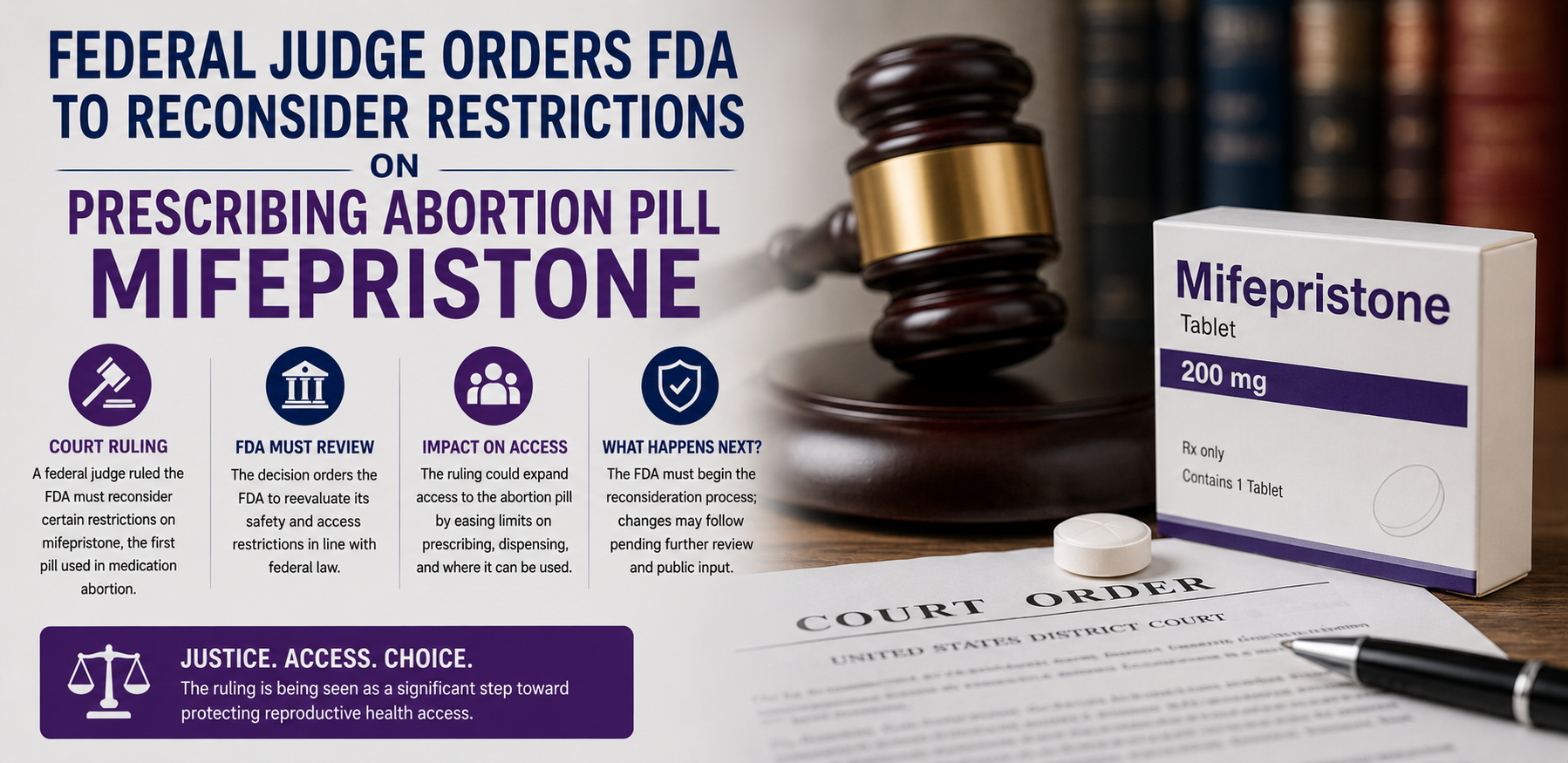
What's Happening
A federal judge in Virginia has ruled that the U.S. Food and Drug Administration (FDA) failed to adequately justify certain restrictions imposed in 2023 on prescribing mifepristone, one of the two medications commonly used in medication abortions.
U.S. District Judge Robert Ballou concluded that the FDA did not sufficiently explain why doctors and pharmacies should be required to obtain special certifications before prescribing or dispensing the medication. Rather than immediately eliminating the restrictions, the judge ordered the FDA to reconsider the rule using a more complete regulatory analysis.
The decision is the latest development in the ongoing legal and regulatory debate surrounding access to medication abortion in the United States. It does not change the FDA's approval of mifepristone itself, nor does it immediately alter how the medication is prescribed. Instead, it requires the agency to re-evaluate whether the additional prescribing requirements remain justified based on available scientific evidence.
Understanding Mifepristone
Mifepristone is an FDA-approved medication that has been used in the United States since 2000 for medication abortion.
The treatment is typically provided as a two-drug regimen:
- Mifepristone blocks the hormone progesterone, which is necessary to maintain a pregnancy.
- A second medication, misoprostol, is taken later to complete the process.
Medication abortion has become the most common method of abortion in the United States, accounting for more than 60% of procedures in recent years.
Beyond abortion care, mifepristone may also be used in certain miscarriage management protocols under clinical supervision.
What Were the 2023 FDA Restrictions?
In 2023, the FDA updated its Risk Evaluation and Mitigation Strategy (REMS) program governing mifepristone.
Although the agency expanded access in several ways, including allowing certified retail pharmacies to dispense the medication, it continued requiring:
- Healthcare providers to obtain special certification.
- Pharmacies to become specially certified before dispensing the drug.
- Additional documentation requirements for prescribers and patients.
The FDA stated that these measures were intended to ensure safe prescribing and appropriate patient counseling.
The plaintiffs in the Virginia lawsuit argued that the certification requirements created unnecessary administrative barriers that limited patient access without improving safety.
Why the Judge Ruled Against the FDA
Judge Ballou did not conclude that the FDA lacks authority to regulate mifepristone.
Instead, he found that the agency did not adequately explain why the certification requirements remained necessary after repeatedly concluding that mifepristone is a safe and effective medication.
According to the ruling, the FDA failed to sufficiently:
- Evaluate relevant scientific evidence.
- Consider the impact of the restrictions on patients and healthcare providers.
- Explain why the certification requirements were needed despite previous findings supporting the medication's safety.
Because of those deficiencies, the court determined that the rule was legally flawed under federal administrative law and directed the FDA to reconsider it.
Importantly, the decision focuses on how the FDA reached its regulatory decision rather than questioning the safety or effectiveness of mifepristone itself.
Why This Case Matters
The ruling highlights how healthcare regulation depends not only on scientific evidence but also on the legal process agencies use when creating regulations.
Federal agencies such as the FDA must:
- Review available scientific evidence.
- Consider public comments and stakeholder impacts.
- Clearly explain the reasoning behind regulatory decisions.
- Demonstrate that rules are supported by the administrative record.
Even when courts agree that agencies have broad regulatory authority, they may require rules to be reconsidered if they conclude that the decision-making process was incomplete or inadequately explained.
This principle applies across healthcare regulation, affecting pharmaceuticals, medical devices, diagnostics, and public health policies.
Industry Impact
- Healthcare Providers: Physicians, advanced practice clinicians, and reproductive healthcare providers will continue operating under the current regulatory framework while the FDA reviews the court's decision. Future changes could reduce administrative requirements depending on the agency's response.
- Pharmacies: Retail pharmacies that currently participate in the FDA certification program will closely monitor any revisions to dispensing requirements. Simplified regulations could broaden participation among pharmacies interested in providing medication abortion services where permitted by state law.
- Pharmaceutical Manufacturers: Manufacturers of reproductive health medicines continue to face a highly dynamic regulatory environment shaped by litigation, evolving state laws, and federal policy decisions. Regulatory uncertainty may influence commercial planning and market access strategies.
- Healthcare Policy: The ruling demonstrates how administrative law continues to shape healthcare delivery. Even after scientific questions are addressed, regulatory policies may remain subject to judicial review regarding how agencies justify their decisions.
Looking Ahead
The FDA must now reconsider the challenged certification requirements in light of the court's findings.
Several outcomes remain possible:
- The FDA could provide additional justification and maintain the existing restrictions.
- The agency could modify the certification requirements.
- Certain administrative requirements could be removed or replaced.
- Additional appeals or future litigation could further shape the regulatory landscape.
At the same time, other lawsuits concerning mifepristone continue moving through federal courts, meaning the overall regulatory environment surrounding medication abortion remains unsettled.
Why This Matters
The case illustrates the growing intersection of healthcare regulation, administrative law, and evidence-based policymaking.
Regardless of the broader policy debate surrounding abortion, the decision reinforces an important principle for healthcare regulation: federal agencies must clearly demonstrate how scientific evidence supports the rules they impose.
For healthcare organizations, the ruling serves as a reminder that regulatory requirements can evolve through both scientific review and judicial oversight. Organizations operating in highly regulated healthcare sectors must remain prepared to adapt to changes that emerge through ongoing legal proceedings.
Key Takeaways
- A federal judge ruled that the FDA did not adequately justify certain 2023 certification requirements for prescribing and dispensing mifepristone.
- The court ordered the FDA to reconsider the rule rather than immediately eliminating the restrictions.
- The decision does not affect the FDA's approval of mifepristone as a medication.
- The case centers on administrative procedure and regulatory justification rather than the drug's safety or effectiveness.
- Additional litigation involving mifepristone remains ongoing, meaning the regulatory landscape may continue to evolve.
What This Means for Healthcare Marketers
Regulatory decisions affecting prescribing requirements can significantly influence provider workflows, pharmacy participation, patient access, and healthcare delivery models. Organizations serving reproductive health providers, pharmacies, digital health platforms, compliance teams, and healthcare technology vendors should closely monitor FDA policy changes and related court decisions. For healthcare marketers, periods of regulatory transition create opportunities to provide educational resources, compliance support, and evidence-based guidance that help healthcare organizations adapt to evolving federal requirements while maintaining high standards of patient care.