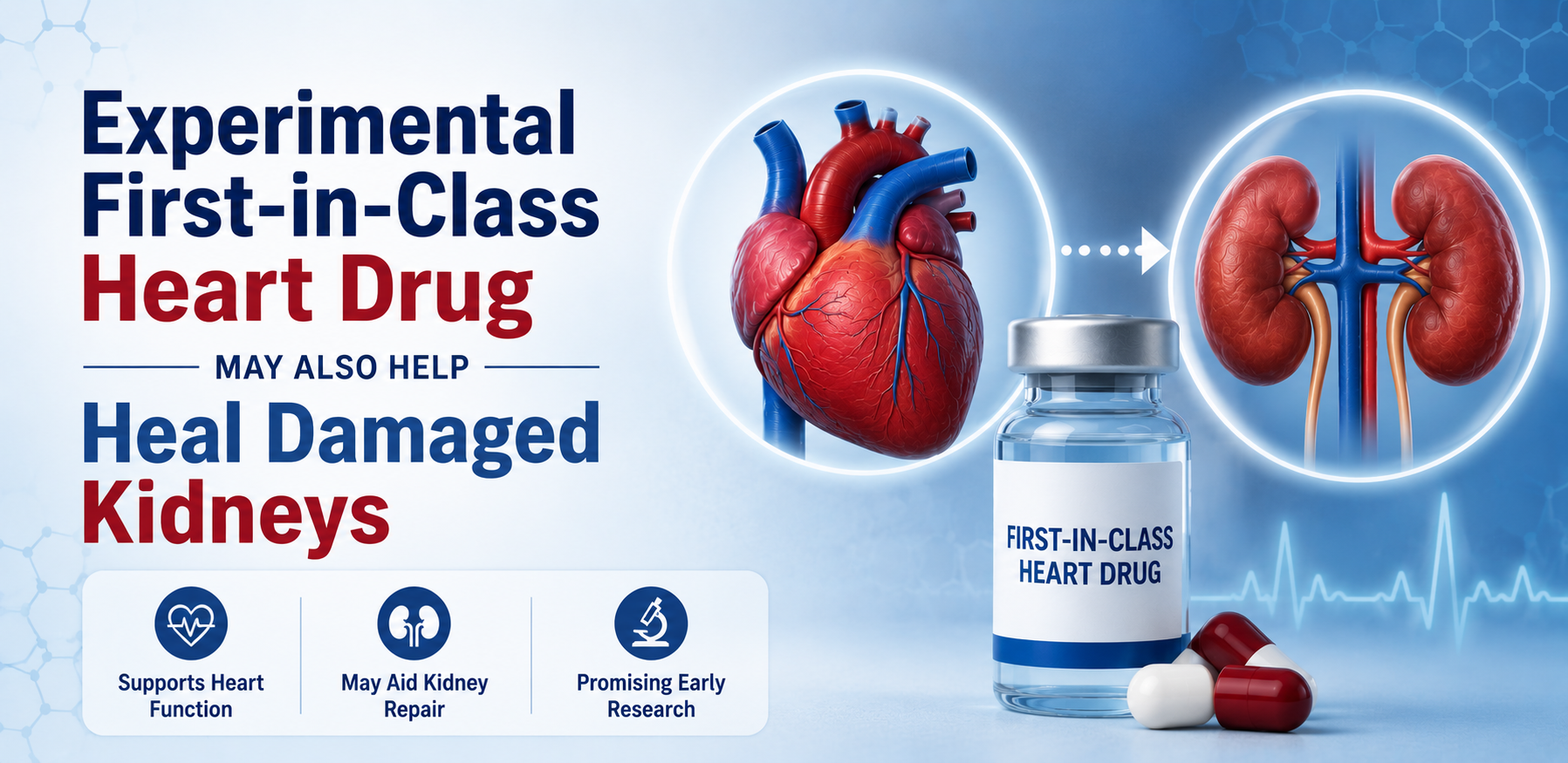
Experimental First-in-Class Heart Drug May Also Help Heal Damaged Kidneys
What's Happening
Researchers have discovered that an experimental drug originally designed to help the heart heal after a heart attack may also help repair damaged kidneys.
The drug, called AD-NP1, is being developed by scientists at UCLA and is currently being prepared for early human testing as a potential treatment to prevent heart failure following heart attacks. New laboratory research suggests the same biological mechanism that helps repair heart tissue may also improve healing in kidney tissue.
The finding is generating excitement because chronic kidney disease affects millions of people worldwide and, unlike some organs, the kidneys have a limited ability to repair themselves once significant damage occurs.
If future studies confirm these results in humans, the therapy could potentially open an entirely new approach to treating kidney disease rather than simply slowing its progression.
How the Drug Works
The drug targets a protein known as ENPP1.
Researchers previously discovered that ENPP1 becomes highly active after a heart attack and interferes with the body's natural repair process. By blocking this protein, AD-NP1 helps create conditions that allow damaged heart tissue to heal more effectively.
While studying kidney disease, researchers noticed something unexpected.
Kidney tissue samples from patients with chronic kidney disease also showed elevated levels of the same ENPP1 protein. This raised an important question: if ENPP1 interferes with healing in the heart, could it be doing the same thing in the kidneys?
That observation became the foundation for a new series of experiments.
What Researchers Found
Scientists first induced kidney injury in laboratory mice.
Some mice had normal ENPP1 activity, while others had the protein genetically blocked.
Initially, both groups experienced kidney damage. However, as recovery progressed, the mice lacking ENPP1 showed significantly better healing. Researchers observed:
- Improved kidney function
- Reduced tissue scarring
- Enhanced repair mechanisms
- Better long-term recovery
The results suggested that ENPP1 may be actively preventing damaged kidneys from healing efficiently.
Researchers then tested AD-NP1 directly.
After inducing kidney injury, they treated mice with the experimental drug.
Within a week, treated animals showed improved healing and better kidney function compared with untreated animals.
The findings were significant enough to be published in the scientific journal Cell Stem Cell.
Why This Could Be Important for Kidney Disease
Most current kidney-disease treatments focus on slowing further damage rather than repairing existing injury.
Doctors can often help patients:
- Control blood pressure
- Manage diabetes
- Reduce inflammation
- Slow disease progression
However, truly reversing kidney damage remains one of the biggest challenges in nephrology.
Once scar tissue develops inside the kidneys, recovery becomes difficult.
This is why the UCLA findings have attracted attention.
Instead of simply preventing further deterioration, AD-NP1 appears to activate biological pathways involved in tissue repair and regeneration.
If similar effects occur in humans, it could represent a fundamentally different treatment strategy.
The Heart-Kidney Connection
The study also highlights how closely connected different organs can be.
Traditionally, researchers have studied heart disease and kidney disease separately.
However, scientists increasingly recognize that many biological pathways affect multiple organs simultaneously.
Patients with heart disease often develop kidney problems.
Likewise, chronic kidney disease significantly increases the risk of cardiovascular complications.
The discovery that the same protein may interfere with healing in both organs suggests there may be common mechanisms driving damage throughout the body.
Understanding those shared mechanisms could lead to therapies that benefit multiple conditions at once.
Why "First-in-Class" Matters
AD-NP1 is described as a "first-in-class" therapy.
In pharmaceutical development, this means the drug works through a biological mechanism that has not previously been targeted by approved treatments.
First-in-class therapies are important because they can create entirely new categories of treatment rather than offering incremental improvements to existing drugs.
Many of the most significant medical breakthroughs over the past several decades began as first-in-class medicines.
However, these therapies also carry higher development risk because researchers have less historical experience with the underlying mechanism.
As a result, extensive testing is still required before scientists know whether the benefits seen in laboratory studies will translate into real-world patient outcomes.
What Happens Next?
Although the results are encouraging, the therapy remains in the early stages of development.
The research so far has primarily involved laboratory studies and animal models.
The next steps include:
- Additional safety testing
- Human clinical trials
- Evaluation of long-term effects
- Determining optimal dosing
- Assessing effectiveness in kidney-disease patients
Drug development is a lengthy process, and many experimental therapies fail during clinical testing despite promising early data.
Researchers caution that much more evidence will be needed before AD-NP1 could become available to patients.
Nevertheless, the findings provide a strong scientific rationale for continued development.
Why This Matters
Chronic kidney disease affects tens of millions of people and remains one of the leading causes of illness worldwide.
Many patients eventually progress to:
- Kidney failure
- Dialysis
- Kidney transplantation
- Cardiovascular complications
Despite advances in treatment, relatively few therapies are capable of directly repairing damaged kidney tissue.
The possibility of a medicine that promotes actual healing rather than merely slowing decline represents a potentially important shift in how kidney disease is treated.
While much work remains, the study provides evidence that regenerative approaches may become an increasingly important area of future kidney-disease research.
Key Takeaways
- UCLA researchers found that an experimental heart-repair drug may also help damaged kidneys heal.
- The therapy works by blocking a protein called ENPP1 that interferes with tissue repair.
- Animal studies showed improved kidney function, reduced scarring, and enhanced recovery.
- The drug was originally developed to help prevent heart failure after heart attacks.
- Human clinical trials will be needed before the treatment can be considered for patients.
What This Means for Healthcare Marketers
This story highlights one of the most important trends in healthcare innovation: platform biology.
Instead of developing separate treatments for every disease, researchers are increasingly identifying biological mechanisms that influence multiple organs and conditions. Companies that discover these shared pathways may unlock opportunities across several therapeutic markets simultaneously.
For healthcare marketers, this creates valuable early-stage signals. A therapy initially developed for cardiovascular disease could potentially expand into nephrology, creating entirely new commercial opportunities. Organizations involved in kidney care, cardiovascular health, diagnostics, clinical research, and specialty pharmaceuticals should pay close attention to developments like this because they often reveal future growth areas years before products reach the market.
The research also reflects growing interest in regenerative medicine. Healthcare companies are investing heavily in therapies designed not merely to manage disease but to repair damaged tissues and restore function. As these approaches advance, they may reshape how providers, payers, and pharmaceutical companies think about chronic disease treatment.
More broadly, the findings demonstrate how a single scientific discovery can create opportunities across multiple healthcare sectors, making translational research an increasingly important source of future healthcare innovation.