GoodRx Offers Family Health Subscription, Plans Employer Benefit Launch in 2027
What's Happening
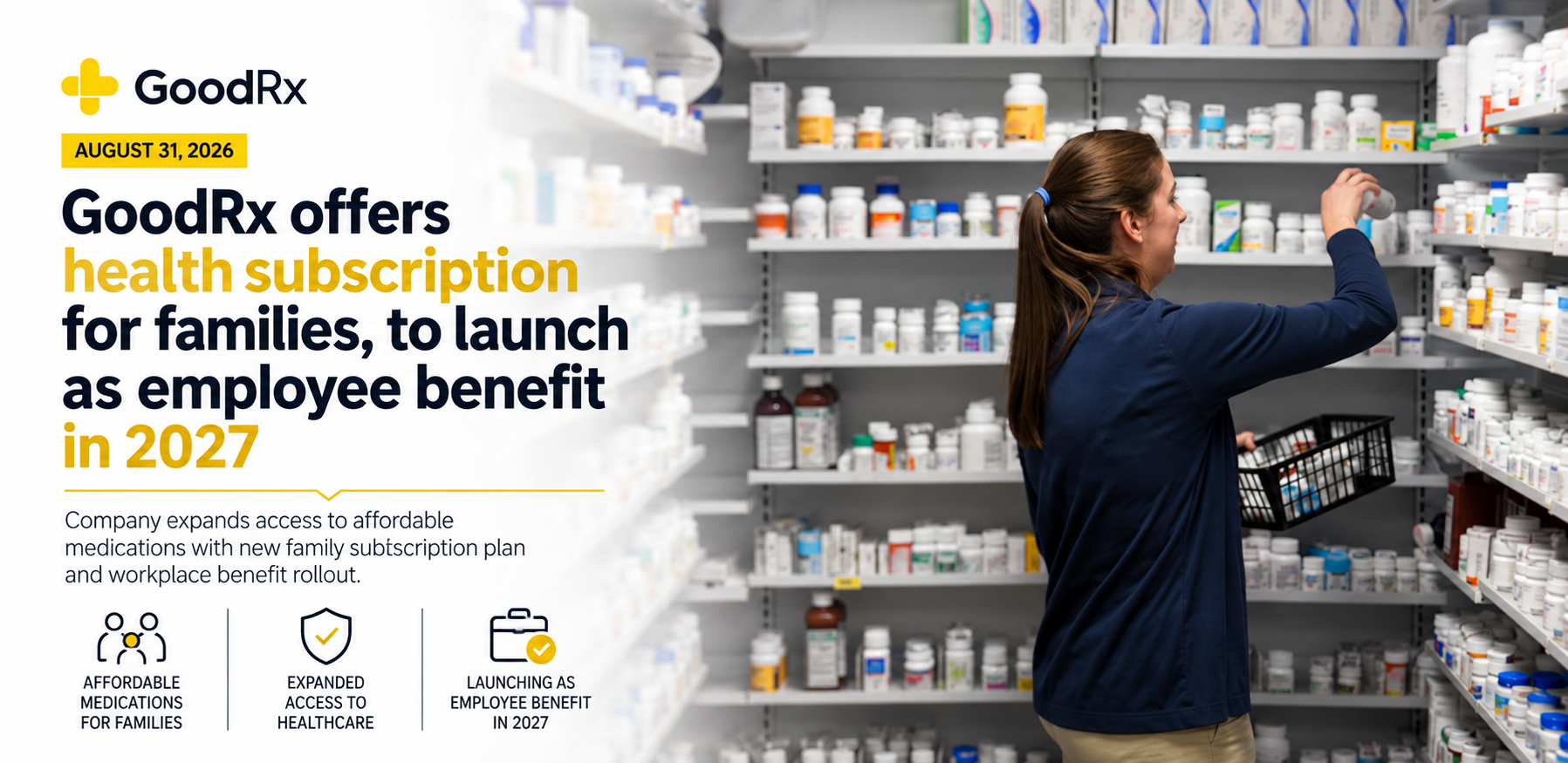
GoodRx, the U.S. prescription drug savings company, is expanding beyond its traditional prescription-discount business with a family healthcare subscription called Companion.
The program gives families access to more than 250 medications, along with discounted telehealth, vision, dental and laboratory services, for $24.99 per month. GoodRx plans to begin offering Companion as an employee health benefit in 2027, with employer partnerships expected to start on January 1, 2027. (Reuters)
The move comes as employers and workers face increasing healthcare costs and as having health insurance does not necessarily protect families from high deductibles, copays, prescription expenses and other out-of-pocket costs.
GoodRx is effectively positioning its subscription as a layer of healthcare affordability support that can sit alongside traditional insurance.
GoodRx Is Expanding Companion From Individuals to Families
The program was previously an individual subscription
Companion was previously available directly to consumers on an individual basis.
An individual subscription costs $14.99 per month. The new family version costs $24.99 per month, allowing the service to address healthcare expenses across an entire household rather than focusing on one person at a time. (Reuters)
GoodRx said the expansion is intended to address affordability gaps that families are experiencing as healthcare coverage becomes more expensive and, in some cases, less comprehensive.
More than just prescription discounts
The family subscription includes 250 generic medications at no cost, along with discounted access to:
- Telehealth
- Vision services
- Dental services
- Laboratory services
That makes Companion broader than a conventional prescription-discount card.
GoodRx is effectively bundling medication savings with access to several common healthcare services into a recurring membership model. (Reuters)
GoodRx Is Targeting the Gap Between Insurance and Affordability
Having insurance does not guarantee low costs
GoodRx CEO Wendy Barnes said the company sees an expanding affordability problem on both sides of the insurance divide.
For insured households, rising deductibles, out-of-pocket costs and coverage restrictions can still make healthcare difficult to afford. (Reuters)
That distinction is important.
The traditional healthcare market often treats a person as either insured or uninsured. GoodRx's strategy is built around the idea that there is another category: people who have insurance but still struggle to pay for the care or medications they need.
Prescription prices can remain a problem
A patient may have health coverage but still encounter a prescription price that is unaffordable under their particular plan.
GoodRx's model addresses that problem by creating an additional mechanism through which consumers can access lower prices, rather than relying entirely on the insurance benefit structure.
This puts GoodRx in a position between traditional insurance and direct consumer healthcare purchasing.
Employers Will Become a New Distribution Channel
GoodRx is moving into employee benefits
Beginning in 2027, GoodRx plans to make Companion available as an employer-sponsored health benefit.
The company is already lining up employers interested in offering the program, with partnerships expected to begin January 1. (Reuters)
This represents an important change in GoodRx's business model.
Historically, the company has primarily reached consumers directly. Employer distribution gives it access to households through the workplace, potentially allowing GoodRx to reach a much larger pool of consumers without acquiring each subscriber individually.
Employers can choose how much to subsidize
Employers will be able to decide whether to subsidize the membership.
Employees who enroll would pay whatever portion of the monthly cost remains after the employer contribution. (Reuters)
That creates flexibility in how the benefit is structured.
An employer could potentially pay the full membership cost as part of its benefits package or contribute a portion while asking employees to cover the balance.
Healthcare Costs Are Putting Pressure on Employers
Employers expect healthcare costs to rise
GoodRx's expansion into employee benefits comes as companies themselves are anticipating substantial increases in healthcare costs.
The Business Group on Health estimates that employers could see healthcare costs increase by 9.2% in 2027 if they do not take action to mitigate those expenses. (Reuters)
That creates a strong incentive for employers to look for ways to improve healthcare affordability without simply absorbing all of the increase.
Higher deductibles are one response
Some employers are responding by offering plans with higher deductibles, requiring employees to pay more out of pocket before insurance coverage begins. (Reuters)
That can lower employer premiums or help manage plan costs, but it also shifts more financial responsibility onto employees.
GoodRx is targeting that precise pain point.
Rather than replacing insurance, Companion can potentially provide workers with lower-cost ways to obtain certain medications and services when their insurance leaves them with significant expenses.
GoodRx Sees Strong Momentum in Subscription Revenue
Subscription revenue rose 39%
GoodRx's move into employee benefits comes after strong growth in its existing subscription business.
In the second quarter of 2026, GoodRx's subscription revenue increased 39% year over year. CEO Wendy Barnes also said uptake of the Companion program had exceeded expectations. (Reuters)
That performance provides the company with evidence that consumers are willing to pay for recurring healthcare-affordability services.
The employer launch therefore appears to be an expansion of an existing business rather than an entirely new experiment.
The Subscription Model Changes GoodRx's Position in Healthcare
From price comparison to healthcare access
GoodRx became well known primarily as a way for consumers to compare prescription prices and find discounts.
Companion expands the company's role.
Instead of helping consumers at the point when they are already looking for a prescription, GoodRx is attempting to become a recurring healthcare-access platform that consumers use across multiple categories.
The addition of telehealth, dental, vision and laboratory services increases the number of healthcare interactions that can occur within the GoodRx ecosystem.
Recurring revenue becomes more important
A subscription model also creates a more predictable revenue stream than relying exclusively on advertising, referrals or individual prescription transactions.
For GoodRx, growing recurring subscription revenue can help diversify its business and deepen its relationship with consumers.
The 39% year-over-year increase in subscription revenue suggests the company is already seeing momentum in this part of its business. (Reuters)
Families Are Becoming an Important Healthcare Unit
Costs rarely affect only one individual
GoodRx's family strategy reflects a broader reality of healthcare spending.
Household healthcare costs can accumulate across multiple family members through prescriptions, dental visits, vision care, laboratory testing and other routine services.
A product that addresses only one individual's prescription expenses may therefore leave a large portion of a household's healthcare spending untouched.
By packaging several services into one membership, GoodRx is attempting to capture more of that household-level spending.
Why Employers May Be Interested
For employers, the appeal is not necessarily that Companion replaces health insurance.
Instead, the service could potentially function as a supplemental affordability benefit.
Employers facing rising healthcare costs can offer workers another mechanism for obtaining routine care and lower-cost medications while giving employees an additional benefit that may be easier to understand and use than complicated insurance structures.
That could be particularly attractive as companies try to control benefit costs while maintaining competitive employee packages.
There Is Still a Cost-Control Question
Lower prices for consumers do not automatically mean lower total healthcare spending
One issue employers will need to consider is whether easier access to discounted healthcare services ultimately reduces overall healthcare costs or simply shifts how employees obtain care.
For example, if lower prices encourage greater use of healthcare services, employers could see higher utilization even while individual transactions become less expensive.
The value proposition will therefore depend on whether the program can reduce the cost of necessary care, improve medication adherence or prevent more expensive downstream healthcare events.
GoodRx's ability to demonstrate those outcomes could be important as it competes for employer benefit contracts.
GoodRx Is Entering a Crowded Benefits Market
The employer-health-benefits market already includes a large number of companies offering point solutions for pharmacy costs, virtual care, behavioral health, chronic conditions and other areas.
GoodRx's advantage is its existing consumer brand and its established relationship with people searching for lower healthcare prices.
The challenge will be convincing employers that the service delivers enough value to justify adding another healthcare benefit to an already complicated benefits ecosystem.
The company's existing consumer subscription growth could help support that case.
Why This Matters
The GoodRx move reflects a larger change in how Americans are paying for healthcare.
The traditional distinction between insured and uninsured is becoming less useful when even insured consumers face substantial deductibles, out-of-pocket costs and coverage restrictions.
Companies such as GoodRx are increasingly targeting the space between formal insurance coverage and what consumers can actually afford.
The move into employer-sponsored benefits is particularly important because it gives GoodRx a new distribution channel and places its affordability tools directly inside the workplace benefits ecosystem.
For employers, the strategy also offers another possible way to address rising healthcare costs without relying exclusively on higher employee premiums or deductibles.
Looking Ahead
GoodRx expects its first employer partnerships for Companion to begin on January 1, 2027. (Reuters)
The early employer response will provide an important test of whether a consumer-focused healthcare savings platform can successfully transition into a formal employee-benefit product.
GoodRx will also need to demonstrate that its subscription can deliver meaningful value across an entire household rather than simply providing isolated discounts.
The company's strong subscription growth gives it momentum going into the launch, but the employer market will introduce a different set of purchasing criteria, including cost effectiveness, employee engagement, utilization and measurable outcomes.
If employers adopt the program at scale, GoodRx could move from being primarily a consumer prescription-savings company toward becoming a broader participant in the U.S. employer healthcare-benefits market.
Key Takeaways
- GoodRx is expanding its Companion healthcare subscription to families.
- The family program costs $24.99 per month. (Reuters)
- Members receive 250 generic medications for free plus discounted telehealth, vision, dental and laboratory services.
- The individual version of Companion costs $14.99 per month. (Reuters)
- GoodRx plans to launch Companion as an employee health benefit in 2027.
- Employer partnerships are expected to begin January 1, 2027.
- Employers can choose to subsidize some or all of the membership cost.
- GoodRx's subscription revenue increased 39% year over year in Q2 2026.
- Employers are facing an estimated 9.2% increase in healthcare costs in 2027 without mitigation efforts. (Reuters)
- Some employers are responding to cost pressure with higher-deductible plans, increasing employees' out-of-pocket exposure.
- GoodRx is positioning Companion as a solution for the affordability gap that exists even among people with health insurance.
What This Means for Healthcare Marketers
GoodRx's strategy shows how affordability has become a product in its own right.
Healthcare companies are increasingly competing not only on clinical outcomes or insurance coverage, but on how easily consumers can actually access and pay for care.
The employer launch also highlights the importance of understanding who controls healthcare purchasing decisions. GoodRx is moving from direct-to-consumer acquisition toward employer-sponsored distribution, potentially giving it access to entire households through one institutional buyer.
For healthcare marketers, the broader signal is that companies that can identify persistent affordability gaps, package multiple solutions around those gaps and distribute them through new channels can create entirely new healthcare markets.