What's Happening
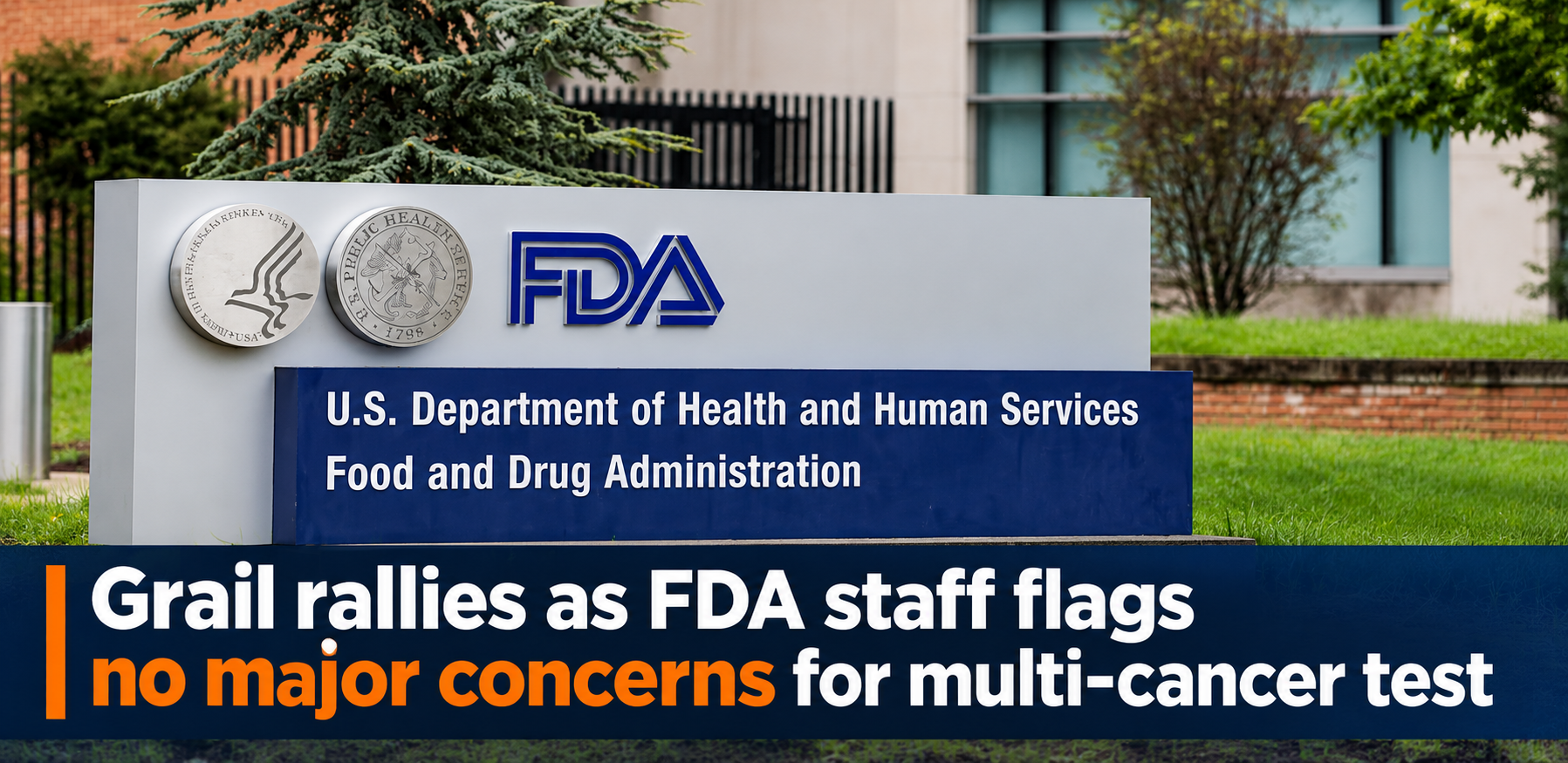
Shares of Grail jumped about 35% on September 21 after FDA staff reviewers raised no major concerns about the company's Galleri blood test, which is designed to detect signals associated with more than 50 types of cancer.
The FDA's findings were released ahead of an external advisory committee meeting scheduled for September 23. The panel will review Grail's request for premarket approval of Galleri.
The FDA staff briefing documents did not identify outstanding questions about the test's analytical performance, study design or primary safety analyses.
However, regulators are asking the advisory panel to consider a more fundamental question: whether the available evidence supports describing Galleri as an "early detection" test.
What Is Galleri?
Galleri is a multi-cancer early detection blood test.
Instead of looking for one specific cancer, the test analyzes a blood sample for molecular signals that can be released by tumors.
The test is designed to:
- Detect signals associated with multiple cancers
- Estimate where in the body a detected cancer signal may have originated
- Help guide follow-up diagnostic testing
A major difference between Galleri and conventional cancer screening is the number of cancers it is designed to detect from a single blood draw.
Traditional screening programs generally focus on individual cancers, such as breast, colorectal or cervical cancer.
Galleri is intended to complement those established screenings rather than replace them.
Galleri Is Already Being Used, But It Is Not FDA-Approved
Galleri is already commercially available in the United States under Clinical Laboratory Improvement Amendments regulations.
That means the test can currently be offered through the laboratory-developed-test pathway.
However, it does not currently have FDA approval.
Grail is seeking formal premarket approval, which would be a major regulatory milestone for the company.
FDA approval could make it easier for the test to achieve broader distribution and adoption and could strengthen the case for inclusion in physician guidelines and routine health insurance coverage.
Why FDA Approval Matters So Much
The difference between being available as a laboratory-developed test and receiving FDA approval is commercially important.
FDA approval could potentially:
- Expand distribution: More healthcare organizations could become willing to offer the test.
- Increase physician adoption: Formal regulatory approval can give physicians greater clarity about how a diagnostic has been evaluated.
- Support guideline adoption: Professional medical organizations could be more likely to evaluate the test for inclusion in screening recommendations.
- Improve insurance coverage prospects: Payers generally examine regulatory status and clinical evidence when making coverage decisions.
For Grail, these potential changes could significantly expand the market beyond its current level of use.
FDA Staff Did Not Flag Major Safety or Analytical Problems
The positive FDA staff assessment is important because regulators did not identify major unresolved issues in several core areas.
The briefing documents did not list outstanding questions involving:
- Analytical performance: Whether the test reliably performs its laboratory measurement.
- Study design: Whether the evidence submitted by Grail was generated through an appropriate study structure.
- Primary safety analyses: Whether the testing process itself raised major safety concerns.
This does not mean the FDA has approved Galleri.
It means the staff review did not identify major problems in those specific areas ahead of the advisory committee discussion.
The Bigger Regulatory Question Is About "Early Detection"
The main issue still facing the advisory committee is how Galleri should be characterized.
The company calls Galleri a multi-cancer early detection test.
The FDA wants its advisers to consider whether the current evidence actually demonstrates the "early detection" benefit implied by that description.
This distinction matters because detecting a cancer signal is not necessarily the same as proving that a screening test improves health outcomes through earlier diagnosis.
A test can detect cancer without yet proving that its use leads to fewer late-stage diagnoses or better survival.
The UK Trial Created a Major Challenge
Grail's regulatory path was complicated by results from a large clinical trial conducted in the United Kingdom.
The three-year NHS-Galleri trial involved more than 140,000 participants and tested whether adding Galleri to standard cancer screening could improve early cancer detection.
The trial failed to show a statistically significant improvement in early detection or a reduction in late-stage cancer diagnoses overall.
Those results raised concerns about the test's potential value and contributed to a sharp decline in Grail's share price earlier in the year.
The company has nevertheless continued pursuing FDA approval using additional evidence.
Grail's U.S. Regulatory Submission Used Multiple Sources of Data
Grail submitted its FDA application in January 2026.
The application included:
- Data from a smaller U.S. clinical study
- First-year data from the UK NHS-Galleri trial
- A bridging analysis comparing Galleri with an earlier version of the test
This means the FDA is not evaluating the product based on just one clinical trial.
Instead, the company has assembled evidence from multiple studies and analyses to support its application.
The UK Results Did Not End the U.S. Regulatory Process
Although the UK trial did not meet its primary objective, the FDA continued reviewing Grail's application.
This is important because the regulatory process is not simply a pass-or-fail decision based on one trial.
The agency can evaluate multiple aspects of a diagnostic, including how accurately it detects cancer signals, how often false positives occur, how follow-up testing is handled and whether the overall benefits justify the potential risks.
The advisory committee meeting gives outside experts the opportunity to examine those issues publicly before the FDA makes its final decision.
False Positives Are an Important Part of Multi-Cancer Screening
A test designed to detect many cancers faces a particular challenge.
Even if the test is technically capable of identifying cancer signals, some people who receive a positive result may not actually have cancer.
Those people could then undergo additional imaging, biopsies or other diagnostic procedures.
The value of an early-detection test therefore depends on more than how many cancers it identifies.
Healthcare systems also need to consider what happens after a positive result.
Too many unnecessary follow-up procedures could create financial costs, patient anxiety and potential medical risks.
Galleri Is Designed to Work With Existing Screening
Grail says Galleri is not intended to replace established cancer screening programs.
A person using Galleri would still be expected to follow recommended screening for cancers where established screening methods exist.
For example, Galleri is not positioned as a substitute for mammography or colonoscopy.
Instead, the proposed role is to identify cancer signals that may otherwise not be detected through currently recommended screening programs.
That positioning is important because the value proposition is not "one blood test replaces everything."
It is an additional layer of screening.
The Test Covers More Than 50 Cancer Types
Galleri is designed to detect molecular signals associated with more than 50 cancer types.
That broad coverage is one of its major selling points.
Many cancers do not currently have recommended population-wide screening tests.
A blood test capable of identifying signals from multiple cancers could potentially expand screening into diseases where early detection options are currently limited.
However, the effectiveness of the approach depends on whether detecting those cancers earlier ultimately improves outcomes.
Finding the Cancer Is Only the First Step
A positive Galleri result does not itself diagnose cancer.
It provides a signal that requires follow-up.
The test can also predict the likely cancer signal origin, meaning the part of the body where the signal may have originated.
A physician would then use additional diagnostic tests to determine whether cancer is actually present and, if so, identify the specific cancer.
This creates an entire care pathway after the blood test.
- Blood test: Galleri identifies a potential cancer signal.
- Signal localization: The test estimates where the signal may have originated.
- Diagnostic workup: Doctors order appropriate imaging, laboratory testing or other procedures.
- Cancer diagnosis: If cancer is confirmed, the patient enters the appropriate treatment pathway.
The effectiveness and economics of the entire process matter, not just the performance of the initial blood test.
Safety of the Testing Process Has Also Been Studied
The FDA's review included data on what happens to patients after a cancer signal is detected.
In Grail's PATHFINDER 2 study, adverse events related to the diagnostic evaluation were uncommon.
The majority of study-related adverse events were associated with blood-draw procedures and were not serious.
The FDA materials also reported that less than 1% of enrolled participants experienced an adverse event during the 12-month follow-up period, with no adverse device effects reported.
The test's impact on patient anxiety was also examined.
Participants who received a cancer-signal-detected result experienced a temporary increase in anxiety that generally returned toward baseline during follow-up.
Grail Has a Significant Commercial Business Already
Galleri generated approximately $136.8 million in U.S. revenue in 2025.
That is significant because the company already has a commercial business even without FDA approval.
Formal approval could potentially expand that business considerably by making broader adoption easier.
The market opportunity therefore extends beyond whether Grail can launch the product. The company already has a product in use and is seeking regulatory approval that could change the scale of its market.
Grail's Stock Has Been Under Pressure
Despite the strong reaction on September 21, Grail's shares had fallen more than 20% since February.
The decline followed the company's disclosure that the large UK trial had failed to significantly improve early cancer detection or reduce late-stage diagnoses overall.
The new FDA staff assessment therefore changed the immediate investor outlook.
The market reaction reflects expectations surrounding the upcoming advisory committee meeting and the possibility of eventual FDA approval.
The Advisory Committee Will Be Important
The FDA's external advisory committee will meet on September 23 to discuss Grail's application.
Advisory committees provide independent expert input to the FDA.
The committee will examine the evidence behind Galleri and address the questions identified by the agency, including whether the available evidence supports its description as an early-detection test.
The panel's recommendation will not itself constitute FDA approval.
The FDA will make the final regulatory decision.
The Approval Decision Could Have Broader Market Effects
Galleri is not the only multi-cancer blood test being developed.
Abbott Laboratories also has a multi-cancer blood test called Cancerguard that is commercially available under the laboratory-developed-test framework but does not yet have FDA approval.
That means the FDA's handling of Galleri could influence how the broader multi-cancer detection market develops.
A clear regulatory pathway could encourage additional diagnostic companies to pursue formal approval.
A more demanding interpretation of clinical benefit could increase the amount of evidence companies need before bringing similar products through the approval process.
Medicare Coverage Could Eventually Become Important
Another potential growth driver is government coverage.
Recent U.S. legislation created a pathway for Medicare coverage of FDA-approved multi-cancer early detection tests beginning in 2029, subject to the required clinical benefit determination.
That makes FDA approval an especially important milestone for companies operating in this market.
For Grail, regulatory approval could therefore have implications not only for physician adoption and commercial insurance but also for future access to Medicare-covered screening.
The Core Challenge Is Proving Clinical Benefit
The biggest question for Galleri is not whether the test can detect molecular signals.
The more difficult question is whether using the test as a screening tool actually leads to better health outcomes.
Healthcare systems ultimately care about whether screening results in:
- Earlier diagnosis
- More successful treatment
- Fewer advanced cancers
- Lower cancer mortality
A test can demonstrate strong technical performance and still face questions about whether widespread screening improves these outcomes.
That is why the FDA's focus on the meaning of "early detection" is so important.
The Test Could Address an Important Unmet Need
Many cancers are currently diagnosed only after symptoms appear.
For some cancers, routine screening does not exist or is limited to people with specific risk factors.
A blood-based test that can screen for multiple cancers simultaneously could potentially identify disease before symptoms develop.
This is the central clinical opportunity behind multi-cancer early detection technology.
The challenge is establishing that the additional detection translates into meaningful benefits for patients without creating excessive false positives or unnecessary procedures.
Healthcare Systems Would Need to Prepare for the Downstream Work
If multi-cancer screening becomes more widely adopted, healthcare systems would need to build infrastructure around it.
A larger number of positive test results would generate demand for:
- Imaging
- Specialist consultations
- Biopsies
- Pathology
- Follow-up testing
- Cancer treatment
This means the commercial impact of the technology could extend well beyond the diagnostic company itself.
Hospitals, imaging centers, pathology laboratories and oncology practices could all become part of the resulting care pathway.
Why This Matters
Grail's FDA review comes at an important moment for the multi-cancer early detection market.
The company already has a commercially available test generating meaningful U.S. revenue, but formal FDA approval could substantially change its ability to distribute the product, gain physician adoption and pursue broader insurance coverage.
At the same time, the FDA's question about whether the evidence supports the term "early detection" highlights the central challenge facing the entire category.
Detecting cancer signals is only one part of the problem.
The healthcare system ultimately needs evidence that finding those cancers earlier changes patient outcomes.
Looking Ahead
The next major event is the September 23 FDA advisory committee meeting.
The panel will review Galleri's performance, safety and clinical evidence and discuss whether the test should be characterized as an early-detection screening tool.
After the advisory meeting, the FDA will make its own decision on Grail's premarket approval application.
The outcome could affect Grail's commercial expansion as well as the broader development of multi-cancer blood tests.
Investors and healthcare organizations will also be watching whether the regulatory process creates a clearer path toward physician adoption, clinical guidelines and future insurance coverage.
What This Means for Healthcare Marketers
Grail's situation shows how important regulatory milestones are in emerging diagnostic markets.
A company can already have paying customers and meaningful revenue, but FDA approval can fundamentally change its commercial opportunity.
For healthcare marketers, signals such as FDA advisory meetings, clinical-trial results, diagnostic approvals, payer decisions and physician-guideline discussions can reveal when an emerging technology is moving from an experimental market toward broader healthcare adoption.
For B2B healthcare companies, the downstream effects can also be significant. A successful multi-cancer screening product could increase demand for diagnostic testing, imaging, pathology, oncology referrals and healthcare data infrastructure.
Key Takeaways
- Grail's shares rose about 35% after FDA staff reviewers raised no major concerns about Galleri's accuracy and safety.
- Galleri is a blood-based multi-cancer test designed to detect signals associated with more than 50 cancer types.
- The FDA found no outstanding questions regarding analytical performance, study design or primary safety analyses.
- The major remaining question is whether the evidence supports describing Galleri as an "early detection" test.
- A large three-year UK trial failed to significantly improve early detection or reduce late-stage cancer diagnoses overall.
- Grail submitted its FDA application in January 2026, using data from U.S. and UK studies along with a bridging analysis.
- Galleri is already commercially available under CLIA regulations, but it is not yet FDA-approved.
- The test generated about $136.8 million in U.S. revenue in 2025.
- FDA approval could support broader distribution, physician adoption, guideline consideration and insurance coverage.
- An FDA advisory committee will review Galleri on September 23.
- The broader question for the multi-cancer screening industry is whether detecting cancers earlier translates into better patient outcomes, not simply whether the technology can detect cancer signals.