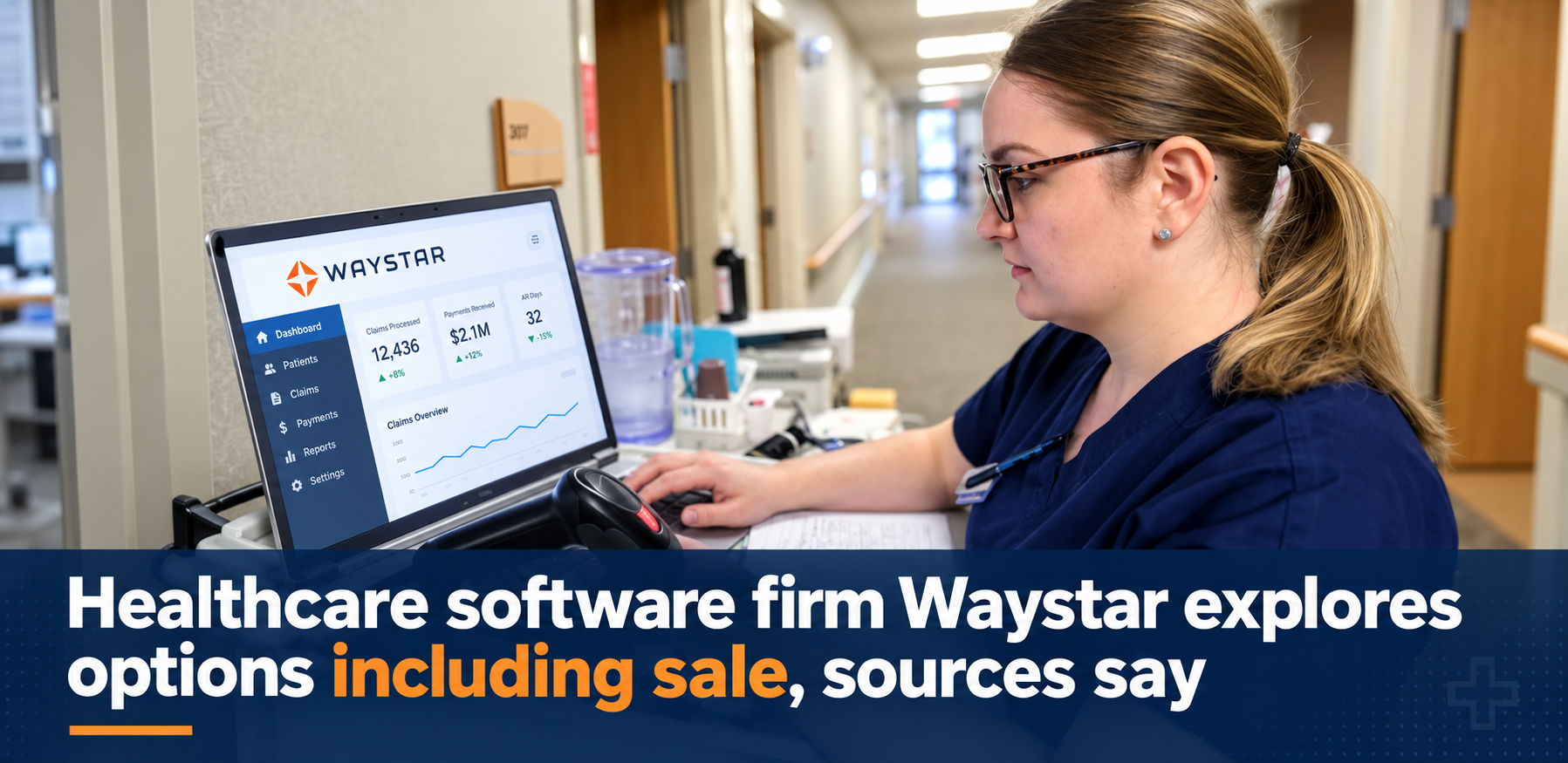
What's Happening
Healthcare software company Waystar is exploring strategic options that could include a potential sale of the company, according to seven people familiar with the matter.
The process is still at an early stage, and there is no guarantee that a transaction will happen. Waystar has hired Evercore to advise on the potential process, while Barclays is also advising the company. Waystar and Barclays declined to comment, while Evercore did not immediately respond to Reuters' request for comment. (Reuters)
A sale would potentially take Waystar private only about two years after it became a publicly traded company, creating an important development in the healthcare software and health-tech market. (Reuters)
What Waystar Does
Technology automation for hospital and physician payment and administrative workflows
Waystar provides technology used by hospitals, physicians and other healthcare organizations to manage payments and administrative work.
Its software is designed to automate parts of the healthcare revenue cycle, helping organizations handle processes associated with billing, claims and payments.
The company's business model is based on positioning itself as a technology provider rather than a healthcare services company.
That distinction matters because Waystar has sought to demonstrate that its software can automate administrative work at scale rather than relying heavily on people to perform those functions. (Reuters)
Why Waystar Is Exploring a Sale
Stock pressure amid broader public software selloffs and investor valuation concerns
Waystar's potential sale comes during a difficult period for publicly traded software businesses.
After initially performing strongly following its IPO, Waystar's shares came under pressure as investors became increasingly concerned about how rapidly advancing artificial intelligence could affect software companies. (Reuters)
Waystar's stock had climbed from about $20 at its 2024 public listing to a peak of $45 in 2025, but subsequently declined.
By Monday, the company's market value had fallen by almost one-quarter during 2026 amid a broader selloff in software stocks.
Following the Reuters report on September 15, Waystar shares jumped more than 8%, partially recovering those losses. After the rise, Waystar's market capitalization was approximately $5.2 billion, based on Reuters calculations. (Reuters)
The AI Question
Balancing workflow automation value against competitive disruption risks from AI
Artificial intelligence is one of the biggest strategic issues facing enterprise software companies.
Waystar has historically sold software that automates administrative processes. AI could potentially strengthen that proposition by allowing healthcare organizations to automate more complex workflows.
At the same time, investors are questioning whether new AI technologies could make some traditional software products less valuable or increase competition from newer AI-native platforms.
Morgan Stanley analysts cited in the Reuters report said investor concerns over AI disruption had contributed to pressure on Waystar's stock. (Reuters)
This leaves companies like Waystar balancing two possibilities: AI can increase the value of automation, while also potentially changing what customers expect from healthcare software.
The Healthcare Administrative Opportunity
Massive administrative scale across claims, billing, and revenue cycles
Healthcare remains a particularly large market for administrative automation.
Hospitals and physicians have to manage substantial amounts of work related to claims, payments, billing, revenue-cycle processes, insurance interactions, and administrative documentation.
Software that reduces manual work can potentially help providers improve efficiency while reducing administrative costs.
Waystar's strategy has been to use technology to manage these functions rather than operate as a traditional services business. (Reuters)
That positioning has been important to the company's valuation story.
From Private Company to Public Company and Potentially Back Again
Private equity roots and ownership transitions reflect market volatility
Waystar's corporate history is closely tied to private-equity investment.
The company was created in 2017 through the merger of healthcare revenue-management companies Zirmed and Navicure. (Reuters)
Its major financial backers included EQT, Canada Pension Plan Investment Board (CPPIB), and Bain Capital, who took Waystar public in 2024.
Now, only two years later, a potential sale could return the company to private ownership.
That possibility illustrates how quickly ownership structures can change in healthcare technology, particularly when valuations in public software markets become more volatile.
Who Owns Waystar?
Institutional and private-equity stakeholders hold significant stakes
EQT remains Waystar's largest shareholder, with approximately a 13% stake, according to LSEG data cited by Reuters.
CPPIB owns about 10%, while BlackRock Institutional Trust Company holds roughly 8%. (Reuters)
The involvement of large institutional and private-equity investors means any potential transaction would be closely watched by investors across both healthcare and technology markets.
Why the Timing Matters
Reassessment of software valuations and proprietary technology defenses
Waystar's potential sale comes during a broader reassessment of software-company valuations.
For years, healthcare software companies were frequently valued on expectations of recurring revenue growth, scalability and operating leverage, but AI has introduced another variable.
Investors now have to assess whether established software platforms have enough proprietary technology, customer relationships and workflow integration to defend their positions as AI capabilities improve.
An acquisition process could therefore provide a test of how private investors value healthcare software compared with public markets.
What a Sale Could Mean
Potential strategic rationales spanning private equity, buyers, and integration
No transaction has been agreed, and the current process could end without a deal, but if a buyer emerges, several types of strategic logic could come into play:
- Private Equity: A financial sponsor could acquire an established healthcare software platform and invest in its next growth phase outside public markets.
- Strategic Buyer: A larger healthcare technology or services company could view Waystar's payment and administrative infrastructure as complementary.
- Technology Integration: An acquirer could combine Waystar's healthcare workflows with AI capabilities or other automation technologies.
The Importance of Healthcare Workflow Data
Deeply embedded platforms create operational stickiness
Waystar's value is not limited to the software interface itself.
Healthcare administrative platforms sit inside workflows involving providers, insurers and payment systems, meaning the technology can become deeply embedded in day-to-day operations.
Once a platform is integrated into billing and payment processes, replacing it can require significant operational and technical effort.
This type of workflow integration can be an important consideration when evaluating healthcare software companies.
Why Hospitals Use Automation
Managing surging transaction volumes without proportional staffing increases
Healthcare organizations face persistent pressure to manage administrative costs while maintaining revenue collection and operational efficiency.
Automation can help organizations process larger volumes of transactions without increasing administrative staffing at the same pace.
That makes healthcare revenue-cycle technology an important part of the broader modernization of healthcare operations, built around Waystar's core business opportunities. (Reuters)
The IPO Story
Shift from technology-driven margin narratives to AI market pressures
When Waystar entered the public market in 2024, investors initially responded positively to its positioning as a healthcare technology company.
That positioning helped distinguish it from healthcare businesses whose economics depend more heavily on labor, wanting investors to view it as a scalable software platform. (Reuters)
Its subsequent share-price decline shows the difficulty of maintaining that valuation narrative in a market increasingly focused on AI.
Why This Matters
Waystar's situation reflects a broader transition taking place across healthcare technology.
Healthcare organizations continue to need automation, particularly in administrative and revenue-cycle functions, while AI forces reconsideration of traditional software platform values.
A potential transaction would therefore be relevant beyond Waystar itself, providing another data point for how investors value healthcare software businesses combining workflows, recurring revenue, and AI exposure.
Looking Ahead
Preliminary evaluation phase with potential strategic alternatives
The potential sale process remains preliminary, and Waystar could continue operating as a publicly traded company, pursue a transaction, or consider other alternatives.
The immediate developments to watch are whether additional bidders emerge, whether the company formally launches an auction process and whether its shareholders support a potential transaction.
For now, the most concrete development is that Waystar has brought in investment banks to evaluate its options while its market value stands at about $5.2 billion. (Reuters)
Key Takeaways
- Waystar is exploring strategic options, including a potential sale, though the process is early and uncertain. (Reuters)
- Evercore and Barclays are advising Waystar on the potential process.
- Products automate healthcare administrative and payment-related processes for hospitals and physicians.
- The company originated in 2017 via the merger of Zirmed and Navicure, and was taken public in 2024 by EQT, CPPIB, and Bain Capital.
- EQT remains the largest shareholder at approximately 13%.
- Market value reached about $5.2 billion following an 8+ % share price increase post-Reuters report. (Reuters)
- Shares had previously lost nearly a quarter of their value in 2026 amid investor concerns regarding AI impact. (Reuters)
What This Means for Healthcare Marketers
Waystar's potential sale highlights the increasing importance of healthcare administrative infrastructure as a technology market.
For healthcare companies, the relevant signals extend beyond clinical products. Revenue-cycle automation, claims workflows, payments, provider operations and AI-driven administrative tools can all reveal where organizations are investing to improve efficiency.
For marketers selling into healthcare providers, payers or health-tech companies, these strategic moves can also signal changing priorities. A company evaluating a sale, investing in AI or restructuring its technology portfolio may be entering a period where new technology partnerships, workflow modernization and operational efficiency become higher-priority buying areas.