Hims & Hers Could Benefit as Employers Drop Coverage for Weight-Loss Drugs
What's Happening
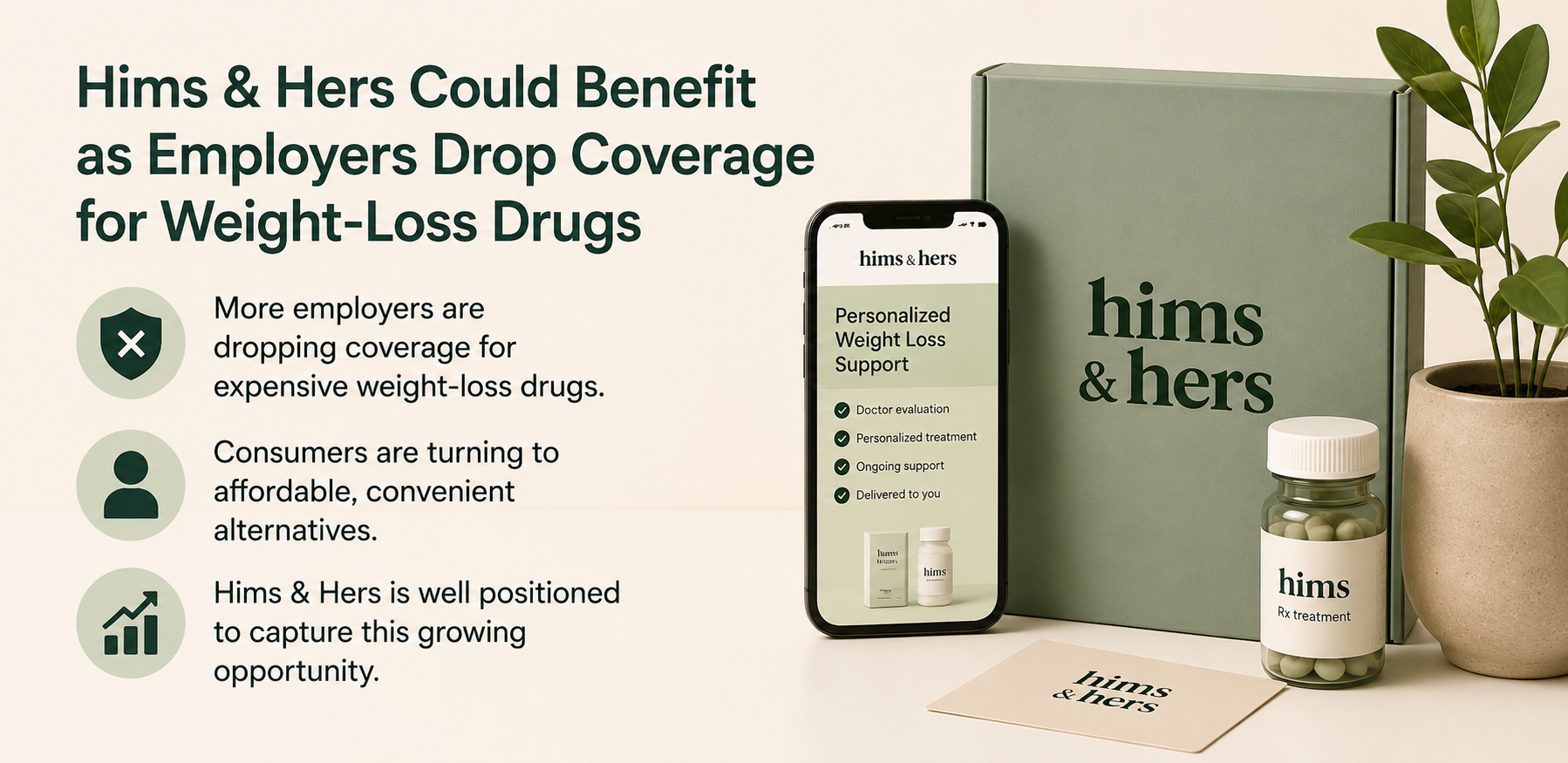
Telehealth company Hims & Hers Health could see significant growth in its weight-loss business as more U.S. employers consider stopping insurance coverage for expensive GLP-1 obesity drugs such as Novo Nordisk's Wegovy and Eli Lilly's Zepbound beginning in 2027. Investors and analysts believe this shift could send more patients directly to telehealth platforms that offer subscription-based access to weight-loss care.
Employer-sponsored health insurance is the primary source of health coverage for more than 150 million Americans. However, the rapid increase in the use of GLP-1 medications has dramatically increased healthcare costs for employers. To control spending, some companies are choosing to remove obesity-drug coverage from their employee health plans while continuing to cover these medicines for diabetes treatment.
As insurance coverage declines, many patients are expected to pay for treatment themselves through direct-to-consumer healthcare companies like Hims, which combines online medical consultations, prescriptions, ongoing clinical support, and medication access through monthly subscriptions.
Why Employers Are Dropping Coverage
GLP-1 medications have become some of the most successful drugs ever developed for obesity treatment. Clinical studies have shown they can help patients lose substantial amounts of weight while also improving conditions such as:
- Type 2 diabetes
- High blood pressure
- Heart disease risk
- Sleep apnea
- Metabolic health
As more people qualify for treatment and remain on therapy for extended periods, employer healthcare costs have risen sharply. According to the Business Group on Health, around 43% of employers covered weight-loss GLP-1 drugs in 2025. While coverage levels are expected to remain similar in 2026, about 10% of employers that currently provide coverage say they intend to eliminate that benefit in 2027 because of rising costs.
Many employers believe that although manufacturers have reduced direct cash prices for some GLP-1 drugs, the overall cost of covering large employee populations remains difficult to sustain.
Why Hims Could Benefit
Hims & Hers has become one of the largest telehealth providers offering weight-loss treatment in the United States. Rather than relying entirely on insurance reimbursement, the company focuses on a direct-to-consumer model. Patients typically subscribe online, complete a medical consultation with a licensed provider, and receive ongoing clinical support through the platform.
This approach allows patients whose insurance no longer covers obesity medication to continue treatment by paying directly. Analysts believe this business model could become increasingly attractive as employer-sponsored coverage declines. Because patients pay monthly subscriptions, Hims also generates recurring revenue rather than relying on one-time medication sales. This creates a predictable business model that investors generally view favorably.
Hims' Growing Weight-Loss Business
Weight-loss treatments have quickly become one of Hims' fastest-growing businesses. According to analysts:
- About one-third of the company's revenue already comes from its weight-loss business.
- Analysts expect that percentage to continue growing over the next several years.
- Wall Street estimates Hims will generate approximately $2.89 billion in revenue during 2026, increasing to roughly $3.45 billion in 2027.
The company has also built a strong subscription model. Industry analysts estimate that approximately 70% to 80% of new GLP-1 customers continue renewing their subscriptions each month, suggesting many patients remain on treatment long term.
Partnership with Novo Nordisk
Earlier this year, Hims expanded its relationship with Novo Nordisk, one of the world's largest diabetes and obesity drug manufacturers. Under the partnership, Hims offers Novo's branded weight-loss medicines through its platform while continuing to provide personalized treatment programs and clinical support for eligible patients. Novo executives have described Hims as one of the company's highest-volume telehealth partners in the United States.
For pharmaceutical companies, telehealth providers offer access to millions of patients who are already comfortable receiving healthcare digitally. Rather than building entirely new direct-to-consumer platforms themselves, drug manufacturers can partner with companies that already have established patient relationships. This trend is expected to continue as more healthcare services move online.
Why Telehealth Is Becoming More Important
Telehealth became widely adopted during the COVID-19 pandemic, but its growth has continued well beyond that period. Today, many patients use telehealth platforms for weight management, mental health services, primary care, sexual health, hair loss treatment, and chronic disease management. The convenience of virtual appointments, home delivery of medications, and ongoing digital support has made telehealth attractive to many consumers.
For obesity care, telehealth can simplify what has traditionally required multiple in-person visits by allowing patients to complete consultations, receive prescriptions, and schedule follow-up appointments online. This convenience is one reason many analysts believe telehealth companies could continue gaining market share.
Challenges Still Remain
Despite the positive outlook, Hims still faces several challenges. The company recently had to adjust its business after federal regulators tightened rules governing compounded versions of GLP-1 drugs. That transition affected sales and contributed to weaker-than-expected quarterly results earlier in the year.
Competition is also increasing. Other telehealth companies, including Noom, Ro, and Ivim Health, are expanding their own obesity-treatment programs and expect demand to continue growing as prices decline and more oral GLP-1 medications enter the market. At the same time, pharmaceutical companies are launching their own direct-to-consumer programs, creating additional competition for patient relationships. Even so, analysts believe Hims' large subscriber base and recurring subscription model provide a strong competitive advantage.
Why This Matters
The obesity treatment market is undergoing a major transformation. Instead of relying primarily on employer-sponsored insurance, the market is gradually shifting toward direct-to-consumer healthcare, where patients choose and pay for treatment themselves. This represents a significant change in how obesity care is delivered. For patients, losing insurance coverage may increase out-of-pocket costs, but telehealth platforms could provide additional treatment options and easier access to medical care. For companies like Hims, the shift could create a substantial business opportunity as millions of Americans look for affordable alternatives outside traditional insurance plans. The trend also reflects a broader change across healthcare, where digital health platforms are playing a larger role in delivering ongoing care for chronic conditions.
Key Takeaways
- More U.S. employers are expected to stop covering GLP-1 weight-loss drugs beginning in 2027 because of rising healthcare costs.
- Hims & Hers could benefit as more patients seek direct-to-consumer obesity treatment.
- Weight-loss treatments already account for about one-third of Hims' revenue.
- The company has strengthened its position through a partnership with Novo Nordisk.
- Telehealth is becoming an increasingly important channel for delivering obesity care in the United States.
What This Means for Healthcare Marketers
This story highlights one of the biggest shifts currently taking place in healthcare commercialization: the movement from insurance-driven care to direct-to-consumer healthcare. For healthcare marketers, telehealth platforms are becoming powerful customer acquisition and engagement channels rather than simply virtual clinics. Companies like Hims have built long-term relationships with millions of consumers through subscription models that combine digital consultations, medication fulfillment, and ongoing care. As employer insurance coverage becomes less comprehensive, these platforms may become even more influential in how patients discover, purchase, and remain on treatment.
The story also illustrates how commercial strategy is evolving for pharmaceutical companies. Rather than relying exclusively on physicians and traditional healthcare systems, manufacturers are increasingly partnering with telehealth companies to reach patients directly. These partnerships create new opportunities for patient education, adherence programs, digital engagement, and personalized care experiences. For healthcare intelligence teams, employer benefit decisions can serve as early indicators of changing healthcare demand. Monitoring shifts in insurance coverage, patient payment behavior, telehealth adoption, and subscription healthcare models can help organizations anticipate where future healthcare spending and patient engagement are likely to move. More broadly, the article demonstrates that obesity care is no longer defined solely by breakthrough medicines. Success in this market increasingly depends on how treatments are distributed, financed, and supported throughout the patient journey, making digital healthcare platforms an increasingly important part of the healthcare ecosystem.