Instagram Head Adam Mosseri Testifies in Meta Trial Over Children's Social Media Use
What's Happening
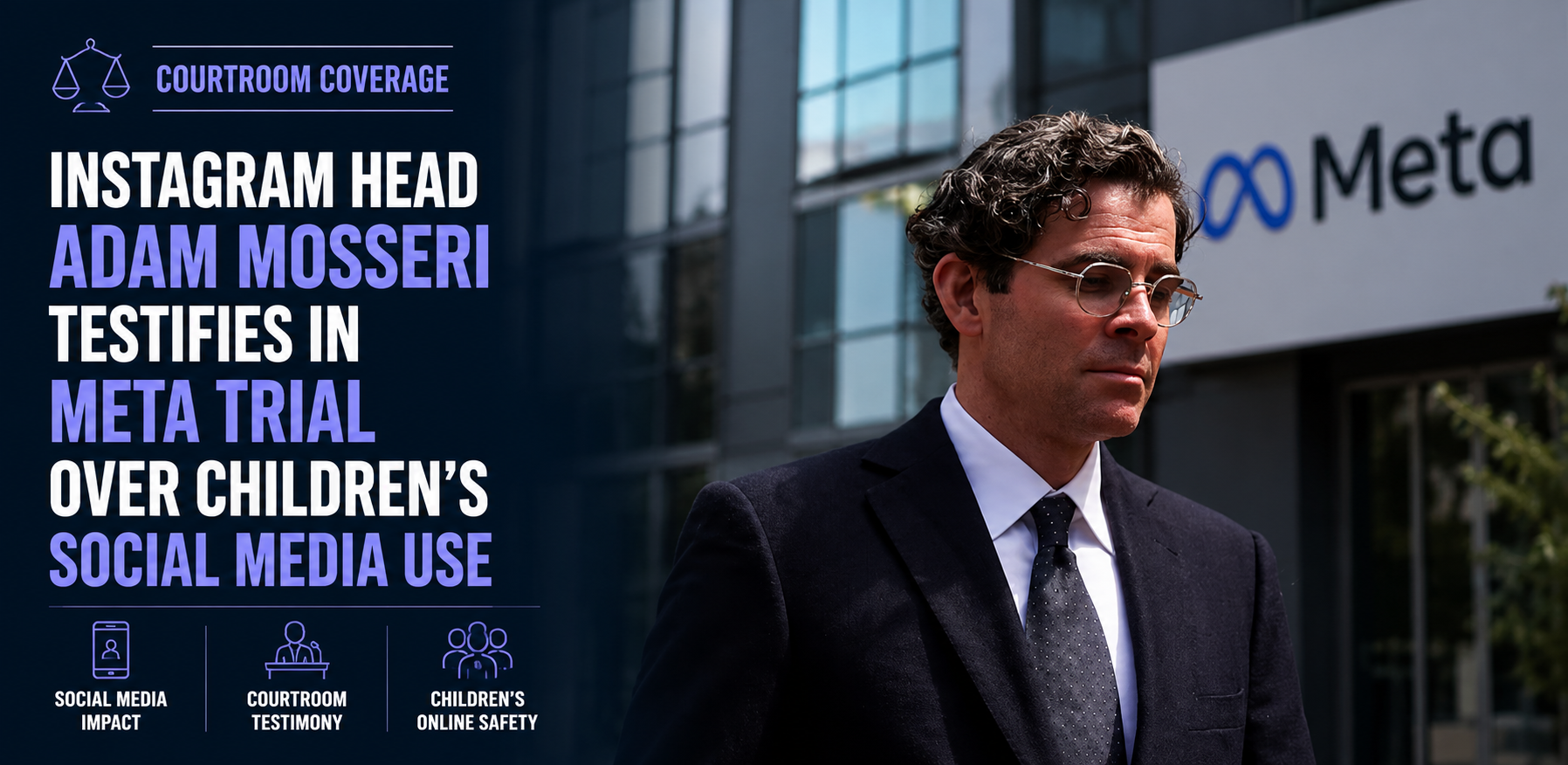
Instagram head Adam Mosseri testified in a major U.S. trial examining whether Meta deliberately designed Instagram and Facebook to be addictive to children and teenagers.
The case, brought by a coalition of 29 U.S. states, is taking place in federal court in Oakland, California. The states accuse Meta of designing its platforms to keep young users engaged while contributing to mental-health problems and improperly collecting data from children under 13. (Reuters)
The states could seek nearly $200 billion in civil penalties, along with changes to how Meta operates Facebook and Instagram. (Reuters)
What Mosseri Said
Mosseri, who has led Instagram since 2018, defended the company's efforts to protect young users.
A major focus of his testimony was Instagram's "Take a Break" feature, which encourages users to stop using the platform after spending a certain amount of time on it.
Mosseri acknowledged that only a low-single-digit percentage of teenagers were using the feature before Instagram eventually made it the default for teenagers in 2024. (Reuters)
He rejected the suggestion that Instagram intentionally delayed safety improvements to protect engagement.
The States' Allegations
The four lead states, California, Colorado, Kentucky and New Jersey, allege that Meta deliberately designed Facebook and Instagram to keep young people hooked.
They argue that the platforms contributed to:
- Anxiety.
- Depression.
- Suicidal behavior.
- Other mental-health problems among young people.
The broader coalition of 29 states also alleges that Meta violated federal law by improperly collecting and using personal information belonging to children under 13. (Reuters)
Meta has rejected the allegations and says its research does not establish a clear link between adolescents' social-media use and poor well-being. (Reuters)
Internal Safety Data Under Scrutiny
Mosseri's testimony came after Francesco Fogu, an Instagram product-design director, testified about internal research.
Fogu acknowledged that data showing teenage users were exposed to 1.5 times more bullying, suicide, hate, nudity and violent content than adults had been removed from one presentation slide intended for Instagram leadership. (Reuters)
He also testified that Instagram knew fewer teenagers would use "Take a Break" if the feature was not turned on by default.
These exchanges have become central to the states' argument that Meta knew about risks to young users but did not respond aggressively enough.
The Broader Mental-Health Debate
The case is part of a much broader U.S. legal and public-health debate over the effects of social media on children.
Meta, Google, TikTok and other platforms face thousands of lawsuits alleging that their products contribute to youth mental-health problems.
Earlier this year, a California jury found Meta and Google's parent company Alphabet negligent in designing platforms that harmed a young user and awarded $6 million in damages. (Reuters)
Meta is also facing other state-level cases, including a major New Mexico case in which a judge ordered the company to pay $567 million over allegations concerning teenagers' mental health. (Reuters)
Why This Is a U.S. Health Story
Although the defendant is a technology company, the central issue is increasingly a U.S. public-health concern: the potential relationship between social-media use and children's mental health.
The trial could influence how technology companies approach:
- Teen safety features.
- Age verification.
- Platform design.
- Algorithmic recommendations.
- Mental-health safeguards.
- Collection of children's data.
Impact on Healthcare
- Mental Health: If courts ultimately establish that certain platform designs contribute to youth mental-health problems, the findings could influence how clinicians, researchers and policymakers approach social-media exposure among children.
- Pediatric Care: Pediatricians and mental-health professionals may increasingly need to address social-media use when assessing adolescents' behavioral and psychological health.
- Technology Companies: The case creates significant pressure on social-media platforms to demonstrate that their products are designed with children's safety in mind.
- Public Health: The litigation could contribute to broader policy discussions about whether social-media platforms should be treated partly as a youth-health and safety issue, rather than solely as a technology or consumer-protection issue.
Looking Ahead
Mosseri's testimony is expected to continue as the trial proceeds.
The trial is expected to last approximately six weeks. Jurors will issue an advisory verdict, while U.S. District Judge Yvonne Gonzalez Rogers will ultimately determine whether Meta is liable and, if so, what penalties or changes should apply. (Reuters)
Why This Matters
This is a U.S. health-related story because the litigation directly concerns the potential effects of social-media platforms on children's mental health and safety.
It also represents one of the largest legal tests yet of whether technology companies can be held responsible for the health consequences associated with the design and operation of their platforms. (Reuters)
Key Takeaways
- Instagram chief Adam Mosseri testified in the Meta youth-social-media trial.
- 29 U.S. states are suing Meta over alleged harms to children and teenagers. (Reuters)
- Mosseri defended Instagram's youth-safety measures.
- He acknowledged that only a low-single-digit percentage of teenagers used "Take a Break" before it became a default feature.
- An Instagram design executive acknowledged that potentially concerning youth-safety data had been removed from an internal presentation slide. (Reuters)
- The states could seek nearly $200 billion in penalties.
- The case could influence future regulation and safety requirements for social-media platforms used by children.
What This Means for Healthcare Marketers
The case creates relevance for behavioral health, adolescent mental health, digital health, pediatric care, health research and population health. As social-media exposure becomes increasingly connected to discussions around youth well-being, healthcare organizations may need stronger ways to identify, understand and address digital-behavior-related health risks.