Intuitive Surgical Shares Fall as Insurance Changes Renew Debate Over Medical Device Demand
What's Happening
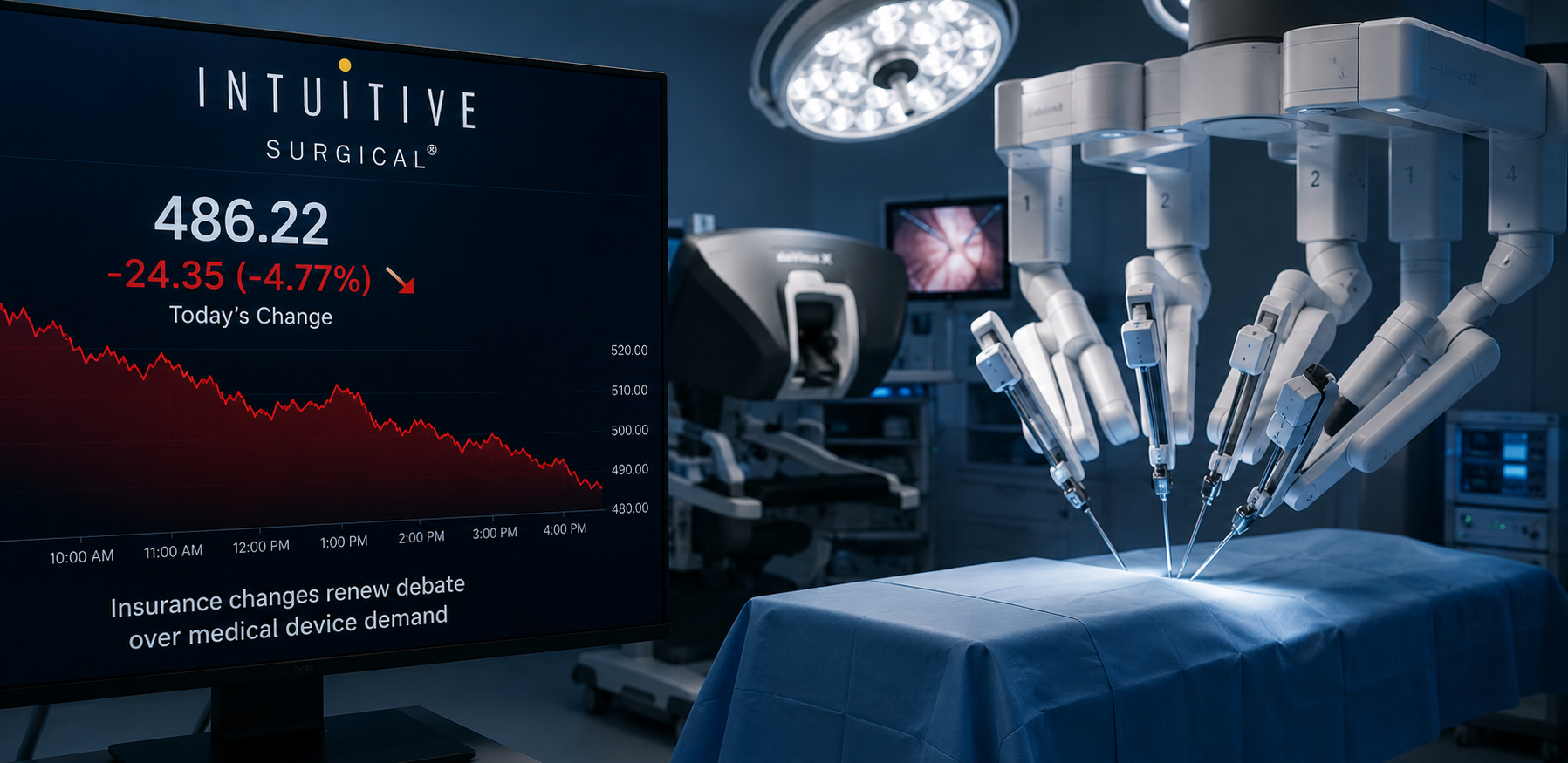
Shares of Intuitive Surgical, the maker of the widely used da Vinci robotic surgical system, fell sharply after the company warned that changes to Affordable Care Act (ACA), or Obamacare, insurance coverage could reduce demand for certain elective surgeries in the United States.
Although the company maintained its full-year global procedure growth forecast, investors were concerned after executives said some patients may be delaying non-urgent surgeries because of changes in insurance coverage and rising premiums following the expiration of enhanced ACA subsidies introduced during the COVID-19 pandemic. The stock fell about 13%, its largest one-day decline in more than two years.
The announcement reignited an industry-wide debate over whether declining insurance coverage could slow growth across the medical technology sector, particularly for companies whose products are used primarily in elective procedures.
What Is Intuitive Surgical?
Intuitive Surgical is one of the world's leading medical technology companies specializing in robot-assisted surgery.
Its flagship da Vinci Surgical System enables surgeons to perform minimally invasive procedures using robotic instruments controlled from a surgical console.
The technology is commonly used in:
- General surgery.
- Urology.
- Gynecology.
- Colorectal surgery.
- Thoracic surgery.
- Bariatric (weight-loss) surgery.
Rather than replacing surgeons, the robotic platform provides enhanced precision, improved visualization, and greater dexterity during complex procedures.
Why Insurance Coverage Matters
Many surgical procedures performed using robotic systems are elective, meaning they are medically necessary but can often be scheduled weeks or months in advance.
When patients experience:
- Higher insurance premiums.
- Loss of health coverage.
- Increased out-of-pocket costs.
- Financial uncertainty.
they may choose to postpone non-emergency procedures until coverage improves or finances become more manageable.
According to Intuitive Surgical, customer feedback suggests that changing insurance dynamics may be influencing when some patients move forward with surgery rather than eliminating demand altogether.
What Changed Under the Affordable Care Act?
During the COVID-19 pandemic, the U.S. government expanded financial assistance that helped millions of Americans purchase health insurance through Affordable Care Act marketplaces.
As those enhanced subsidies expired:
- Some individuals faced significantly higher monthly premiums.
- Others lost marketplace coverage altogether.
- Hospitals reported an increase in uninsured patients.
- Some healthcare providers observed slower growth in elective procedures.
Earlier in the week, hospital operator HCA Healthcare also reported softer surgical volumes, while Abbott Laboratories argued that concerns about widespread declines in medical technology demand may be overstated.
Procedure Growth Remains Strong—But Slower
Despite investor concerns, Intuitive Surgical continues to report overall growth.
The company maintained its expectation that worldwide procedures performed using da Vinci systems will increase 13.5% to 15.5% during 2026.
However, second-quarter procedure growth slowed to 12%, compared with 14% in the previous quarter.
Executives attributed much of the slowdown to procedures that patients can safely delay, while more urgent surgeries remained relatively stable.
Why Investors Reacted
Medical device companies depend heavily on procedure volumes because hospitals purchase equipment, instruments, and related services based on how frequently those procedures are performed.
If elective surgeries slow:
- Hospitals may delay purchasing new equipment.
- Instrument usage may decline.
- Service revenue could grow more slowly.
- Investors may lower future revenue expectations.
Although Intuitive maintained its annual guidance, the suggestion that insurance coverage changes could affect procedure timing led investors to reassess growth expectations across the broader medtech industry.
Shares of other medical device companies, including Stryker, Boston Scientific, and Medtronic, also declined following the announcement.
Is This a Temporary Slowdown?
Some analysts believe the market reaction may have been excessive.
Their reasoning is that many of the affected procedures are deferred rather than cancelled.
Patients who postpone surgeries because of insurance costs may still require treatment later, meaning demand could shift into future quarters rather than disappear entirely.
Others argue that continued uncertainty surrounding insurance enrollment makes forecasting future procedure volumes more difficult.
The coming quarters will likely provide a clearer picture of whether current trends represent a temporary delay or a longer-term change in healthcare utilization.
Industry Impact
- Medical Device Manufacturers: Companies that depend on elective procedure volumes may face greater uncertainty if insurance enrollment continues to decline.
- Hospitals: Healthcare providers may experience fluctuations in surgical scheduling as patients adjust to changing insurance costs and coverage.
- Health Insurers: Insurance policy changes can influence when patients seek treatment, affecting utilization across multiple areas of healthcare.
- Patients: Higher out-of-pocket healthcare costs may cause some individuals to postpone non-emergency procedures, potentially delaying treatment for chronic conditions.
Why This Matters
The decline in Intuitive Surgical's shares illustrates how healthcare policy can quickly influence investor sentiment and the broader medical technology market.
While demand for innovative surgical technologies remains strong over the long term, access to health insurance continues to play a critical role in determining when patients receive care. Even modest changes in insurance coverage can affect hospital procedure volumes, purchasing decisions, and financial expectations for medical device manufacturers.
The situation also highlights the close connection between healthcare policy, patient affordability, and medical innovation. As policymakers continue debating insurance reforms, healthcare companies will closely monitor whether changes in coverage translate into lasting shifts in demand for elective care.
Key Takeaways
- Intuitive Surgical's shares fell after the company warned that changes to Affordable Care Act coverage could delay some elective surgeries.
- The company maintained its full-year global procedure growth forecast despite the warning.
- Procedure growth slowed to 12% in the second quarter as some patients postponed non-urgent surgeries.
- Concerns spread across the medical technology sector, affecting several other medtech companies.
- Analysts remain divided on whether the slowdown represents deferred demand or a longer-term trend.
What This Means for Healthcare Marketers
The market reaction to Intuitive Surgical's results demonstrates how closely healthcare demand is tied to insurance coverage and patient affordability. Even highly innovative medical technologies can experience short-term fluctuations when changes in reimbursement or insurance enrollment influence when patients seek care. Organizations serving providers should continue monitoring policy developments alongside traditional market indicators.
For healthcare marketers, the story reinforces the importance of communicating clinical value and long-term patient outcomes, particularly during periods of healthcare policy uncertainty. Providers and health systems increasingly evaluate new technologies not only on innovation but also on their ability to deliver measurable value in an evolving reimbursement environment.
For healthcare intelligence teams, the development highlights the need to monitor healthcare policy, insurance enrollment, hospital utilization, and procedure volumes together rather than in isolation. These interconnected signals can provide early insight into shifts that may influence medical device adoption, capital investment, and future healthcare demand.