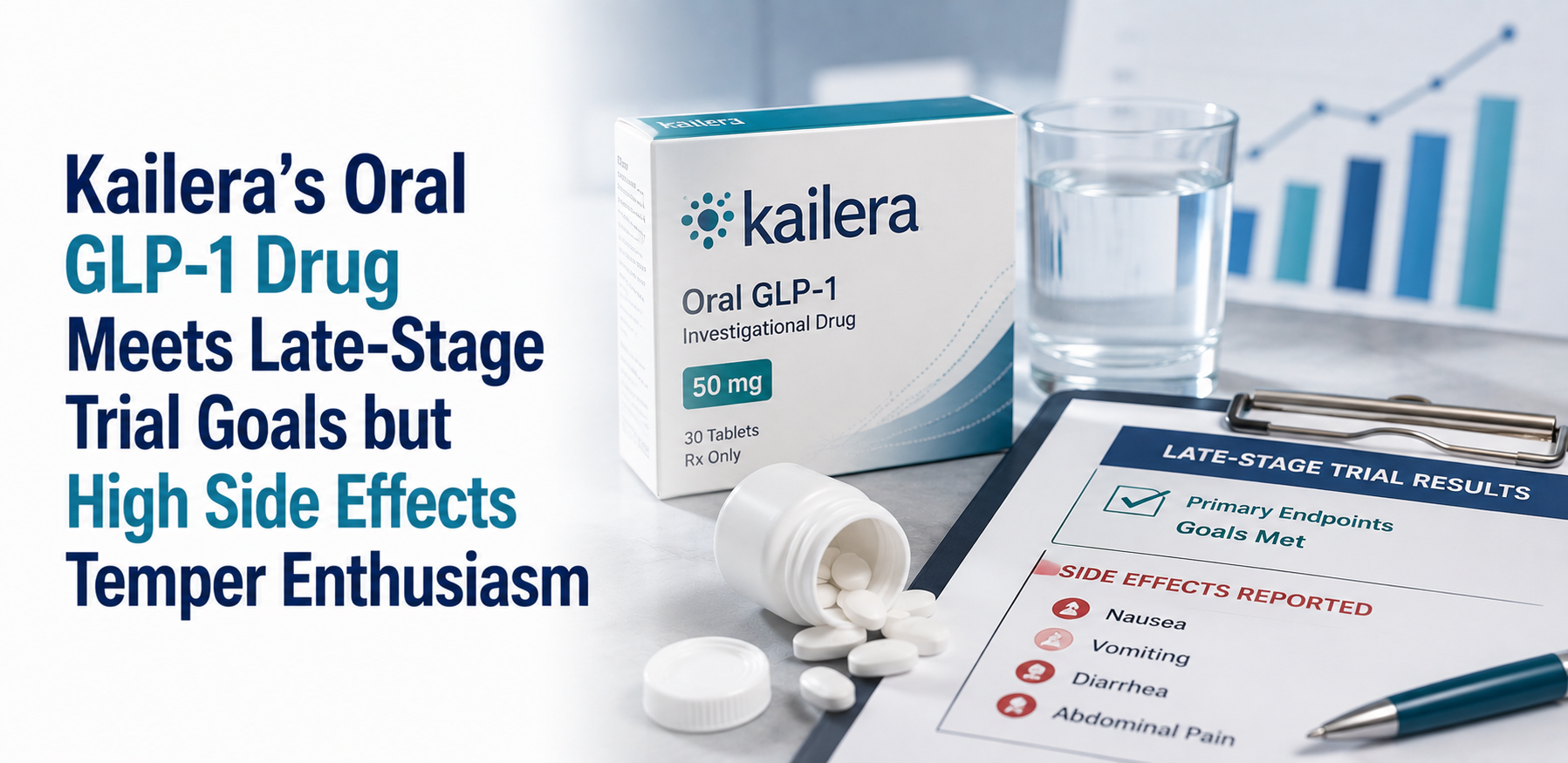
Kailera's Oral GLP-1 Drug Meets Late-Stage Trial Goals but High Side Effects Temper Enthusiasm
What's Happening
Kailera Therapeutics announced that its experimental oral GLP-1 weight-loss drug HRS-7535 successfully met the primary goals of two late-stage clinical trials conducted in China for patients with obesity and type 2 diabetes. The results demonstrate that the once-daily pill can produce meaningful weight loss while also improving blood sugar control.
However, the positive efficacy results were overshadowed by a high rate of gastrointestinal side effects. Roughly 70% of patients experienced nausea, while more than 65% experienced vomiting, substantially higher than patients who received placebo. Following the announcement, Kailera's shares fell about 10% as investors questioned whether the drug's tolerability would be competitive in an increasingly crowded obesity treatment market.
The results highlight an important reality in today's obesity drug race: achieving strong weight loss alone is no longer enough. Companies must also demonstrate that patients can comfortably remain on treatment long enough to realize those benefits.
What Is HRS-7535?
HRS-7535 is an oral GLP-1 receptor agonist, a type of medication designed to mimic the natural hormone glucagon-like peptide-1 (GLP-1). GLP-1 medications help patients lose weight by:
- Reducing appetite
- Slowing stomach emptying
- Increasing feelings of fullness
- Improving blood sugar control
- Reducing calorie intake
Unlike injectable GLP-1 therapies, HRS-7535 is taken as a once-daily pill, making it potentially more convenient for patients who prefer oral medication over injections. The drug is being developed by Jiangsu Hengrui Pharmaceutical in China, while Kailera holds rights for development outside Greater China.
What Did the Clinical Trials Show?
The company reported positive results from two separate late-stage studies.
Obesity Trial: Patients receiving HRS-7535 achieved up to 10.9% average weight loss after 44 weeks and up to 11.1% average weight loss after 50 weeks. The study successfully met its primary efficacy endpoint, demonstrating statistically significant weight reduction compared with placebo.
Type 2 Diabetes Trial: In patients with diabetes, HRS-7535 also met its primary objective. The drug was shown to be non-inferior to AstraZeneca's dapagliflozin in lowering HbA1c, an important measure of long-term blood glucose control. Together, the studies suggest the medicine has potential for treating both obesity and diabetes.
Why Investors Focused on Side Effects
Although the efficacy results were encouraging, investors paid much closer attention to the drug's tolerability. According to the trial results:
- Around 70% of patients reported nausea.
- More than 65% experienced vomiting.
By comparison, placebo patients reported nausea and vomiting rates of only 16.2% and 4.5%, respectively. These side effects are common across the GLP-1 drug class because the medicines intentionally slow digestion. However, if symptoms become severe, patients may stop taking the medication, miss doses, require dose reductions, or experience lower long-term treatment success. Because obesity treatment often requires long-term use, tolerability has become one of the most important factors influencing physician prescribing decisions.
Why Tolerability Is Becoming a Competitive Advantage
The obesity drug market has evolved rapidly over the past few years. Initially, companies competed primarily on how much weight patients lost. Today, competition has expanded to include several additional factors:
- Weight-loss effectiveness
- Side-effect profile
- Ease of administration
- Dosing schedule
- Long-term safety
- Manufacturing capacity
- Insurance coverage
As more GLP-1 drugs reach the market, physicians increasingly compare therapies based not only on efficacy but also on how well patients tolerate treatment. Analysts noted that reducing nausea and vomiting substantially would make HRS-7535 much more competitive.
Why Oral GLP-1 Drugs Are Important
Most of today's leading obesity medicines, including earlier versions of Wegovy and Zepbound, are injectable therapies. Many companies are now developing oral alternatives because they could:
- Improve patient convenience.
- Increase treatment acceptance.
- Simplify distribution.
- Reduce barriers to starting therapy.
- Expand access globally.
Several major pharmaceutical companies are racing to commercialize oral GLP-1 medicines, making this one of the industry's most competitive therapeutic areas.
What's Next for Kailera?
Although the late-stage Chinese trials have been completed, Kailera is continuing international development. The company launched a global mid-stage clinical trial of HRS-7535 earlier this year, with results expected in 2027. These studies will help determine whether the drug produces similar results in broader patient populations outside China. Researchers will also continue evaluating strategies that may improve tolerability, including different dosing schedules and gradual dose escalation.
Industry Impact
- Pharmaceutical Companies: The results reinforce that future obesity therapies will compete on both effectiveness and tolerability.
- Healthcare Providers: Physicians will increasingly evaluate side-effect profiles when selecting among numerous GLP-1 treatment options.
- Investors: The market reaction demonstrates that strong efficacy alone may not be sufficient if adverse events limit patient adherence.
- Patients: The continued development of oral GLP-1 therapies could eventually provide more treatment choices beyond injectable medications.
Why This Matters
Kailera's trial results demonstrate both the promise and the challenges of next-generation obesity medicines. The drug achieved meaningful weight loss and improved blood sugar control, confirming that additional oral GLP-1 therapies are advancing successfully through clinical development.
At the same time, the high rates of nausea and vomiting illustrate how competitive the obesity market has become. As multiple companies develop effective weight-loss medicines, success will increasingly depend on delivering therapies that patients can comfortably use over months or years. The study also reinforces the growing importance of oral obesity treatments, which could expand access and provide patients with greater flexibility as the next generation of GLP-1 medicines enters the market.
Key Takeaways
- Kailera's oral GLP-1 drug HRS-7535 met the primary goals of late-stage obesity and diabetes trials.
- Patients achieved up to 11.1% average weight loss in the obesity study.
- The drug was non-inferior to dapagliflozin in improving blood sugar control among patients with diabetes.
- High rates of nausea and vomiting led to investor concerns despite the positive efficacy results.
- Oral GLP-1 therapies remain one of the fastest-growing areas of obesity drug development.
What This Means for Healthcare Marketers
Kailera's results illustrate how the obesity treatment market is entering a new phase of competition. Early GLP-1 therapies established that significant weight loss was achievable, but future differentiation will increasingly depend on factors such as tolerability, convenience, patient adherence, and overall treatment experience. Companies can no longer rely solely on efficacy data to distinguish their products.
For healthcare marketers, the growing shift toward oral GLP-1 therapies represents an important commercial opportunity. Oral medicines may appeal to patients reluctant to use injections, potentially expanding the addressable market while creating new positioning strategies around convenience and accessibility. At the same time, communications will need to balance efficacy claims with realistic discussions about side effects and long-term treatment adherence.
For healthcare intelligence teams, the trial highlights the importance of monitoring more than headline efficacy results. Safety profiles, patient persistence, physician prescribing preferences, and competitive benchmarking are becoming equally important indicators of commercial success. As additional oral GLP-1 candidates advance through development, organizations that closely track these factors will be better positioned to anticipate shifts within one of healthcare's fastest-growing therapeutic markets.