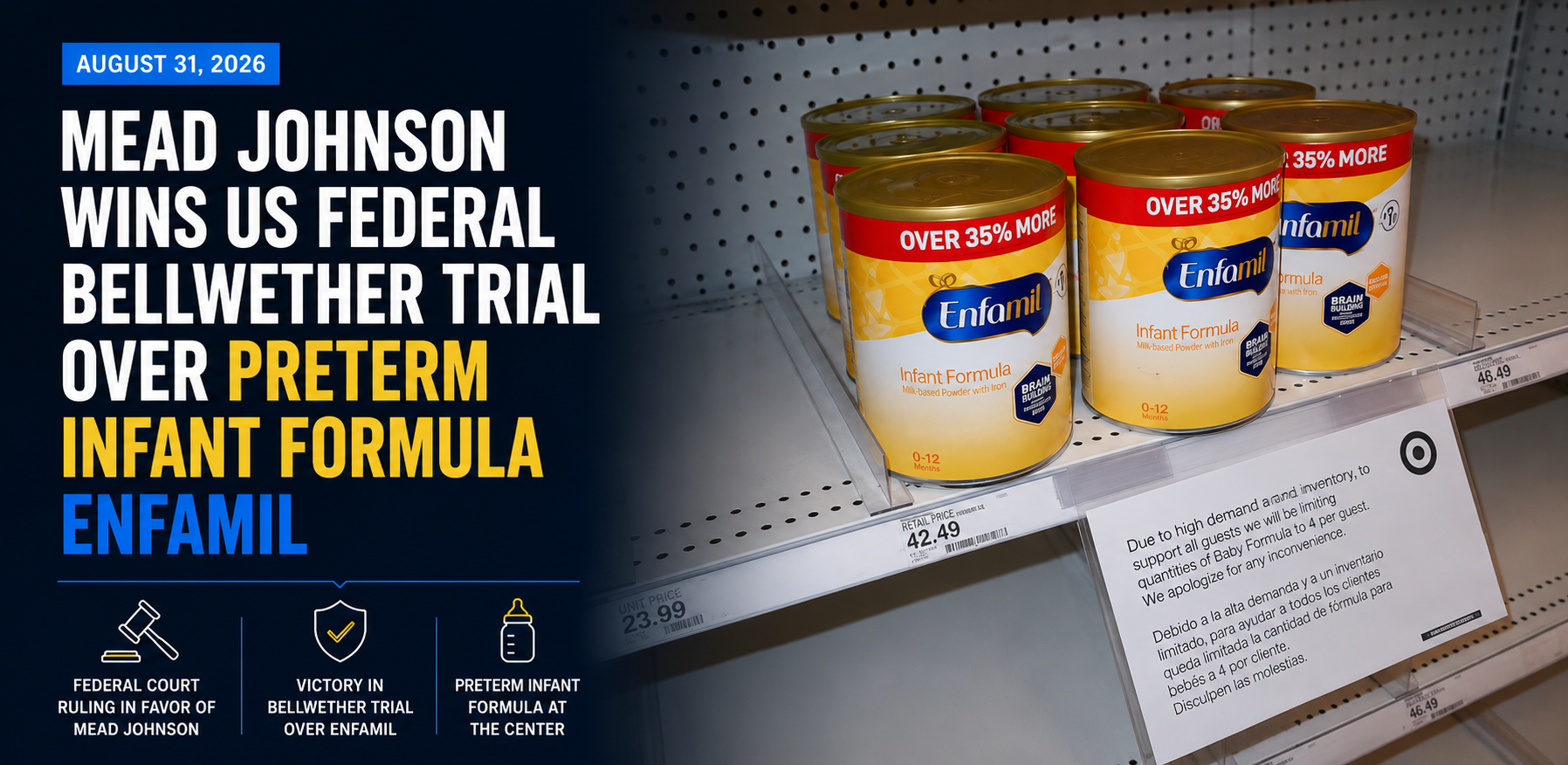
Mead Johnson Wins U.S. Federal Bellwether Trial Over Preterm Infant Formula Enfamil
What’s Happening
A U.S. federal jury has sided with Mead Johnson, the infant-formula business owned by Reckitt Benckiser, in a closely watched trial involving its Enfamil formula for premature infants.
The Illinois jury concluded that Enfamil did not cause a premature baby boy to develop necrotizing enterocolitis (NEC), a serious and potentially fatal intestinal disease that can affect premature newborns.
The case was brought by Alexis Inman, whose son was born prematurely at 29 weeks and died shortly after birth. Inman alleged that Mead Johnson failed to warn her or her son's doctors that Enfamil's premature-infant formula could cause NEC.
The verdict represents an important win for Mead Johnson because it is one of a large number of lawsuits brought against the company and Abbott Laboratories, which makes Similac, over allegations linking preterm infant formula to NEC.
What Is Necrotizing Enterocolitis?
A serious disease affecting premature babies
Necrotizing enterocolitis, commonly called NEC, is a dangerous bowel disease that primarily affects premature and medically fragile newborns.
The disease can damage intestinal tissue and become life-threatening. Because premature infants can already face significant medical complications, NEC is a major concern in neonatal intensive-care settings.
The lawsuits focus on allegations that certain cow's-milk-based premature infant formulas increase the risk of NEC compared with alternative feeding approaches.
The case centered on causation
In this particular trial, the jury was asked to determine whether Enfamil was responsible for the boy's NEC.
After considering the evidence, the jury concluded that the formula did not cause the disease.
That finding directly rejected the central allegation in Inman's lawsuit.
The Lawsuit Involved a Premature Infant
The child at the center of the case was born at 29 weeks' gestation, making him significantly premature.
His mother argued that Mead Johnson should have warned both her and his physicians about an alleged connection between its premature-infant formula and NEC.
Mead Johnson rejected that allegation, arguing that available scientific evidence does not establish that its products cause NEC. After the verdict, the company said the decision supported its position on the broader litigation.
An attorney for Inman did not immediately comment on the verdict.
This Was a Bellwether Trial
Why one case matters to thousands of lawsuits
The trial is a bellwether case, meaning it is being used as a test case within a much larger group of lawsuits.
There are nearly 1,700 similar lawsuits against Mead Johnson and Abbott Laboratories.
More than 800 cases have been centralized in an Illinois federal court, while additional lawsuits remain pending in state courts including Illinois, Missouri and Pennsylvania.
Bellwether trials can help both sides assess the strength of their arguments and the potential outcomes of future cases. They can also influence settlement discussions and litigation strategy.
That makes this verdict significant well beyond the individual family involved in the case.
Mead Johnson Has Had a Stronger Trial Record So Far
Previous cases have also favored Mead Johnson
Mead Johnson said it has no outstanding jury verdicts against it in the NEC litigation.
The company has won two previous trials and also won an appeal involving a third case.
That gives the latest verdict additional importance because it adds another successful outcome to Mead Johnson's record in this litigation.
However, the broader litigation remains unresolved, and the experience of Abbott demonstrates that individual cases can produce dramatically different outcomes.
Abbott Has Faced a Major Adverse Verdict
A $495 million verdict in 2024
The litigation has not consistently favored the formula manufacturers.
In 2024, an Illinois woman was awarded $495 million in a verdict against Abbott in another NEC-related case.
Abbott appealed that verdict and ultimately reached a $670 million settlement covering that case and about 2,000 other claims.
The contrasting outcomes show why the bellwether process is important. Different juries have reached different conclusions based on the evidence and claims presented in individual trials.
The Scientific Debate Is Central to the Litigation
Mead Johnson has maintained that scientific evidence does not establish that its infant formulas cause NEC.
After the latest verdict, the company said it strongly rejects the assertion that its products cause NEC and plans to continue defending itself against the remaining claims.
The lawsuits therefore turn not only on individual circumstances but also on questions about medical evidence, causation and whether manufacturers had an obligation to warn consumers or physicians about alleged risks.
Why This Matters to the Infant-Formula Market
The litigation is important because the products involved are used in a highly vulnerable patient population: premature infants.
Infant nutrition is an essential component of neonatal care, particularly for babies who spend weeks or months in intensive-care settings.
Any finding that a commonly used formula contributes to NEC could have major consequences for hospitals, neonatologists, parents, manufacturers and insurers.
Conversely, repeated verdicts rejecting a causal relationship can strengthen manufacturers' position and make plaintiffs' broader litigation strategy more difficult.
Potential Business Impact for Mead Johnson
The latest verdict gives Mead Johnson another favorable outcome in a litigation campaign involving potentially significant financial exposure.
Large product-liability cases can create substantial costs through legal expenses, settlements, potential damages and reputational pressure, even when companies ultimately prevail in individual trials.
A series of favorable bellwether results could reduce pressure on Mead Johnson and strengthen its negotiating position in future cases.
At the same time, the existence of thousands of outstanding claims means the company still faces considerable litigation risk.
Impact on Hospitals and Neonatal Care
The legal dispute also matters to hospitals because neonatal intensive-care units must make decisions about how premature infants are fed.
Hospitals and neonatal specialists will continue to rely on clinical evidence when determining appropriate nutrition for premature babies.
As litigation continues, healthcare providers are likely to pay close attention to emerging scientific evidence, clinical guidance and court decisions surrounding NEC and infant formula.
Looking Ahead
More NEC-related cases against Mead Johnson and Abbott are expected to continue moving through the courts.
The latest ruling provides Mead Johnson with another favorable data point, following two previous trial victories and an appellate victory.
But the litigation remains fluid. Previous cases have produced very different jury outcomes, including Abbott's major 2024 verdict and subsequent settlement.
The future of the litigation will depend on the evidence presented in individual cases, additional bellwether trials, appellate decisions and whether the companies and plaintiffs eventually pursue broader settlements.
Key Takeaways
- A federal jury in Illinois ruled in favor of Mead Johnson in a case alleging that its Enfamil premature-infant formula caused NEC.
- The jury concluded that Enfamil did not cause the premature baby's NEC.
- The child was born at 29 weeks and died shortly after birth.
- The mother alleged that Mead Johnson failed to warn her or the child's doctors about the alleged NEC risk.
- Nearly 1,700 lawsuits have been filed against Mead Johnson and Abbott Laboratories over similar allegations.
- More than 800 cases are centralized in an Illinois federal court, with others pending in state courts.
- Mead Johnson says it has won two previous trials and an appeal in the NEC litigation.
- Abbott previously faced a $495 million verdict in 2024 and ultimately settled that case and about 2,000 others for $670 million.
- The latest verdict strengthens Mead Johnson's position but does not resolve the broader litigation.
What This Means for Healthcare Marketers
This case shows how clinical evidence, litigation and brand trust can become tightly connected in healthcare.
For companies selling products used in hospitals and other clinical environments, allegations about patient safety can affect purchasing decisions, physician confidence and reputation even before a final legal resolution is reached.
Healthcare marketers therefore need to track more than product performance and sales. Clinical evidence, litigation outcomes, regulatory developments and the concerns of healthcare professionals can all become market signals that influence how a product is perceived and adopted.