For years, the hardest part of selling digital health into US healthcare wasn't the technology. Everyone already agreed remote monitoring worked. Everyone agreed virtual care and digital coaching helped people manage long-term conditions.
The problem was simpler and more annoying than that: there was often no clean way to get paid for it.
Original Medicare pays for defined activities. A visit. A test. A device. Continuous, technology-supported care doesn't fit neatly into any of those boxes, so a lot of genuinely useful programmes ran on grant money, pilot budgets, or hope.
That changed on July 5, 2026, when CMS launched the ACCESS Model.
What ACCESS actually is
ACCESS stands for Advancing Chronic Care with Effective, Scalable Solutions. It comes from the CMS Innovation Center, and three things about it matter more than the name:
It's a 10-year model, not a pilot. It runs from July 2026 through 2036. Most CMS experiments last three to five years. A decade is a very different signal about intent.
It pays for outcomes, not activities. Instead of billing for a service you delivered, you get a recurring payment for managing a patient's condition, and you only earn the full amount if their health actually improves. CMS calls these Outcome-Aligned Payments, or OAPs.
It's voluntary, and it's Original Medicare only. Medicare Advantage plans can't participate directly, though they can copy the approach in their own contracts. More on that later, because it matters more than it sounds.
The conditions covered affect more than two-thirds of people on Medicare.
How the money actually works
This is the part most write-ups skip, and it's the part that decides whether a business model works.
ACCESS is built around four clinical tracks. Each pays a set annual amount per patient:
| Track | What it covers | Initial year | Follow-on year |
|---|---|---|---|
| eCKM (early cardio-kidney-metabolic) | High blood pressure, abnormal cholesterol, obesity or overweight with central obesity, prediabetes | $360 | $180 |
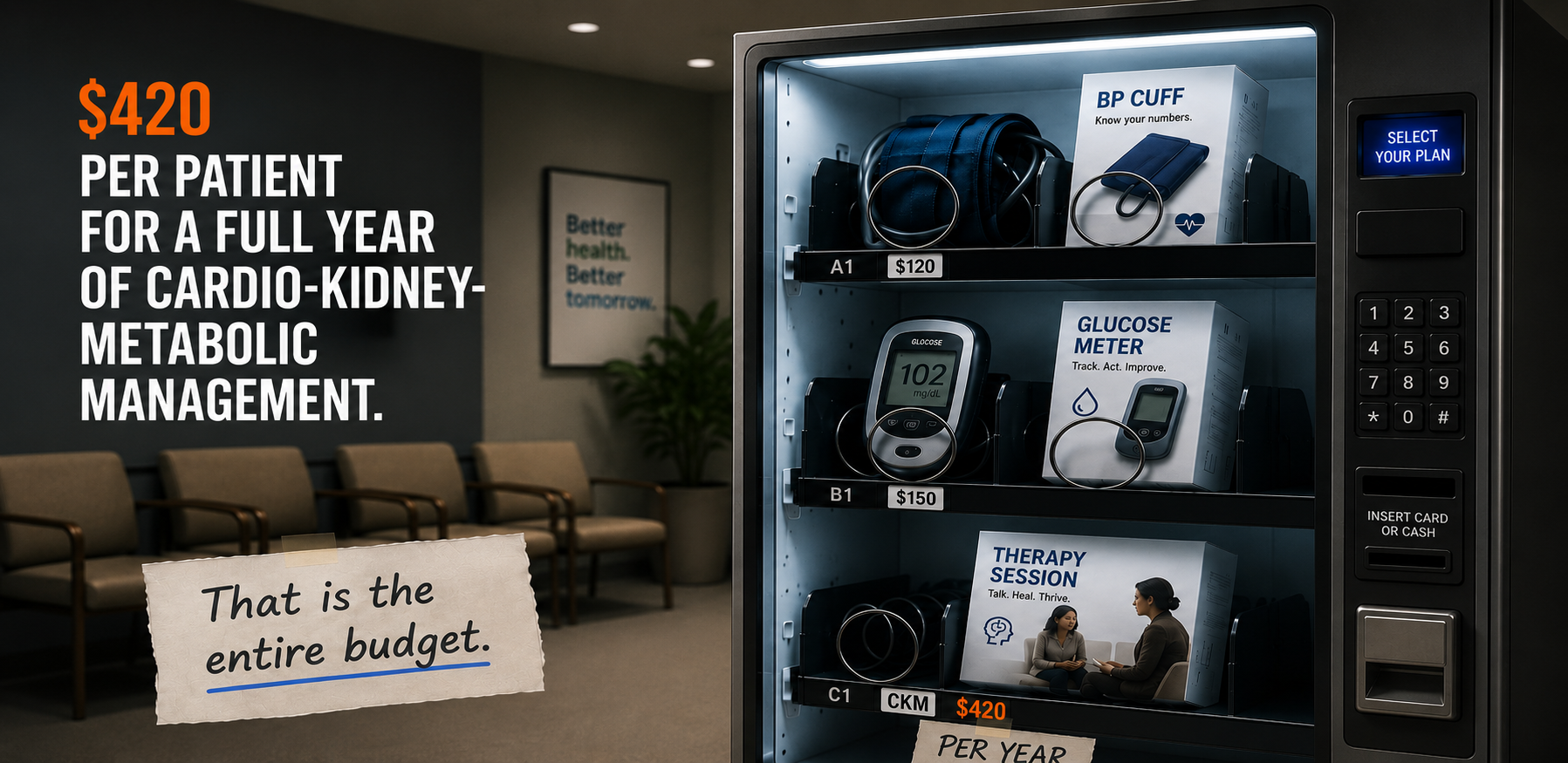
| CKM (cardio-kidney-metabolic) | Diabetes, chronic kidney disease (stage 3a or 3b), heart disease | $420 | $210 |
| MSK (musculoskeletal) | Long-term musculoskeletal pain | $180 | None |
| BH (behavioural health) | Depression and anxiety | $180 | $90 |
Patients in rural areas on the eCKM or CKM tracks carry an extra $15 in the first year, to cover the added cost of getting connected devices to them.
Those figures include both Medicare's 80% share and the patient's 20% coinsurance. Roughly, that works out to something like $7.50 to $35 per patient per month depending on the track.
Three mechanics turn those numbers into something quite different from a normal contract:
Only half the money arrives during the year. CMS pays monthly, but monthly payments are capped at 50% of the annual amount. The other half is held back and settled after the full 12-month care period ends, once outcomes are known. If you're modelling cash flow on the headline figure, you're modelling it wrong.
You don't need every patient to succeed. CMS sets an Outcome Attainment Threshold, currently 50%. If at least half your patients hit their targets, you earn 100% of the payment. That's a deliberate design choice to stop organisations cherry-picking the easiest patients.
Other people's billing can reduce your payment. There's a Substitute Spend Adjustment: if your patients go elsewhere and receive services that overlap with what you're being paid to do, your payment drops. The threshold is currently 90%.
Talk to Intent.Health →What "improvement" actually means
CMS didn't leave outcomes vague. Every track has specific, measurable targets, and a patient counts as a success if they hit either a control target or a minimum improvement target.
A few real examples:
- Blood pressure: get systolic below 130, or bring it down by 15 points
- Weight: BMI under 30 with no significant gain, or a 5% reduction
- Diabetes: HbA1c under 7.5%, or a 1 percentage point drop
- Depression: PHQ-9 score under 10, or a 5-point reduction
- Anxiety: GAD-7 score under 10, or a 4-point reduction
- Knee or hip pain: a 10-point improvement on the relevant joint score
The improvement targets are set against where each patient started, not against a universal finish line. Someone arriving with a systolic reading of 160 needs to reach 145, even though the real clinical goal is below 130. That design exists so organisations aren't punished for taking on sicker patients.
Partial success doesn't count. A patient has to hit all their required measures to be counted.
Who's already in
CMS published its accepted applicant list, and it reads less like a Medicare roster and more like a digital health conference directory. The published list has grown past 150 to around 187 organisations, and includes names like Noom, Verily, Whoop, Headspace, Cadence, and SonderMind.
Two patterns in that list are worth noticing.
Most participants have never billed Medicare before. These are technology companies, not traditional providers. Every one of them has to enrol in Medicare Part B and appoint a physician Clinical Director. That's a real operational lift, and it's where a lot of them will need help.
Almost nobody picked just one track. About three quarters of participants signed up for two or more, and roughly a quarter took all four. The most common pairing is eCKM plus CKM. Behavioural health shows up on more than 100 entries, and the large majority of those organisations also run a physical health track. The market is treating mental and physical health as one problem, not two.
The rules that quietly reshape business models
A few requirements deserve more attention than they usually get.
Exclusivity. During an active care period, an ACCESS participant (and any financially affiliated entity) generally cannot bill regular Medicare fee-for-service claims for other services to that same patient. Only ACCESS G-codes. That's a significant commitment, not a side experiment you bolt onto existing revenue.
Devices and drugs are billed separately. Medications, lab tests, imaging, and durable medical equipment sit outside the OAP and are billed by financially unaffiliated entities. Device and lab suppliers also can't be ACCESS participants themselves. So if you make hardware, your route in is as a partner to a participant, not as a participant.
The data burden is real. Baseline measurements must be submitted within 60 days through an API, then quarterly, then at the end of the period. Some measures have tight validity windows: blood pressure and weight readings must be no more than 15 days old. That's a genuine engineering requirement, and a genuine product opportunity.
Talk to Intent.Health →Why this matters beyond Medicare
Here's the fact that changes the size of this story.
Private payers covering roughly 165 million people across Medicare Advantage, Medicaid, and commercial plans have committed to aligning with the ACCESS payment approach, many of them starting this year. CMS is actively helping that along by publishing standard G-codes any payer can use, provider agreement templates, and shared reporting infrastructure.
So this isn't only a Medicare programme. It's a template that a large chunk of the commercial market has already agreed to copy.
What this means if you sell into healthcare
The applicant list is the cleanest target list you'll get all year. It's a public roster of organisations that have formally committed to outcome-based, technology-supported care. Not organisations that said something enthusiastic in a webinar. Ones that filed paperwork.
But it's a starting point, not an answer. The list doesn't include organisations that applied and were rejected, that plan to apply later, or that are quietly building the same capability without joining. Those are often better prospects, because they have the same need and no solution yet.
The economics tell you who's under pressure. At $180 to $420 per patient per year, with half the payment held back and outcomes required to release it, participants need volume and they need efficiency. Anything that improves outcome attainment rates or reduces the cost of measurement collection has an unusually clear ROI story right now.
Follow the operational gaps. Most participants have never enrolled in Medicare Part B, never built a FHIR reporting pipeline, and never had to collect a blood pressure reading within a 15-day validity window at scale. Those gaps are visible, dated, and urgent.
Public outcome data is coming. CMS will publish risk-adjusted results for every participant in a public directory. That's a competitive intelligence source that doesn't exist in most of healthcare, and it will show you exactly who's struggling.
And know which entity actually decides. A health system's participation might be run centrally, or by a single service line, or by a partner organisation entirely. At an IDN or a corporate owner, that call often sits at the parent level rather than the hospital. Working out who owns the decision, and who feels the pain of missing an outcome target, is usually the difference between a meeting and a deal. That's what we work on at Intent.Health, but the principle holds whatever tools you use.
What to do in the next quarter
- Cross-reference the CMS accepted applicant list against your existing accounts and pipeline
- Work out which of the four tracks your product actually supports, and be specific about it
- Rewrite your ROI story in the model's language: outcome attainment rate, not engagement or usage
- If you sell hardware, identify which participants need a device partner, since they can't be one themselves
- Watch for the January 1, 2027 cohort, because organisations that missed the first deadline are deciding now
- Track the private payer rollout, since that's where the volume eventually sits
FAQ
What is the CMS ACCESS Model? A voluntary Medicare payment model that pays healthcare organisations for improving chronic conditions using technology-supported care, rather than paying them for individual visits or services.
When did it start and how long does it run? It launched on July 5, 2026 and runs for 10 years, through 2036.
What does ACCESS stand for? Advancing Chronic Care with Effective, Scalable Solutions.
What is an Outcome-Aligned Payment (OAP)? A recurring payment for managing a patient's condition over a 12-month care period, where the full amount is only earned if measurable health outcomes are achieved.
Which conditions are covered? Four tracks: early cardio-kidney-metabolic (high blood pressure, abnormal cholesterol, obesity, prediabetes), cardio-kidney-metabolic (diabetes, chronic kidney disease, heart disease), musculoskeletal pain, and behavioural health (depression and anxiety).
How much does it pay? Between $180 and $420 per patient for the first year depending on the track, dropping to between $90 and $210 in a follow-on year. Rural patients on the two metabolic tracks add $15. Roughly $7.50 to $35 per patient per month.
When does the money actually arrive? Monthly payments are capped at half the annual amount. The remaining half is held back and settled after the 12-month care period, once outcomes are confirmed.
Do all patients need to improve? No. The current Outcome Attainment Threshold is 50%, so if at least half of a participant's patients hit their targets, the participant earns full payment.
What counts as an outcome? Specific clinical or patient-reported targets. For example, lowering systolic blood pressure by 15 points or getting it under 130, a 5% weight reduction, or a 5-point drop in a PHQ-9 depression score.
Who can participate? Organisations enrolled in Medicare Part B as providers or suppliers, with a designated physician Clinical Director. Device, prosthetics, and laboratory suppliers are excluded.
Can Medicare Advantage plans join? Not directly. ACCESS is being tested in Original Medicare. However, private payers covering around 165 million people have committed to adopting a similar payment approach in their own plans.
How do patients join? They sign up directly with a participating organisation, either on their own or after a referral. A referral isn't required, and their standard Medicare coverage and rights don't change.
How many organisations are participating? CMS has accepted more than 150, with the published list now around 187 entries, including Noom, Verily, Whoop, Headspace, and SonderMind.
Can you still apply? Yes. CMS reviews applications on a rolling basis through 2033, with periodic start dates. Organisations that missed the first window are being considered for later start dates.
Why should commercial teams care? The accepted applicant list is a public, verified list of organisations committed to outcome-based digital care, the payment mechanics tell you exactly what economic pressure they're under, and CMS will publish performance results for every participant.
This post is a general overview and isn't legal, billing, or reimbursement advice. Model rules can change, so check the official CMS ACCESS Model pages and Request for Applications for current requirements.
Sources
- CMS Innovation Center, "ACCESS (Advancing Chronic Care with Effective, Scalable Solutions) Model"
- CMS Innovation Center, "ACCESS Model Payment Amounts and Performance Targets" (PDF)
- CMS Innovation Center, "ACCESS Model Accepted Applicants"
- CMS Innovation Center, "ACCESS Model Request for Applications" (PDF)
- CMS Innovation Center, "ACCESS for Primary Care Providers and Referring Clinicians"
- Holland & Knight, "CMMI Launches Voluntary Payment Model for Qualifying Chronic Conditions with Tech-Enabled Care"
- Manatt, "ACCESS Unlocked: CMS's Bold New Model for Tech-Enabled Chronic Care Management"
- Healthcare Dive, "CMS accepts more than 150 providers, digital health firms for ACCESS model"
- Healthcare IT News, "CMS announces 150 participants for upcoming ACCESS model launch"
- ROOK, "ACCESS: Analysis of 187 Accepted Applicants" (independent analysis, used for the track breakdown)
- Behavioral Health Business, "Early Participants of CMS ACCESS Model See Program as Accelerant for Value-Based Care"