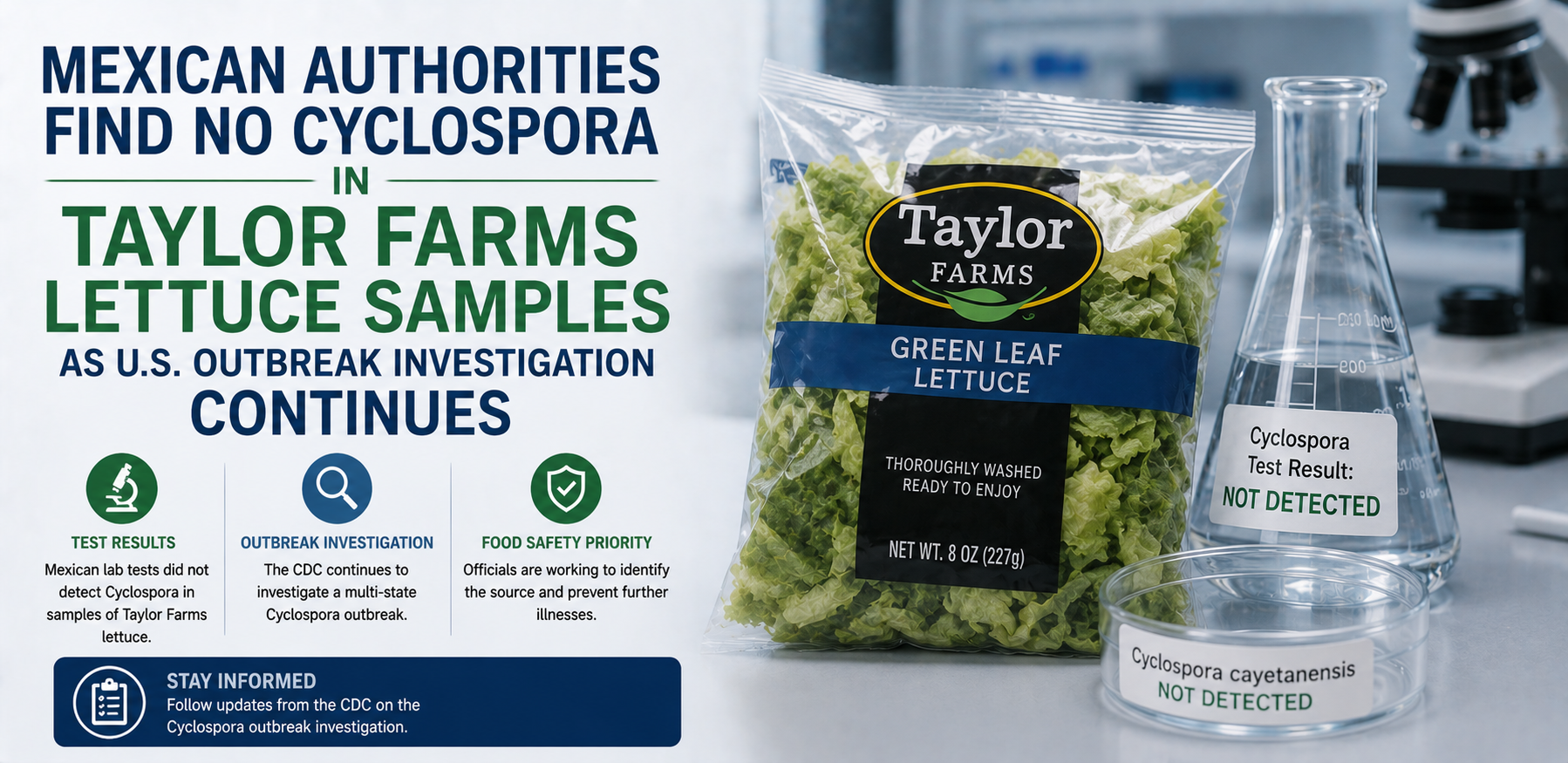
Mexican Authorities Find No Cyclospora in Taylor Farms Lettuce Samples as U.S. Outbreak Investigation Continues
What's Happening
Mexican food safety authorities have reported that laboratory testing found no evidence of Cyclospora contamination in lettuce samples collected from farms supplying Taylor Farms, one of North America's largest fresh produce companies.
The testing was conducted after media reports and ongoing public health investigations linked a multistate Cyclospora outbreak in the United States to fresh produce. Despite the negative test results, the investigation into the outbreak remains active, and U.S. health officials have not yet identified a definitive source of contamination.
The announcement underscores one of the greatest challenges in foodborne illness investigations: negative laboratory findings do not necessarily eliminate a product or supplier from consideration, particularly when contaminated food may no longer be available for testing.
Health authorities in both countries continue working to determine where the contamination originated and whether additional illnesses are connected to the outbreak.
Understanding the Current Cyclospora Investigation
Cyclospora is a microscopic parasite that causes an intestinal illness known as cyclosporiasis.
People become infected after consuming food or water contaminated with the parasite. Because Cyclospora requires time outside the human body before becoming infectious, outbreaks are generally linked to contaminated food rather than direct person-to-person transmission.
Recent U.S. cases have prompted a multistate investigation involving federal and state public health agencies.
Investigators are working to:
- Identify common food exposures among patients.
- Trace produce distribution networks.
- Collect environmental and food samples.
- Determine where contamination occurred.
- Prevent additional illnesses.
At this stage, investigators have not confirmed a single product or farm as the source of the outbreak.
Why Negative Test Results Do Not End an Investigation
Finding no Cyclospora in tested lettuce does not necessarily mean the produce was never contaminated.
Foodborne outbreak investigations often encounter several challenges.
- Short Product Lifespans: Fresh lettuce is highly perishable and is usually consumed or discarded within days. By the time investigators begin collecting samples, the contaminated batch may no longer exist.
- Uneven Contamination: Parasites are not always distributed evenly throughout a shipment. A small contaminated portion may cause illnesses while many other samples test negative.
- Environmental Factors: Rainfall, irrigation, harvesting, transportation, and storage conditions can all influence whether contamination is detected during laboratory testing.
- Sampling Limitations: Laboratories test only a limited number of samples. Even sophisticated testing cannot guarantee that contamination would be detected if only a small portion of a shipment was affected.
For these reasons, public health investigators rely on multiple sources of evidence rather than laboratory testing alone.
How Foodborne Outbreaks Are Investigated
Determining the source of a foodborne illness involves combining several different types of information.
Investigators typically examine:
- Patient interviews about recent meals.
- Grocery purchase records.
- Restaurant exposure histories.
- Supply chain distribution data.
- Farm and processing records.
- Laboratory testing.
- Environmental inspections.
This process, known as traceback investigation, helps identify where products moved through the food supply chain and where contamination may have occurred.
In many outbreaks, epidemiological evidence identifying a common food exposure proves more informative than laboratory testing of products that are no longer available.
The Importance of International Collaboration
Modern food supply chains frequently cross international borders.
Fresh produce sold in the United States may be grown, harvested, processed, or packaged in multiple countries before reaching consumers.
As a result, food safety investigations often require cooperation among:
- National public health agencies.
- Food safety regulators.
- Agricultural authorities.
- Laboratory networks.
- Produce growers.
- Food distributors.
The collaboration between Mexican authorities and U.S. investigators demonstrates how international partnerships help improve outbreak response and strengthen confidence in food safety systems.
Sharing laboratory findings, production records, and traceback information allows investigators to evaluate potential sources more quickly while avoiding unnecessary conclusions.
Industry Impact
- Produce Growers: Fresh produce companies face increased scrutiny whenever large foodborne outbreaks occur, even before a source is confirmed. Growers may conduct additional internal testing and review agricultural practices while investigations continue.
- Food Manufacturers and Distributors: Companies throughout the produce supply chain may increase documentation, environmental monitoring, and traceability efforts to support public health investigations and demonstrate compliance with food safety standards.
- Retailers: Supermarkets closely monitor public health advisories to determine whether products require removal from store shelves. Clear communication with consumers becomes especially important when investigations are ongoing but no recall has been issued.
- Public Health Agencies: Health authorities continue balancing the need to protect consumers with the responsibility to avoid identifying products or companies before sufficient evidence exists. Careful communication helps maintain public confidence while allowing investigations to proceed objectively.
Looking Ahead
The multistate Cyclospora investigation remains active.
Public health officials are expected to continue:
- Interviewing newly diagnosed patients.
- Expanding traceback investigations.
- Reviewing supply chain records.
- Conducting additional laboratory testing.
- Coordinating with domestic and international food safety agencies.
If investigators identify a specific contaminated product or production source, additional public health recommendations or recalls could follow.
Until then, the negative lettuce test results represent one piece of evidence rather than a final conclusion regarding the outbreak's origin.
Why This Matters
Foodborne illness investigations rarely depend on a single laboratory result.
Instead, they require careful analysis of epidemiological, environmental, and laboratory evidence collected over time.
The latest findings illustrate both the complexity of modern food supply chains and the importance of international cooperation in protecting public health.
For consumers, the investigation serves as a reminder that food safety systems rely on continuous surveillance, rapid reporting, and collaboration among growers, regulators, laboratories, and healthcare providers to identify potential risks and limit the spread of foodborne illness.
As global food distribution continues to expand, investments in traceability, testing technologies, and outbreak response capabilities will remain essential for maintaining confidence in the food supply.
Key Takeaways
- Mexican authorities found no Cyclospora contamination in lettuce samples collected from farms supplying Taylor Farms.
- The U.S. multistate Cyclospora investigation remains ongoing, and no definitive source has been confirmed.
- Negative laboratory findings do not necessarily rule out a product or supplier during a foodborne illness investigation.
- Investigators continue relying on epidemiological evidence, traceback analysis, and laboratory testing to identify the outbreak's source.
- International cooperation remains critical for responding to foodborne disease events involving global food supply chains.
What This Means for Healthcare Marketers
Food safety investigations often drive increased activity across public health agencies, diagnostic laboratories, food manufacturers, agricultural technology companies, and supply chain organisations. Businesses involved in food traceability, laboratory diagnostics, environmental monitoring, regulatory compliance, and public health analytics may experience greater demand as the industry strengthens surveillance and risk management capabilities. For healthcare marketers, organisations investing in food safety technologies, disease surveillance, and supply chain transparency represent high-intent prospects as they respond to evolving regulatory expectations and public health priorities.