Mexico Says There Is No Evidence Its Lettuce Caused U.S. Cyclospora Outbreak as Investigation Continues
What's Happening
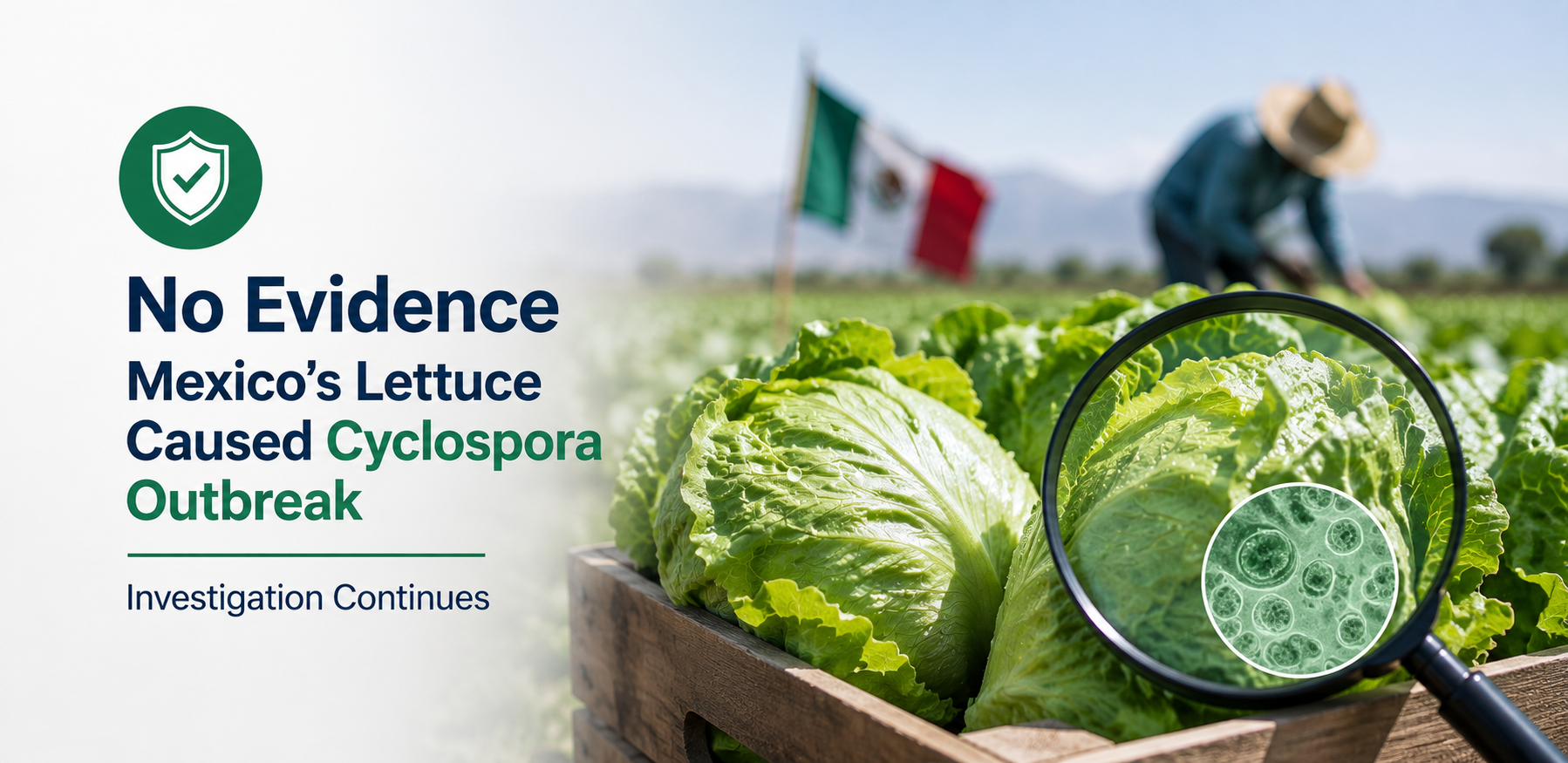
The Mexican government has stated that it has found no evidence so far indicating that lettuce grown in Mexico caused the large cyclospora outbreak currently affecting the United States.
Mexico's Health Minister David Kershenobich made the statement after the U.S. Food and Drug Administration (FDA) said its traceback investigation continued to point toward shredded iceberg lettuce from Taylor Farms' operations in central Mexico as the likely source of a multistate outbreak linked to Taco Bell restaurants in several Midwestern states.
While disputing the FDA's conclusion, Mexican officials said they have launched their own investigation and are working to determine whether any contamination occurred within the country's agricultural supply chain.
Why Are the U.S. and Mexico Reaching Different Conclusions?
The differing positions reflect the complexity of foodborne illness investigations.
The FDA's investigation relies on traceback data and epidemiological evidence, which examines where infected individuals ate, where restaurants sourced their ingredients, and how products moved through the food supply chain.
Mexico, however, says it has not yet identified direct evidence proving that lettuce grown within the country was contaminated with the Cyclospora parasite.
The two positions are not necessarily contradictory.
It is possible for regulators to identify a likely source through epidemiological investigations while laboratory confirmation remains unavailable.
The Challenge of Investigating Cyclospora
Cyclospora outbreaks are among the most difficult foodborne illnesses to investigate.
Unlike bacteria such as Salmonella or E. coli, the parasite:
- Cannot currently be cultured in laboratories.
- Is difficult to detect in food samples.
- Often appears in very small quantities.
- Causes symptoms several days after exposure.
- Is usually linked to fresh produce that has already been consumed before testing begins.
Because of these challenges, investigators frequently rely on multiple forms of evidence instead of laboratory confirmation alone.
Earlier in the investigation, the FDA announced that a lettuce sample had tested positive for Cyclospora before later determining that result was a false positive after additional laboratory review.
Despite withdrawing that laboratory finding, the FDA said its broader traceback investigation still points toward the same supply chain.
Mexico Begins Its Own Investigation
Following the FDA's announcement, Mexican authorities said they have begun precautionary inspections and traceability reviews.
Two federal agencies are participating in the investigation:
- Cofepris, Mexico's health regulatory authority.
- Senasica, the country's food safety and agricultural inspection agency.
Officials are examining agricultural operations in the state of Guanajuato, where the implicated Taylor Farms facilities are located.
According to Health Minister Kershenobich, investigators have not yet uncovered evidence confirming that lettuce produced there was the source of the outbreak, but they are continuing precautionary inspections while the investigation remains active.
Why This Matters Beyond Food Safety
The outbreak has implications beyond public health.
Mexico is one of the largest exporters of fresh produce to the United States, supplying significant volumes of:
- Lettuce.
- Tomatoes.
- Peppers.
- Cucumbers.
- Berries.
- Other fresh vegetables.
Any finding linking imported produce to a major foodborne outbreak could affect:
- International trade.
- Consumer confidence.
- Agricultural exports.
- Food supply chains.
- Import inspections.
As a result, both countries have strong incentives to thoroughly investigate the outbreak before reaching definitive conclusions.
Ongoing FDA Investigation
The FDA continues working with the CDC and state health departments to determine the precise source of the outbreak.
Federal investigators have emphasized that:
- The voluntary recall of implicated lettuce products remains in effect.
- Traceback evidence continues to support the current investigation.
- Additional scientific analysis is ongoing.
- Public health recommendations have not changed despite the earlier false-positive laboratory result.
Health officials continue encouraging consumers to follow recall notices while avoiding conclusions until the investigation is complete.
Industry Impact
- Produce Growers: Fresh produce suppliers may experience increased scrutiny of farming practices, sanitation procedures, and traceability systems as investigators work to identify the outbreak's origin.
- Food Importers: Companies importing fresh produce may face enhanced inspections and documentation requirements while regulators complete their investigations.
- Restaurants and Food Distributors: Food-service operators continue relying on supplier traceability systems to rapidly identify and remove potentially affected products from circulation.
- Public Health Agencies: The investigation highlights the importance of international cooperation between regulatory agencies when food supply chains cross national borders.
Why This Matters
The disagreement between U.S. and Mexican officials demonstrates how foodborne outbreak investigations often evolve as new evidence becomes available.
Unlike many public health investigations, determining the source of contamination in fresh produce requires combining epidemiological analysis, laboratory science, and supply chain tracing across multiple countries. Because Cyclospora is particularly difficult to detect in food samples, investigators frequently rely on the totality of available evidence rather than a single laboratory result.
The situation also underscores the importance of transparency during international food safety investigations. Coordinated communication between regulators helps maintain public confidence while allowing scientific findings to develop before final conclusions are reached.
Key Takeaways
- Mexico says it has not found evidence that lettuce grown in the country caused the U.S. cyclospora outbreak.
- The FDA continues to identify shredded iceberg lettuce from Taylor Farms' operations in central Mexico as the most likely source based on traceback investigations.
- Mexican regulators have launched precautionary inspections and traceability reviews in Guanajuato.
- Earlier laboratory findings linking the lettuce to Cyclospora were later determined to be a false positive, but the FDA says this does not alter its broader investigation.
- Both countries continue investigating while public health recommendations and recalls remain in place.
What This Means for Healthcare Marketers
The differing statements from U.S. and Mexican officials highlight the complexity of communicating scientific findings during active public health investigations. Organizations involved in food safety, diagnostics, laboratory testing, and public health surveillance increasingly need to explain evolving evidence clearly while maintaining public trust.
For healthcare marketers, the story reinforces the value of transparent, evidence-based communication. As investigations progress and new information emerges, organizations that communicate uncertainty responsibly are better positioned to maintain credibility with regulators, healthcare professionals, and the public.
For healthcare intelligence teams, the outbreak demonstrates why monitoring international regulatory developments is essential. Public health events that cross national borders can influence healthcare utilization, food safety policies, supply chain decisions, and regulatory priorities in both domestic and global markets.