Newer-Style Hip Implant Significantly Reduces Risk of Dislocation After Replacement Surgery, Study Finds
What's Happening
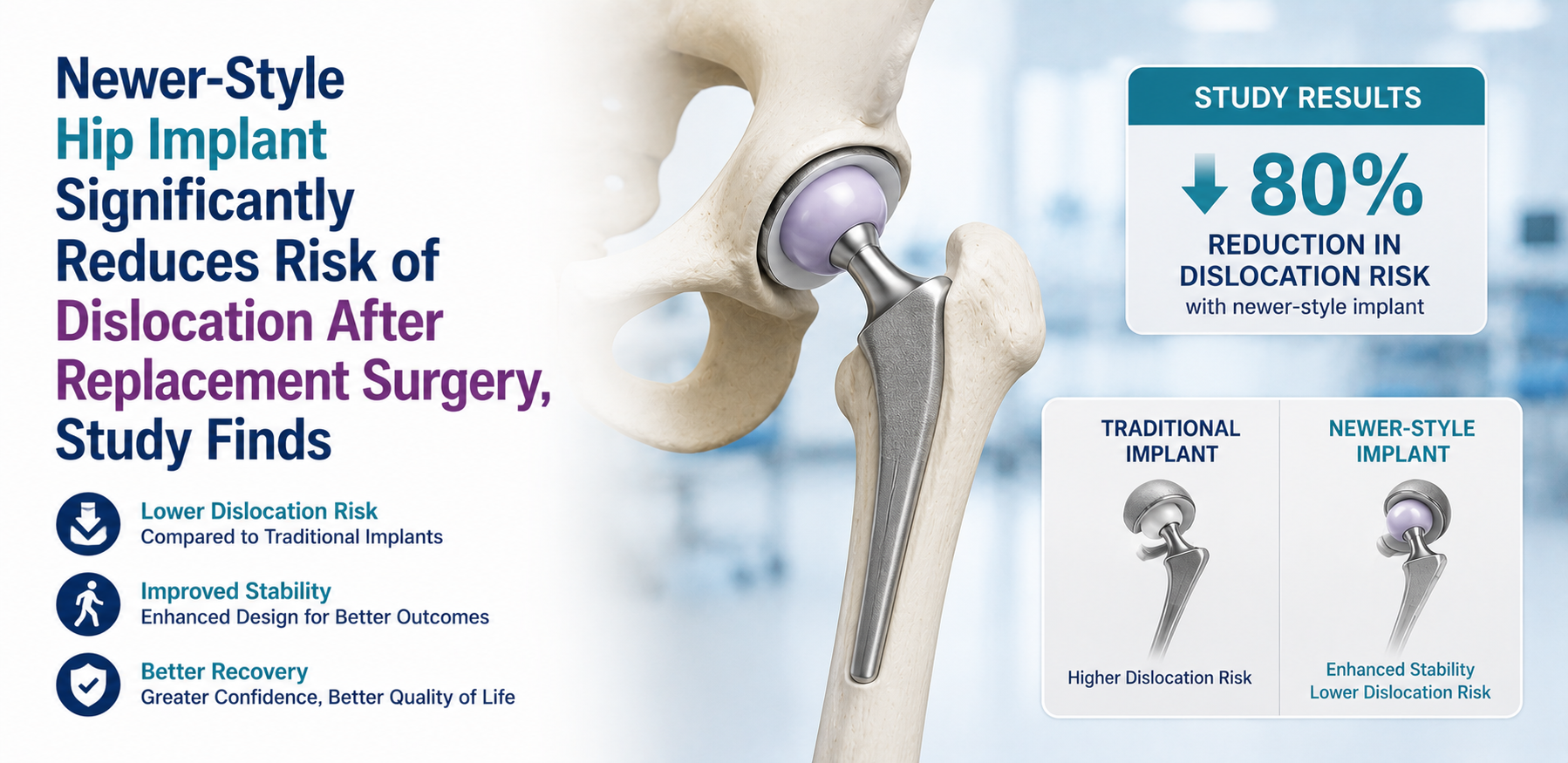
A newer type of artificial hip implant significantly reduces the risk of dislocation following total hip replacement surgery, according to a large international study. Researchers found that patients receiving the newer implant design experienced substantially fewer dislocations than those who received conventional hip replacements, potentially improving long-term surgical outcomes and reducing the need for additional procedures. (reuters.com)
The study evaluated dual mobility hip implants, an increasingly popular implant design used in orthopedic surgery. Researchers reported that the newer implants lowered the likelihood of one of the most common and serious complications following hip replacement while maintaining comparable overall safety.
The findings add to growing evidence supporting wider use of dual mobility implants, particularly among patients considered at higher risk of hip dislocation.
What Is Hip Replacement Surgery?
Hip replacement, also known as total hip arthroplasty, is a surgical procedure that replaces a damaged hip joint with an artificial implant. The procedure is commonly performed to treat:
- Osteoarthritis
- Rheumatoid arthritis
- Hip fractures
- Avascular necrosis
- Other degenerative joint diseases
During surgery, the damaged ball-and-socket joint is removed and replaced with artificial components designed to restore movement and reduce pain. Hip replacement is one of the most successful orthopedic procedures, helping millions of people regain mobility and improve their quality of life.
What Is Hip Dislocation?
One of the most important complications after hip replacement surgery is hip dislocation. This occurs when the artificial ball moves out of the artificial socket. Dislocation can cause:
- Severe pain
- Difficulty walking
- Joint instability
- Emergency medical treatment
- Additional surgery in some cases
Although modern hip replacement surgery is generally very successful, dislocation remains one of the leading reasons patients require revision surgery after the procedure. Reducing this complication has therefore been a major goal of orthopedic research.
What Is a Dual Mobility Hip Implant?
Traditional hip replacements use a single artificial ball that moves within a fixed socket. A dual mobility implant uses a different design. Instead of one point of movement, it contains:
- A small inner artificial ball.
- A larger polyethylene liner that also moves within the metal socket.
This creates two points of movement, allowing the joint to move through a greater range of motion before becoming unstable. Because the implant is less likely to slip out of place, the design helps reduce the risk of postoperative dislocation. This technology has been used in Europe for many years and has become increasingly common in the United States.
What Did the Study Find?
Researchers compared outcomes between patients receiving dual mobility implants and those receiving conventional hip replacement implants. The study found that patients treated with dual mobility implants experienced:
- Significantly fewer hip dislocations.
- Lower rates of revision surgery related to instability.
- Similar overall safety outcomes.
The results suggest that the newer implant design may provide meaningful benefits, particularly for patients who face a greater likelihood of postoperative instability. Researchers noted that reducing dislocations can improve recovery while lowering the need for additional surgical procedures.
Who May Benefit Most?
Although dual mobility implants can be used in many patients, they may be particularly beneficial for individuals at higher risk of dislocation, including:
- Older adults
- Patients undergoing revision hip replacement surgery
- Individuals with weakened muscles around the hip
- Patients with neurological conditions affecting balance or movement
- People with previous hip instability
Orthopedic surgeons consider several patient-specific factors when deciding which implant design is most appropriate.
Why Implant Design Continues to Evolve
Hip replacement technology has improved significantly over the past several decades. Researchers continue developing implants that aim to:
- Increase durability.
- Improve joint stability.
- Reduce wear over time.
- Preserve natural movement.
- Lower complication rates.
Advances in materials, manufacturing techniques, and surgical methods have contributed to longer-lasting implants and better patient outcomes. As life expectancy increases and more younger patients undergo hip replacement surgery, improving implant longevity remains an important area of orthopedic research.
Why This Matters for Healthcare
Hip replacement is among the most frequently performed orthopedic procedures worldwide. Even small improvements in implant performance can affect thousands of patients each year. Reducing dislocation rates may lead to:
- Better patient recovery.
- Fewer emergency hospital visits.
- Lower healthcare costs.
- Reduced need for revision surgery.
- Improved long-term quality of life.
Because revision surgeries are often more complex than the initial procedure, preventing complications benefits both patients and healthcare systems.
Industry Impact
- Medical Device Companies: Positive clinical evidence may accelerate adoption of dual mobility implant technology.
- Orthopedic Surgeons: The findings provide additional evidence supporting implant selection based on patient risk factors.
- Hospitals: Lower complication rates could reduce readmissions and revision surgeries following hip replacement.
- Patients: Individuals undergoing hip replacement may benefit from improved implant stability and better long-term outcomes.
Why This Matters
The study highlights how ongoing innovation in medical device design continues improving outcomes for common surgical procedures. Rather than dramatically changing how hip replacement surgery is performed, dual mobility implants represent an engineering improvement that addresses one of the operation's most significant complications. As orthopedic surgery increasingly focuses on reducing complications and improving long-term outcomes, implant selection is becoming an important component of personalized patient care. The findings may encourage broader adoption of dual mobility implants, particularly for patients at elevated risk of hip instability after surgery.
Key Takeaways
- A large study found that dual mobility hip implants significantly reduce the risk of hip dislocation after replacement surgery.
- Hip dislocation remains one of the leading complications following total hip replacement.
- Dual mobility implants use two points of movement to improve joint stability.
- The technology may be particularly beneficial for patients at higher risk of postoperative instability.
- The findings support continued innovation in orthopedic implant design to improve surgical outcomes.
What This Means for Healthcare Marketers
The study demonstrates how incremental innovation in medical devices can produce meaningful improvements in patient outcomes. While breakthrough technologies often attract the most attention, advances in implant design, materials, and engineering can significantly reduce complications, improve recovery, and lower long-term healthcare costs. Clinical evidence supporting these improvements plays an increasingly important role in hospital purchasing decisions and physician adoption.
For healthcare marketers, orthopedic devices are becoming more evidence-driven than ever. Success depends not only on introducing new technologies but also on demonstrating measurable improvements in patient safety, revision rates, quality of life, and overall healthcare value. Robust clinical data is essential for building confidence among surgeons, hospitals, and payers.
For healthcare intelligence teams, studies evaluating next-generation medical devices provide valuable insight into evolving standards of care. Monitoring clinical trial results, device innovation, regulatory approvals, and adoption trends helps organizations anticipate shifts in orthopedic practice and identify emerging opportunities within the rapidly evolving medical technology market.