What's Happening
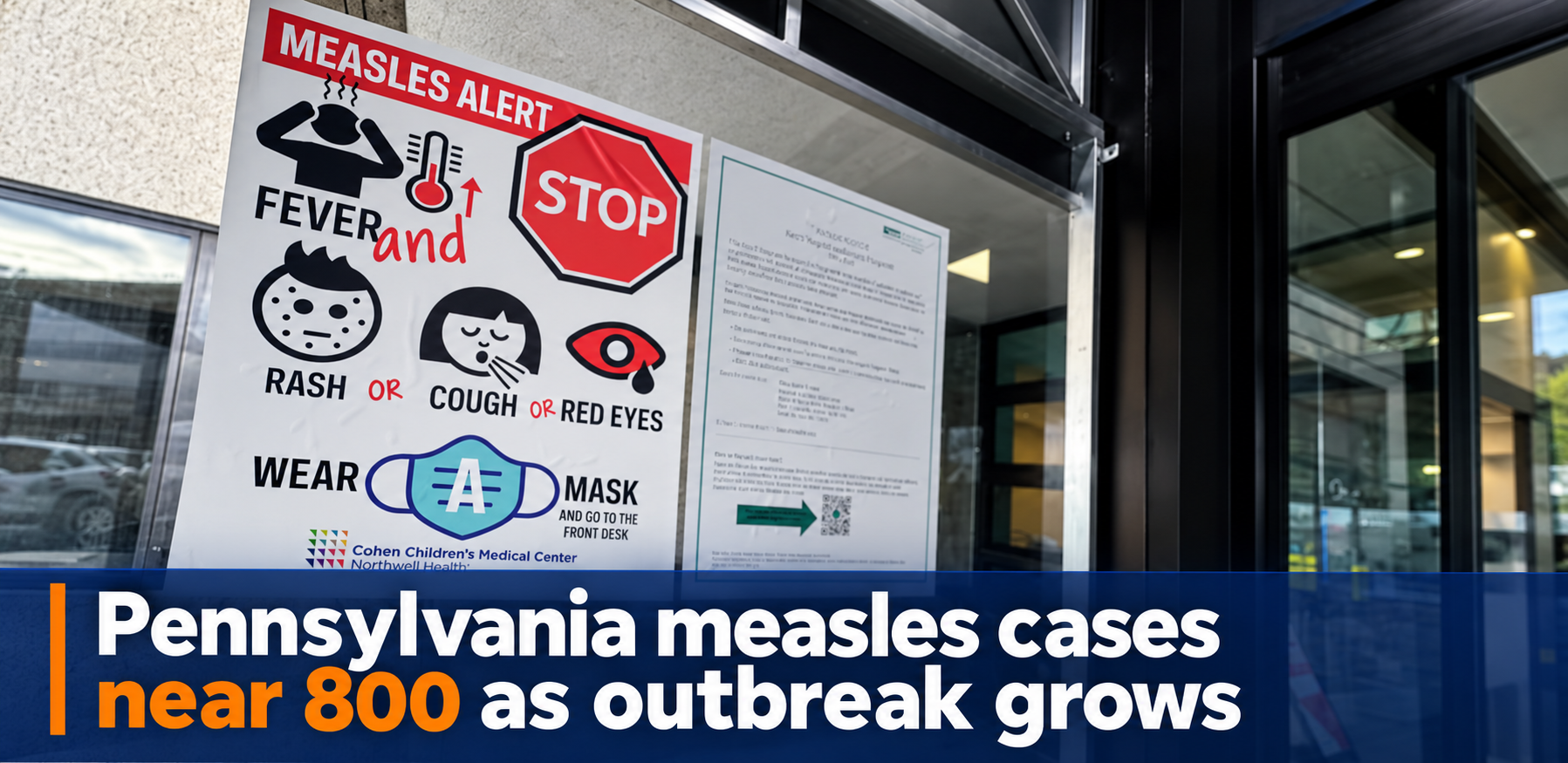
Pennsylvania's measles outbreak has grown to 792 confirmed cases, bringing the state close to 800 cases as the outbreak continues to expand.
The Pennsylvania Department of Health reported 25 new cases between September 18 and September 21. The outbreak now spans 39 counties and remains the largest measles outbreak in the United States this year. (Investing.com)
The state has also reported 155 hospitalizations, up from 150 on September 18.
The continued increase shows that transmission remains active despite ongoing efforts to identify cases, investigate exposures and increase vaccination.
Pennsylvania Is at the Center of the U.S. Measles Resurgence
Pennsylvania has become the main center of the country's current measles resurgence.
Lancaster County remains the hardest-hit part of the state and has accounted for a large share of the infections reported during the outbreak. (Investing.com)
The outbreak is no longer limited to a single local cluster, however.
Cases have now been reported across dozens of counties, meaning the public-health response has to operate across a much broader geographic area.
As the number of affected communities grows, health officials must investigate more potential exposures and monitor more people who may have been infected.
The Outbreak Has Been Growing for Months
The current surge has been building steadily rather than appearing as a short-lived cluster.
Pennsylvania crossed 700 cases earlier in September and has continued adding dozens of new infections at a time.
The increase from 731 cases on September 16 to 792 cases on September 21 means the state added 61 cases in just five days.
The continued growth suggests that transmission has not yet been fully contained.
Hospitalizations Are Also Increasing
The state has recorded 155 measles hospitalizations.
That number increased from 150 on September 18, showing that the outbreak is not simply producing more mild infections but is also creating a continuing need for hospital care. (Investing.com)
Measles can cause serious complications, particularly in people who are very young, unvaccinated or otherwise vulnerable.
Possible complications include pneumonia, dehydration and inflammation of the brain.
The need for hospitalization therefore adds another layer to the public-health burden created by the outbreak.
Four Measles-Associated Deaths Have Been Reported
Pennsylvania has reported four measles-associated deaths during the outbreak.
The state has said those deaths involved unvaccinated residents.
Two of the deaths were reported earlier in the outbreak, while two additional deaths were announced in September in Jefferson and Mifflin counties.
The state's classification of the deaths has become part of a broader disagreement with federal health officials over how measles-related fatalities should be counted.
CDC Has Not Added the Pennsylvania Deaths to Its National Count
The federal death count remains different from Pennsylvania's.
The CDC has not added Pennsylvania's 2026 measles deaths to its national measles death count.
The agency has been reviewing how it defines and classifies measles deaths, which is the subject of a separate effort to establish a more standardized national definition.
This means state and federal figures can currently show different numbers without necessarily using the same underlying criteria.
The issue has become particularly visible because Pennsylvania reports four measles-associated deaths while the federal count has not incorporated them.
The Mortality Dispute Has Complicated the Public-Health Response
The disagreement over the deaths has also affected the relationship between Pennsylvania and the federal government.
Pennsylvania previously asked for help from the CDC through an Epi-Aid, which would bring federal public-health experts into the state to assist with the outbreak.
The state made the request conditional on the CDC recognizing the four deaths that Pennsylvania had classified as measles-associated.
The disagreement illustrates how differences in data definitions can affect more than statistics. They can also influence how state and federal authorities communicate and coordinate during an outbreak.
What Is an Epi-Aid?
An Epi-Aid is a CDC response mechanism used when state or local health authorities need additional epidemiological expertise.
CDC specialists can assist with activities such as:
- Investigating disease transmission
- Identifying potential sources of infection
- Analyzing case data
- Supporting contact tracing
- Developing outbreak-control strategies
For a growing measles outbreak, additional epidemiologists can help a state process information more quickly and identify patterns that may otherwise be difficult to detect.
The National U.S. Case Count Is Also High
Pennsylvania's outbreak is part of a much larger national increase.
The United States had recorded 3,471 confirmed measles cases as of September 17, according to CDC data. (Investing.com)
That means Pennsylvania's 792 cases represented roughly 23% of the national total based on those figures.
The concentration of cases in Pennsylvania makes the state an important part of the national outbreak response.
Why Measles Spreads So Easily
Measles is one of the most contagious infectious diseases.
An infected person can spread the virus to others through respiratory particles released when coughing, sneezing or breathing.
People who have not developed immunity can become infected after relatively brief exposure.
That high level of contagiousness means even relatively small gaps in vaccination coverage can allow the virus to spread through communities.
Once an outbreak begins, public-health officials often need to identify exposed individuals quickly and determine who is already protected.
Vaccination Remains the Main Prevention Tool
The measles, mumps and rubella vaccine remains the primary tool used to prevent measles outbreaks.
Two doses of the MMR vaccine are approximately 97% effective at preventing measles, while one dose is about 93% effective. (Investing.com)
The strong protection provided by two doses is why vaccination coverage is such an important factor in preventing sustained community transmission.
When vaccination levels decline, more people become susceptible to infection.
Pennsylvania Is Continuing Its Vaccination Response
The state health department has continued encouraging residents to make sure they are vaccinated and to take advantage of vaccination opportunities.
During the outbreak, public-health officials have been working with local communities, healthcare providers and other organizations to identify people who may need vaccination.
The response is especially important in communities where cases are continuing to appear.
The objective is not only to treat people who become sick, but also to prevent additional infections.
Children Are an Important Part of the Response
Measles vaccination is part of the routine childhood immunization schedule.
Because children are often closely connected through schools, childcare facilities and community activities, outbreaks can spread quickly when susceptible children are exposed.
Healthcare providers therefore play an important role in checking immunization records and helping families catch up on missed doses.
Schools and childcare settings can also become important locations for identifying possible exposures.
The Outbreak Is Creating Work for Healthcare Systems
A large outbreak creates additional demands across the healthcare system.
- Primary care: Doctors and pediatric practices may need to evaluate patients with fever and rash and determine whether measles testing or isolation is necessary.
- Hospitals: Hospitals need procedures for safely treating patients who may have measles while limiting exposure to other patients and healthcare workers.
- Laboratories: Diagnostic laboratories may experience additional demand for measles testing and confirmation.
- Public-health departments: Health departments must investigate cases, identify contacts, monitor exposed individuals and communicate with communities.
- Vaccination providers: Pharmacies, clinics and physician offices may see increased demand for MMR vaccinations as communities respond to the outbreak.
Exposure Investigations Can Become More Difficult as Cases Spread
When an outbreak is small, health officials can sometimes identify a relatively clear chain of transmission.
As the number of cases rises and infections appear across more counties, identifying every exposure becomes more difficult.
A person may have been exposed in a healthcare facility, workplace, school, public event, airport or other community setting.
Each additional case can therefore create more people who need to be contacted and assessed.
That increases the workload on local and state epidemiology teams.
Lancaster County Remains the Main Hotspot
Lancaster County has remained the most heavily affected part of Pennsylvania throughout the outbreak.
The county's sustained case burden has made it a central area for public-health intervention.
However, the geographic expansion of the outbreak means that authorities cannot focus entirely on Lancaster.
Cases in other counties, including Mifflin and Jefferson, demonstrate that transmission is occurring beyond the original center of the outbreak.
The Outbreak Is Also Testing Public-Health Coordination
The Pennsylvania outbreak has highlighted the importance of coordination between:
- State health authorities
- Local health departments
- Hospitals and healthcare providers
- Laboratories
- Federal agencies
When these organizations use different definitions or reporting methods, it can become more difficult to produce a consistent picture of the outbreak.
That is one reason the CDC's work on a standardized definition for measles deaths is important.
Data Accuracy Matters During an Outbreak
Public-health decisions depend heavily on accurate information.
Officials use case and hospitalization numbers to determine how aggressively to respond, where to allocate personnel and whether additional vaccination campaigns are needed.
Mortality figures provide another measure of how severe an outbreak has become.
When state and federal systems report different numbers, the difference can create confusion among healthcare providers, policymakers and the public.
Standardized definitions can help reduce that problem.
The Outbreak Comes Amid Falling Vaccination Coverage
The measles resurgence is also occurring as childhood vaccination coverage has declined in the United States.
CDC data have shown that kindergarten MMR coverage has fallen below the level historically considered necessary for strong community protection.
That makes local outbreaks more capable of spreading once the virus is introduced.
Pennsylvania's experience illustrates how quickly a preventable disease can create a substantial healthcare and public-health burden when transmission continues.
The Human and Healthcare Costs Are Larger Than the Case Count
The headline number of 792 cases represents only one part of the impact.
Each infection can require:
- Medical evaluation
- Laboratory testing
- Isolation
- Contact tracing
- Follow-up monitoring
- Vaccination of susceptible contacts
Some patients require hospitalization.
Healthcare workers exposed to measles may also need evaluation of their immune status and follow-up monitoring.
The total resource requirement therefore grows as the number of infections rises.
Measles Can Put Healthcare Workers at Risk
Because measles is extremely contagious, healthcare settings can become locations of potential exposure.
Hospitals and clinics need appropriate infection-control procedures when a patient with suspected measles arrives.
Healthcare workers who are not immune can themselves become infected, potentially creating additional transmission.
This makes vaccination and infection-control procedures important not only for patients but also for healthcare staff.
The Current Situation Is Still Evolving
The case count is changing as state health officials continue investigating suspected infections and confirming cases.
The 792 cases reported on September 21 are therefore not necessarily the final number for the outbreak.
More cases could be identified through testing and continued surveillance.
At the same time, aggressive vaccination and outbreak-control efforts could slow transmission.
The direction of the outbreak will depend heavily on how quickly new chains of transmission can be interrupted.
Why This Matters
Pennsylvania is approaching 800 measles cases and has already recorded 155 hospitalizations, making the outbreak one of the most significant public-health events in the United States this year. (Investing.com)
The outbreak also demonstrates how quickly a contagious, vaccine-preventable disease can spread across multiple communities.
The disagreement over measles-associated deaths adds another layer of complexity because state and federal authorities are currently using different approaches to mortality classification.
For healthcare organizations, the effects extend beyond infectious-disease departments. Hospitals, primary-care providers, laboratories, pharmacies, schools and public-health agencies all have roles in controlling transmission.
Looking Ahead
Pennsylvania's immediate priority is to slow the continued spread of measles while identifying new cases and protecting people who are not immune.
The state will continue updating its case and hospitalization numbers and encouraging vaccination.
The federal government is also working toward a standardized definition for measles deaths, which could eventually make state and national mortality figures more consistent.
The key indicators to watch are the pace of new cases, hospitalizations, geographic spread and vaccination activity.
If new cases continue appearing across additional counties, public-health resources may need to remain at elevated levels for an extended period.
What This Means for Healthcare Marketers
For healthcare marketers, a major infectious-disease outbreak can create demand across several parts of the healthcare market at the same time.
Diagnostic companies may see greater need for testing.
Vaccination providers may face increased demand for immunization services.
Healthcare systems may need patient education and outbreak-communication support.
Public-health organizations may require better tools for surveillance, contact tracing and community outreach.
For B2B healthcare companies, tracking case growth, hospitalization trends, vaccination activity, public-health interventions and changes in surveillance definitions can provide early signals of where healthcare demand is increasing.
Key Takeaways
- Pennsylvania reported 792 measles cases as of September 21, an increase of 25 cases since September 18. (Investing.com)
- The outbreak now covers 39 counties.
- Pennsylvania has recorded 155 hospitalizations related to measles. (Investing.com)
- Lancaster County remains the hardest-hit area.
- Pennsylvania has reported four measles-associated deaths among unvaccinated residents.
- The CDC has not yet included those deaths in its national 2026 measles death count while it reviews how measles deaths should be classified.
- The U.S. had recorded 3,471 confirmed measles cases as of September 17. (Investing.com)
- Two doses of the MMR vaccine are approximately 97% effective at preventing measles. (Investing.com)
- The outbreak is continuing to place pressure on hospitals, public-health departments, laboratories, primary-care providers and vaccination programs.
- The coming weeks will show whether vaccination and outbreak-control efforts can slow transmission as Pennsylvania approaches 800 cases.