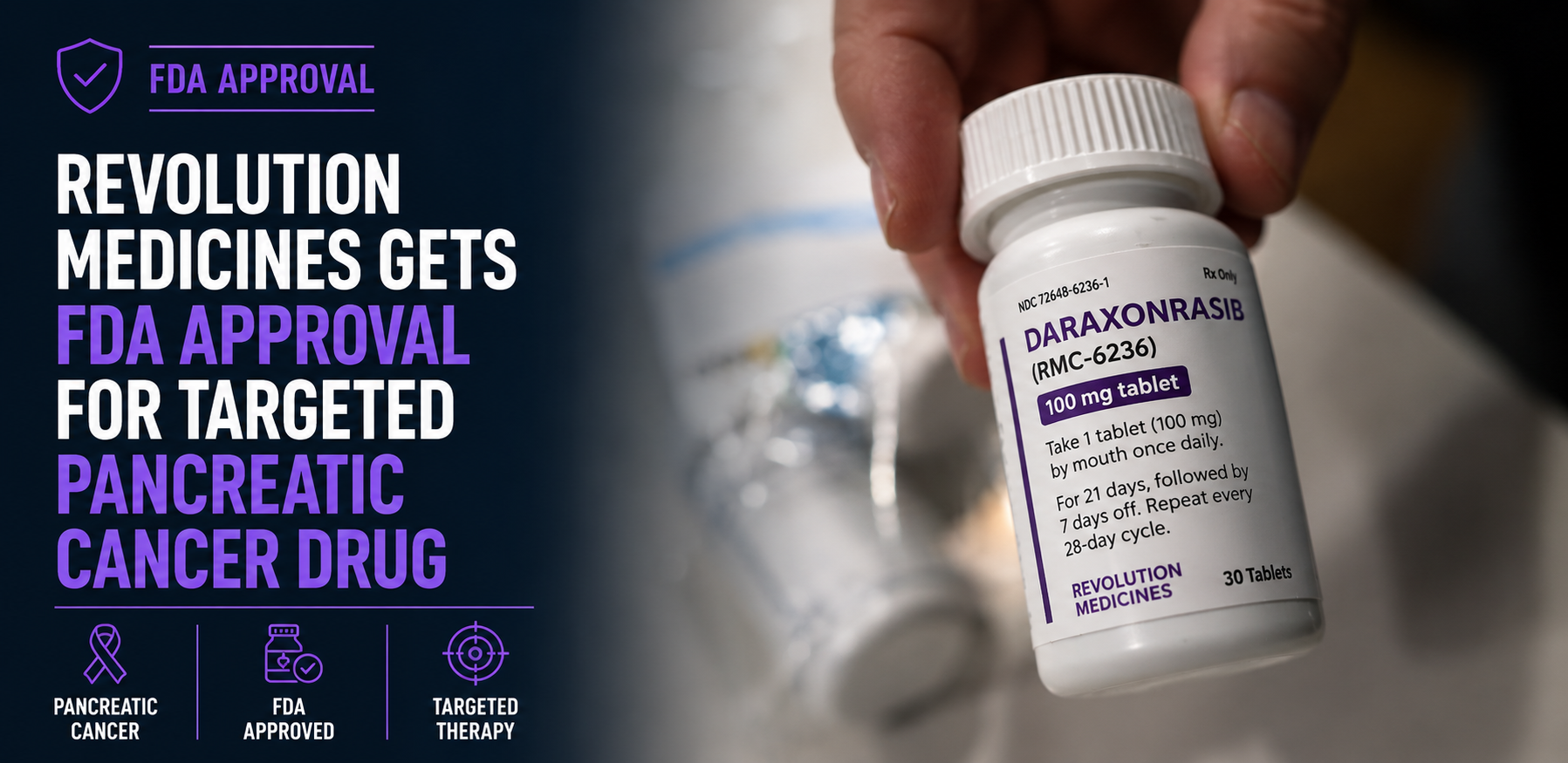
Revolution Medicines Gets FDA Approval for Targeted Pancreatic Cancer Drug
What's Happening
The U.S. Food and Drug Administration (FDA) has approved Revolution Medicines' Rasonque (daraxonrasib) for adults with metastatic pancreatic adenocarcinoma who have received at least one prior systemic treatment or are not candidates for combination chemotherapy. (reuters.com, fda.gov)
The once-daily pill targets RAS proteins, which drive tumor growth in many pancreatic cancers. The approval is a major development for a disease that has historically had very limited treatment options. (reuters.com)
Our Article: Reuters article
Why This Is Significant
In the Phase 3 RASolute 302 trial involving 500 patients, patients receiving Rasonque had median overall survival of 13.2 months, compared with 6.7 months for those receiving standard chemotherapy. (reuters.com, fda.gov)
The treatment also showed improvements in progression-free survival and patient-reported quality of life compared with chemotherapy. (ir.revmed.com)
The FDA granted the drug an expedited review, and the approval came months ahead of the original regulatory deadline. (reuters.com, fda.gov)
How Rasonque Works
Rasonque is designed to block several forms of the RAS protein, a key driver of tumor growth.
RAS mutations are particularly important in pancreatic cancer, where abnormal RAS signaling is involved in a large majority of tumors.
The drug is therefore targeting one of the fundamental biological mechanisms driving the disease rather than simply attacking rapidly dividing cells like traditional chemotherapy.
A Major Shift in Pancreatic Cancer Treatment
Pancreatic cancer remains one of the most difficult cancers to treat.
The new drug is significant because it represents a successful attempt to target the RAS pathway, which researchers have been trying to address for decades. Oncologists told Reuters that the approval could substantially change how advanced pancreatic cancer is treated. (reuters.com)
The treatment is also administered as a once-daily oral pill, rather than through intravenous chemotherapy.
U.S. Availability and Pricing
Revolution Medicines said Rasonque is now available in the United States at $39,800 for a 30-day supply. The company also said it would provide patient assistance. (reuters.com)
The price places the drug firmly within the broader U.S. discussion around the cost of innovative cancer medicines and access to new therapies.
Industry Impact
- Oncology: The approval could establish RAS-targeted therapy as an important new approach to treating pancreatic cancer.
- Pharmaceutical Development: The success could accelerate development of additional drugs targeting different RAS mutations and potentially other RAS-driven cancers.
- Cancer Diagnostics: Unlike some targeted therapies, the FDA approval does not require a companion diagnostic test identifying a specific RAS mutation. (ir.revmed.com)
- Healthcare Providers: Oncologists now have a new oral treatment option for patients with previously treated metastatic pancreatic cancer.
- Patients: The survival improvement seen in clinical trials represents a potentially meaningful advance for patients facing a cancer with historically poor outcomes.
Commercial Potential
Investors have been closely watching Rasonque because of its potential to become a major oncology product.
RBC Capital Markets analysts estimated that U.S. pancreatic-cancer revenue could reach $28 million in the third quarter and $148 million in the fourth quarter, while longer-term annual global sales could reach approximately $11.5 billion. These are analyst estimates, not company guidance. (reuters.com)
Looking Ahead
The immediate focus will shift from regulatory approval to commercial adoption.
Revolution will need to ensure that oncologists can identify appropriate patients, insurers provide coverage and patients can access the drug quickly.
The company is also developing additional RAS-targeted medicines, meaning the pancreatic-cancer approval could be the beginning of a broader RAS-focused oncology franchise. (reuters.com)
Why This Matters
This is a major U.S. healthcare industry story because it combines FDA approval, oncology innovation, targeted therapy and a significant potential improvement in outcomes for pancreatic cancer patients.
It also demonstrates the potential of targeting RAS biology, one of the most heavily pursued areas of cancer-drug development.
Key Takeaways
- FDA approved Rasonque (daraxonrasib) for metastatic pancreatic adenocarcinoma. (fda.gov)
- The drug is the first broad RAS-targeted medicine approved for metastatic pancreatic cancer. (ir.revmed.com)
- Median survival was 13.2 months vs. 6.7 months with standard chemotherapy in the Phase 3 trial. (fda.gov)
- Rasonque is a once-daily oral treatment.
- The U.S. price is $39,800 per 30-day supply. (reuters.com)
- The FDA used an expedited review pathway, approving the drug months ahead of schedule. (reuters.com)
- The approval could open the door to a broader generation of RAS-targeted cancer therapies.
What This Means for Healthcare Marketers
This creates significant relevance across oncology, targeted therapies, precision medicine, cancer diagnostics, specialty pharmaceuticals and patient access. The launch will also create demand for identifying and reaching oncologists, cancer centers and patient populations most relevant to this new treatment.