Robots Improve Drug Testing by Detecting Hidden Cancer Cells Researchers Often Miss
What's Happening
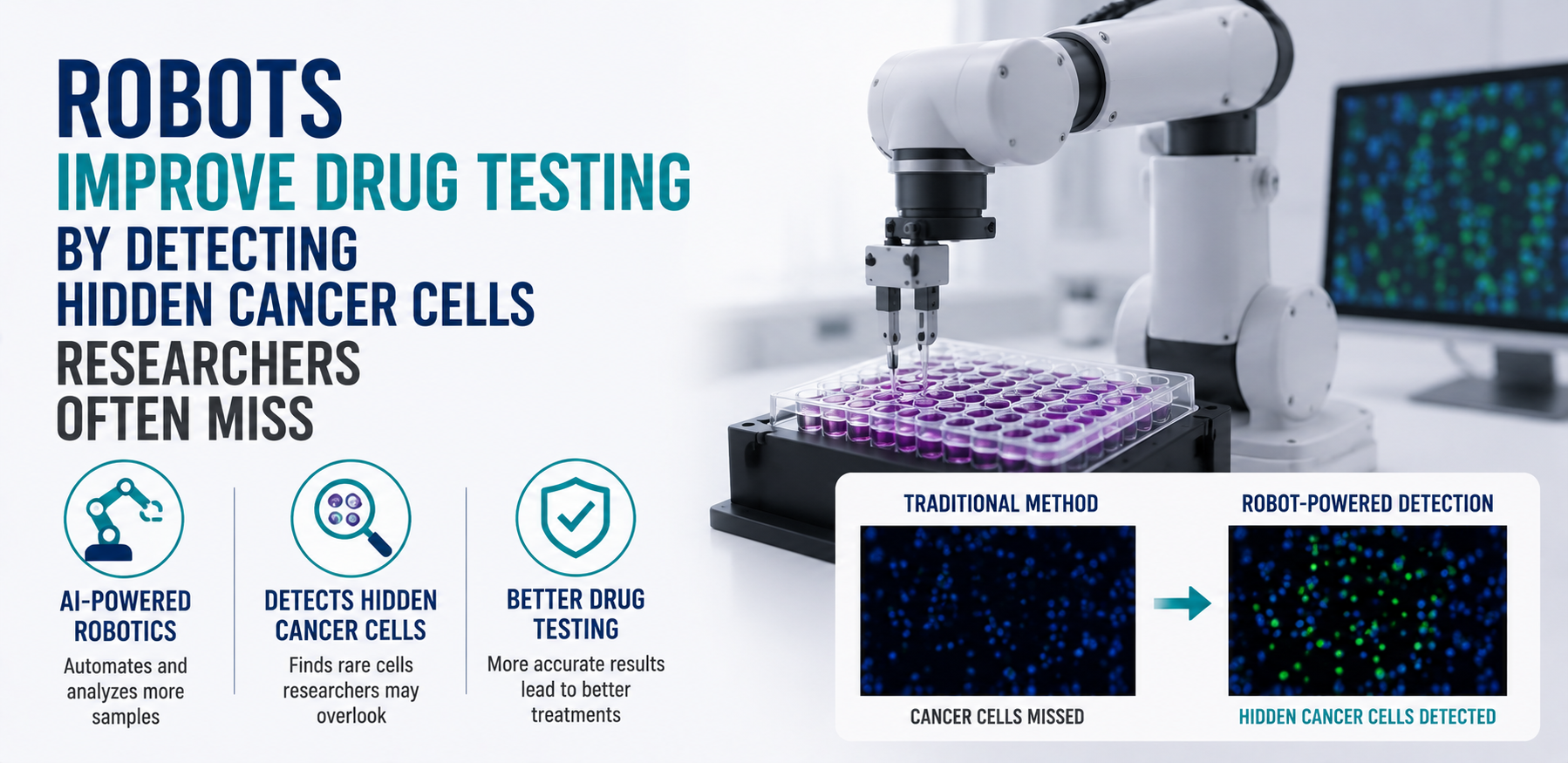
Researchers reported that robotic laboratory systems are helping improve the accuracy of drug testing by identifying small numbers of cancer cells that can remain hidden during traditional testing methods.
The technology is designed to automate parts of the drug-development process and detect cancer cells that might otherwise go unnoticed when scientists evaluate how well experimental treatments are working.
The findings could have significant implications for cancer research because one of the biggest challenges in oncology is determining whether a treatment has truly eliminated cancer cells or merely reduced them temporarily.
Even a small number of surviving cancer cells can sometimes lead to disease recurrence months or years later.
Scientists believe advanced robotic systems may help provide a more complete picture of how experimental therapies perform before they move into larger clinical trials.
Why Detecting Residual Cancer Cells Matters
One of the most difficult aspects of cancer treatment is that tumors are rarely made up of identical cells.
Within a single tumor, different groups of cancer cells may behave differently.
Some cells respond well to treatment.
Others may resist therapy and survive.
When treatment appears successful, doctors and researchers often focus on overall tumor shrinkage. However, tiny populations of resistant cells can sometimes remain behind.
These surviving cells may:
- Continue growing later
- Develop additional mutations
- Become resistant to future treatments
- Cause cancer to return
Because of this, identifying residual cancer cells has become an increasingly important goal in cancer research. The more accurately scientists can detect these cells, the better they can evaluate whether a treatment is likely to provide long-term benefits.
How Robotics Are Changing Drug Research
Drug development has traditionally relied heavily on manual laboratory work.
Researchers perform experiments, analyze samples, record observations, and interpret results.
While these methods remain effective, they also have limitations.
Human analysis can be:
- Time-consuming
- Labor-intensive
- Difficult to scale
- Subject to variation between researchers
Robotic systems help address some of these challenges by automating repetitive tasks and processing large numbers of samples with consistent accuracy.
Modern laboratory robotics can:
- Analyze thousands of cells simultaneously
- Capture highly detailed imaging data
- Detect subtle biological changes
- Identify patterns difficult for humans to observe manually
As artificial intelligence and automation technologies continue advancing, researchers are increasingly using robotic systems to support drug discovery and testing.
Why Cancer Drug Development Is So Expensive
Cancer remains one of the most challenging therapeutic areas in healthcare.
Developing a new cancer treatment often requires:
- Years of laboratory research
- Multiple phases of clinical trials
- Extensive regulatory review
- Significant financial investment
Many experimental therapies fail before reaching patients. In some cases, drugs appear promising during early testing but later prove ineffective when studied in larger populations. Improving preclinical testing could help researchers identify unsuccessful treatments earlier while advancing the most promising candidates more efficiently. If robotic systems can improve prediction accuracy, they could potentially reduce development costs and accelerate innovation.
The Growing Role of Artificial Intelligence and Automation
The study reflects a larger trend occurring throughout healthcare and life sciences.
Artificial intelligence, machine learning, and automation are increasingly being integrated into:
- Drug discovery
- Clinical trial design
- Medical imaging
- Diagnostics
- Laboratory operations
Healthcare companies are investing heavily in these technologies because they offer the potential to:
- Improve efficiency
- Reduce costs
- Accelerate research timelines
- Generate deeper scientific insights
Rather than replacing scientists, most experts view these systems as tools that help researchers process larger amounts of information and make better-informed decisions. In oncology specifically, advanced analytical technologies are becoming especially valuable because cancer biology is extraordinarily complex.
Why This Matters for Patients
Although the research is still focused on laboratory testing, the long-term implications could be significant for patients.
More accurate drug testing may help researchers:
- Identify effective treatments sooner
- Eliminate weaker candidates earlier
- Improve clinical trial success rates
- Develop more targeted therapies
Ultimately, patients benefit when researchers can make better decisions about which treatments deserve further development. The technology may also contribute to future efforts aimed at understanding why certain cancers return after apparently successful treatment. As researchers gain better tools for identifying resistant cancer cells, they may become more successful at designing therapies capable of preventing recurrence.
Industry Impact
Pharmaceutical Companies: Drug developers continue investing in automation technologies that can improve research productivity and reduce development risk.
Biotechnology Firms: Advanced laboratory platforms are becoming increasingly valuable assets within the biotechnology industry.
Research Institutions: Academic researchers may gain access to more powerful tools for studying cancer biology and treatment response.
Patients: Improved testing methods could eventually support the development of more effective cancer therapies.
Key Takeaways
- Researchers found robotic systems can detect hidden cancer cells during drug testing.
- Small populations of surviving cancer cells often contribute to treatment resistance and disease recurrence.
- Automation may improve the accuracy of early-stage cancer research.
- Healthcare organizations continue investing heavily in AI and robotics.
- Better testing tools could help accelerate future cancer-drug development.
What This Means for Healthcare Marketers
This story highlights the growing convergence of healthcare, artificial intelligence, robotics, and advanced analytics.
For healthcare marketers, research automation is becoming an increasingly important area to monitor because pharmaceutical companies are actively seeking technologies that can improve development efficiency and reduce risk. Solutions that accelerate drug discovery or improve scientific decision-making often attract significant investment even before they directly affect patient care.
The article also illustrates how innovation is moving beyond treatments themselves and into the infrastructure supporting healthcare research. Companies developing laboratory automation, AI platforms, data analytics tools, imaging technologies, and research software may find increasing demand as healthcare organizations look for ways to improve productivity and scientific outcomes.
For healthcare intelligence teams, investments in research automation can serve as early indicators of where future pharmaceutical innovation may emerge. Organizations that understand these technology trends may be better positioned to identify new partnerships, growth opportunities, and competitive shifts across the life sciences industry.
More broadly, the story reflects a healthcare sector that is increasingly relying on advanced technology to solve some of medicine's most difficult scientific challenges.