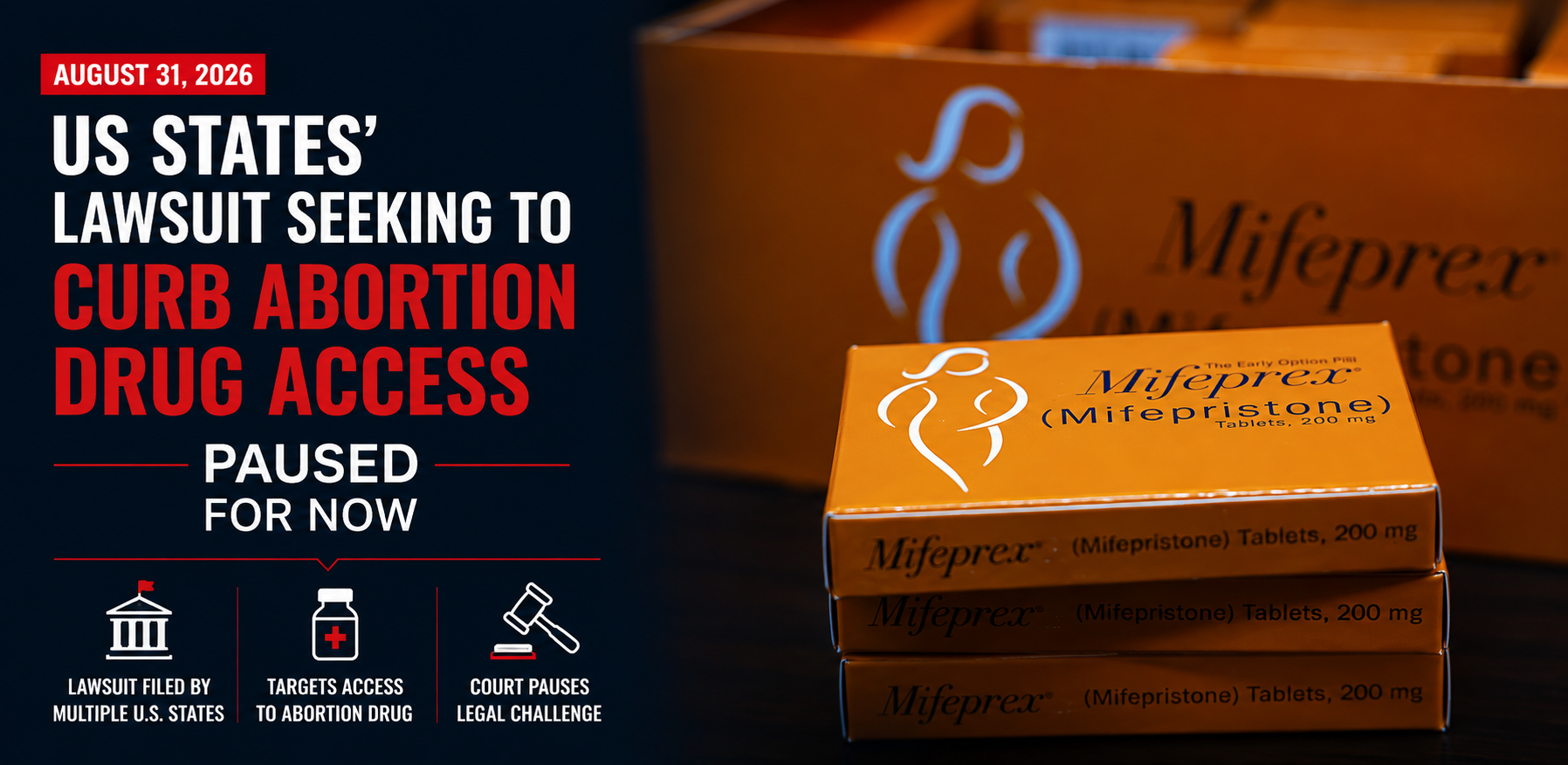
U.S. States’ Lawsuit Seeking to Curb Abortion Drug Access Paused for Now
What’s Happening
A federal judge has temporarily paused a lawsuit brought by Florida and Texas that seeks to severely restrict access to the abortion pill mifepristone nationwide.
U.S. District Judge Reed O’Connor in Fort Worth, Texas, agreed to put the case on hold while the U.S. Food and Drug Administration (FDA) completes its review of the drug’s safety. The pause will last until the earlier of December 1, 2026, or completion of the FDA review. (Reuters)
The decision does not resolve the underlying dispute. Instead, it temporarily stops the litigation while the federal government evaluates a medication that has become a central part of abortion care in the United States.
The Lawsuit Targets Mifepristone’s Federal Approval
Challenge to the 2000 approval
The lawsuit, filed in December 2025, challenges the FDA's original 2000 approval of mifepristone.
Florida and Texas argue that the FDA did not adequately evaluate the drug's safety and effectiveness when it was approved and subsequently failed to properly account for risks associated with its use. (Reuters)
The states are also challenging regulatory changes made under Democratic administrations that expanded how the drug could be accessed.
Mail distribution is part of the dispute
One important target is a 2023 FDA rule allowing mifepristone to be dispensed through the mail.
The lawsuit seeks to roll back access that has expanded significantly since the Supreme Court overturned the constitutional right to abortion in 2022. (Reuters)
The FDA Is Conducting Its Own Review
The lawsuit is being paused because the FDA is already reviewing mifepristone.
The agency first announced the review last year. Reuters reported that the review has reportedly been delayed until after the November 2026 midterm elections. (Reuters)
The timing means the FDA's regulatory assessment could become highly important to the future of the litigation. A finding that the drug remains safe and effective could strengthen the position of the companies and medical organizations defending access, while a significant regulatory change could alter the legal landscape.
Drugmakers Are Defending Access
GenBioPro and Danco intervene
The companies that make mifepristone, GenBioPro and Danco Laboratories, have intervened in the lawsuit to defend access to the medication.
They asked the court to dismiss the case, but Judge O’Connor rejected that request while agreeing to pause the litigation. (Reuters)
GenBioPro's CEO said the company expects the FDA to uphold its previous conclusions that mifepristone is safe and effective.
For the manufacturers, the case represents a direct threat to the regulatory approval and distribution framework underlying their businesses.
Mifepristone Has Become Central to U.S. Abortion Care
Mifepristone is the first drug in the standard two-drug medication-abortion regimen, followed by misoprostol.
The regimen is generally used to terminate a pregnancy within the first 10 weeks. (Reuters)
The medication has become particularly important as abortion access has become more geographically fragmented following the 2022 Supreme Court decision.
Reuters reports that mifepristone is now used in more than 60% of U.S. abortions. (Reuters)
That gives the regulatory dispute significance far beyond the pharmaceutical companies themselves. Changes to the drug's availability could affect abortion providers, pharmacies, telehealth providers and millions of patients.
State-Level Restrictions Have Driven Greater Reliance on Medication Abortion
Nearly half of U.S. states have banned or severely restricted abortion since the Supreme Court overturned the constitutional right to abortion in 2022. (Reuters)
That fragmented legal environment has contributed to a surge in medication abortion, while also generating multiple lawsuits over the legal status and accessibility of abortion drugs.
Florida and Texas are not alone in challenging mifepristone.
Five states have filed three separate lawsuits broadly arguing that the FDA's regulatory decisions regarding the drug were inadequate. (Reuters)
A separate lawsuit brought by Louisiana challenging the 2023 mail-dispensing rule was also put on hold earlier in 2026.
Medical Organizations Say the Drug Is Safe
The legal arguments from the states contrast sharply with the position of major medical organizations.
Most major medical groups, as well as the FDA at various points during the drug's more than two-decade history, have said that mifepristone is safe and effective when taken as directed and that serious adverse events are rare. (Reuters)
That creates a major divide between the medical consensus cited by the drug's defenders and the legal and regulatory arguments being advanced by the states challenging the FDA's decisions.
Why the Pause Matters
The judge's decision provides temporary stability for the companies and healthcare organizations that rely on current mifepristone rules.
For now, the lawsuit does not immediately impose the nationwide restrictions sought by Florida and Texas.
But the underlying challenge remains alive because the judge rejected the manufacturers' motion to dismiss. (Reuters)
That means the future of mifepristone access could still be affected by both the FDA review and the court case.
A High-Stakes Regulatory and Healthcare Battle
The case illustrates how a regulatory decision involving one drug can become entangled with broader questions about reproductive rights, federal authority and state-level healthcare restrictions.
For pharmaceutical manufacturers, the dispute also highlights the commercial risk created when an established FDA approval becomes the subject of litigation decades after launch.
For providers, pharmacies and telehealth companies, uncertainty around dispensing rules creates operational and compliance challenges.
For patients, the biggest issue is whether access to one of the most widely used abortion medications in the country will remain governed by the current federal framework.
Looking Ahead
The immediate next milestone is the FDA's review of mifepristone.
The lawsuit is paused until the earlier of December 1 or the completion of that review, meaning the regulatory findings could become central to what happens next in court. (Reuters)
The broader legal fight is unlikely to disappear even with the temporary pause. Several states are pursuing challenges to the federal government's handling of abortion medication, while manufacturers and healthcare organizations continue defending the existing regulatory framework.
The eventual outcome could influence not only mifepristone but also how much authority states have to challenge long-standing FDA decisions affecting nationwide drug access.
Key Takeaways
- Florida and Texas are seeking to severely restrict nationwide access to mifepristone.
- A federal judge has paused the case while the FDA reviews the drug's safety.
- The pause lasts until December 1, 2026, or the completion of the FDA review, whichever comes first.
- The lawsuit challenges the drug's 2000 FDA approval and later rules expanding access, including mail dispensing.
- Mifepristone is used in more than 60% of U.S. abortions.
- GenBioPro and Danco Laboratories are defending the drug's availability in court.
- Major medical organizations and the FDA have repeatedly said mifepristone is safe and effective when used as directed.
- The judge rejected the manufacturers' request to dismiss the lawsuit, so the broader legal challenge remains active. (Reuters)
What This Means for Healthcare Marketers
This is a strong example of how regulatory and political developments can rapidly change the market environment around an established healthcare product.
For pharmaceutical companies, reproductive-health providers, pharmacies, telehealth platforms and healthcare technology companies, regulatory litigation can affect not only product availability but also distribution models, patient acquisition, provider partnerships and messaging.
The key commercial issue is uncertainty. A product can have established demand and decades of regulatory history, yet a new legal challenge can suddenly change the assumptions businesses have built around its market.