What's Happening
More women in the United States are receiving testosterone prescriptions as interest in menopause treatment grows, but many are encountering pharmacy denials, prescription delays and limited insurance coverage.
An exclusive analysis of healthcare data by Truveta for Reuters found that the rate of women receiving a testosterone prescription increased 146% between January 2023 and July 2026, nearly tripling during that period. The increase is primarily associated with treatment of persistently low sexual desire related to menopause. (Reuters)
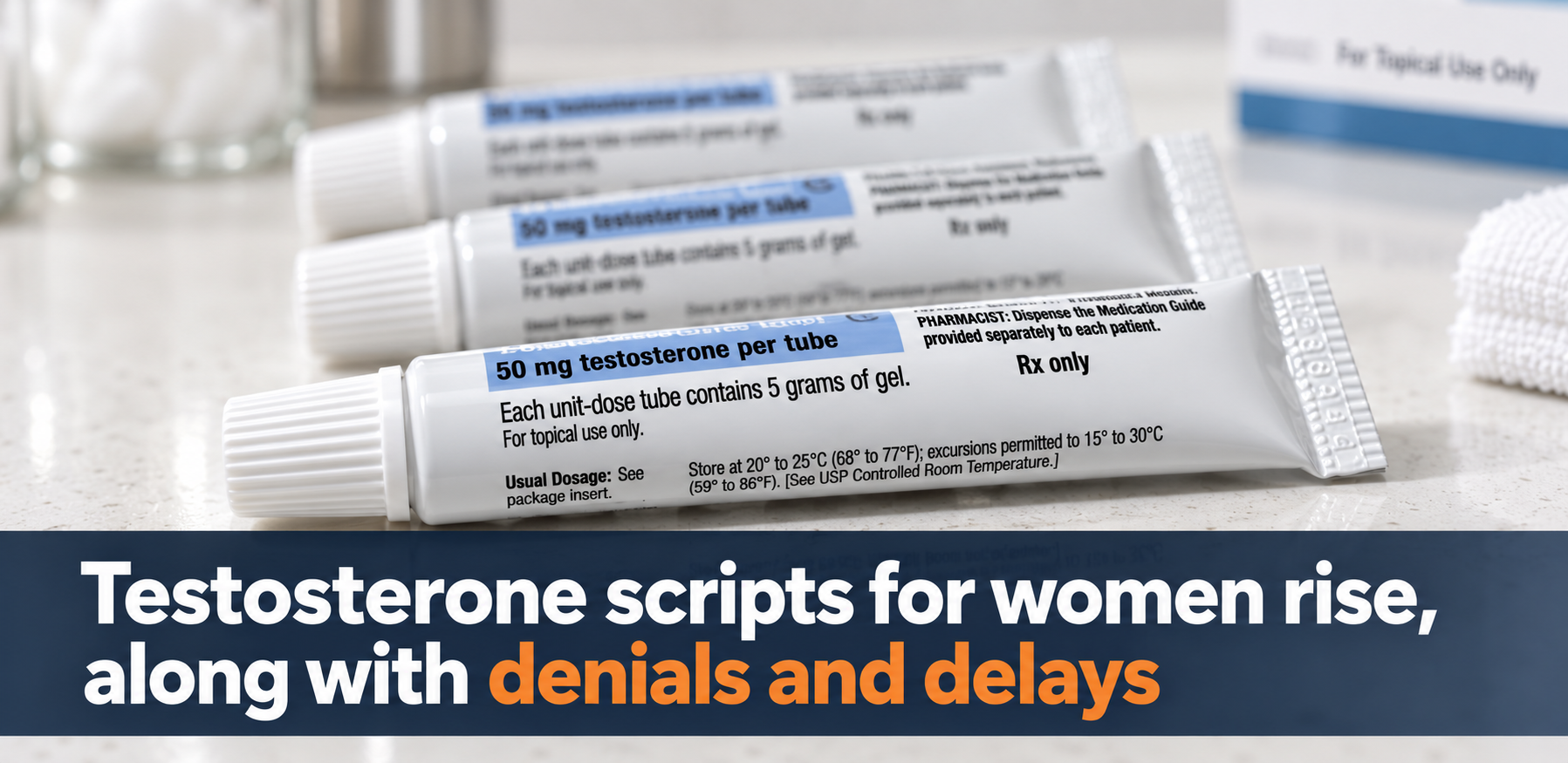
Yet there is a major gap in the U.S. market: no testosterone medication is FDA-approved specifically for women. Doctors can prescribe approved testosterone products off-label, but the medicines available commercially are generally designed and packaged for men. (Reuters)
That mismatch is increasingly creating practical problems for patients trying to obtain treatment.
What Testosterone Is Being Used For
Addressing hypoactive sexual desire disorder amidst broader off-label symptom management
The main evidence-supported use of testosterone in menopausal women is hypoactive sexual desire disorder (HSDD), a condition involving persistently low sexual desire that causes distress.
The Menopause Society and several other medical organizations support testosterone for this specific use.
However, some clinicians are also prescribing testosterone for other menopause-related concerns, including fatigue and loss of muscle strength. Those broader uses do not have the same evidence base.
Dr. Stephanie Faubion, director of Mayo Clinic's Center for Women's Health and medical director of The Menopause Society, said there is not evidence in women that testosterone improves muscle mass, bone density, mood, well-being or other commonly promoted outcomes. (Internazionale)
The distinction is becoming increasingly important as testosterone receives more attention from patients and on social media.
Prescriptions Are Surging
Surging hormone therapy interest drives a 146% increase over three years
The growth in testosterone use is part of a broader increase in interest in hormone therapy for menopause.
The Truveta data analyzed for Reuters show that the rate of women receiving testosterone prescriptions rose 146% from January 2023 to July 2026. (Internazionale)
That growth is happening while the underlying regulatory framework remains largely unchanged.
Women are therefore entering a treatment market where demand is increasing, but the products, labeling and access systems were not originally designed around female patients.
The Problem With Existing Products
Adapting male-oriented commercial products creates dosing and safety hurdles
Most commercially available testosterone products were developed for men.
That matters because women are generally prescribed substantially lower doses.
In practice, some women receiving testosterone have to divide or otherwise customize products designed for male dosing.
This can create questions around whether the patient is consistently receiving the intended dose and whether a product intended for single use can safely be opened, stored and reused.
Pharmacist Kevin Schipper of ProPharma told Reuters that pharmacies may decline certain prescriptions because of concerns involving dosing accuracy, medication safety, stability, storage and contamination. (Internazionale)
Pharmacy Denials and Delays
Retail pharmacies implement restrictions on customized dosing requirements
The access problem is increasingly visible at the pharmacy level.
Jennifer Lanoff, a women's-health nurse practitioner in Washington, D.C., said Amazon Pharmacy rejected testosterone prescriptions from her practice for the first time this year.
Lanoff said her practice had prescribed testosterone off-label for years without this issue and has sometimes had success rewriting prescriptions so patients discard leftover gel rather than save divided doses. (Internazionale)
Amazon said it does not dispense some testosterone prescriptions requiring patients to customize doses, citing safe and compliant dispensing requirements. It also said the policy is not specific to testosterone or based on a patient's sex or gender identity and that it directs customers to compounding pharmacies for specialized doses. (Internazionale)
Other pharmacies have taken different approaches: CVS said its pharmacies regularly fill prescriptions for topical testosterone gel for women, while Walgreens, Costco and Walmart did not respond to Reuters' requests for comment. Kroger declined to comment. (Internazionale)
Patients Are Feeling the Friction
Navigating treatment involves compounding costs, discount hurdles, and fulfillment barriers
The difficulties are not limited to isolated cases.
Magen Price, a nurse practitioner and founder of Mystic Valley Sexual Wellness, said more than one-third of the 80 patients in her practice currently using testosterone have encountered prescription problems, including at CVS and Walgreens, and that those issues have worsened. (Internazionale)
Patients can also face problems once the pharmacy agrees to fill the prescription, such as spending weeks trying to honor discount programs. (Internazionale)
Compounding pharmacies can produce customized doses but can be considerably more expensive, costing approximately $100 for a three-month supply compared with lower costs for discounted commercial options. Most insurance companies do not cover testosterone for women. (Internazionale)
Why There Is No Female-Specific Product
Lack of FDA-approved indications leaves clinicians relying on off-label use
The absence of an FDA-approved testosterone product for women means physicians are working with medications approved for other uses and populations.
The FDA has said that off-label testosterone use in women has not been evaluated by the agency for safety, effectiveness or dosing for those uses. (Internazionale)
A female-specific product would require clinical development establishing the appropriate dose, benefits and risks for women and a formal FDA review to create a more standardized treatment pathway.
The FDA Is Now Reviewing the Evidence
Upcoming public workshop examines sexual function, safety gaps, and clinical endpoints
The issue is receiving direct regulatory attention.
The FDA's Office of Women's Health and Center for Drug Evaluation and Research are holding a public workshop on September 17, 2026, focused specifically on testosterone use in menopausal women to examine current scientific evidence and knowledge gaps across several areas: (U.S. Food and Drug Administration)
- Sexual Function: Examining evidence supporting testosterone for sexual-health conditions. (U.S. Food and Drug Administration)
- Cognition and Mood: Reviewing claims around psychological and cognitive effects. (U.S. Food and Drug Administration)
- Musculoskeletal Health: Considering claims involving muscle and bone health. (U.S. Food and Drug Administration)
- Measurement & Safety: Analyzing testosterone level interpretation and long-term safety data gaps, including cardiovascular and breast-cancer risks. (U.S. Food and Drug Administration)
The FDA Workshop Is Also About Future Drug Development
Establishing regulatory pathways for robust efficacy and safety data
The September 17 meeting is not simply a discussion about current prescribing.
The FDA says the workshop will also address regulatory considerations for developing robust efficacy and safety data that could support a future marketing application for testosterone products intended for menopausal women. (Public Inspection)
That makes the meeting potentially important for pharmaceutical companies considering entry into the market with purpose-built therapies.
More Than 30 Clinical Trials
Active research pipeline signals potential shift toward purpose-built therapies
The commercial opportunity is already attracting research.
More than 30 clinical trials involving testosterone use in women are underway or planned, according to ClinicalTrials.gov data cited by Reuters. (Internazionale)
Marius Pharmaceuticals is preparing a study involving testosterone and sexual dysfunction, while companies are also exploring products designed specifically around women's needs.
This suggests that the market could gradually shift from off-label use of male products toward purpose-built therapies, provided sufficient clinical evidence emerges.
Why a Female-Specific Testosterone Product Could Change the Market
Dedicated products could streamline dosing, fulfillment, and reimbursement
A product designed specifically for women could address several current barriers at the same time:
- Dosing: Establishing appropriate doses for women rather than modifying male-oriented products.
- Pharmacy Fulfillment: Reducing dispensing issues caused by dose customization.
- Regulatory Clarity: Providing clinicians with formal prescribing information specific to the intended population.
- Reimbursement: Offering payers a clearer framework for evaluation, though not guaranteeing immediate coverage.
The Larger Healthcare Market Issue
Ecosystem fragmentation exposes friction across prescribing, fulfillment, and coverage
The testosterone story illustrates a broader problem in healthcare: demand can grow faster than the infrastructure supporting a treatment.
Here, the demand signal is prescription growth, but the rest of the ecosystem remains fragmented across clinician prescribing, pharmacy fulfillment, insurance coverage, patient payment, and continued treatment.
A failure anywhere along that chain can prevent an eligible patient from actually receiving therapy, making the market relevant to pharmaceutical manufacturers, providers, pharmacies, payers, and health-tech companies.
Why This Matters
The rapid rise in testosterone prescriptions shows that there is growing patient and clinician interest in testosterone as part of menopause care, while the U.S. still lacks a testosterone product approved specifically for women. (Internazionale)
The resulting market is fragmented, leading to pharmacy restrictions, higher compounding costs, and limited insurance coverage.
The FDA's September 17 workshop is therefore significant because it brings the evidence, safety, measurement and future drug-development questions into a formal regulatory discussion. (U.S. Food and Drug Administration)
Looking Ahead
Transitioning from off-label fragmentation toward standardized systems
The immediate milestone is the FDA's public workshop on September 17, 2026, followed by the longer-term question of whether emerging research will support an FDA-approved testosterone product for menopausal women.
The market could then move toward a more standardized system with dedicated products, clearer dosing and stronger support, depending on clinical evidence and regulatory requirements.
Key Takeaways
- U.S. testosterone prescriptions for women increased 146% from January 2023 to July 2026. (Internazionale)
- There is no FDA-approved testosterone product specifically for women in the United States. (Internazionale)
- Current evidence and medical guidelines support testosterone primarily for hypoactive sexual desire disorder in menopausal women.
- Some clinicians prescribe testosterone for other symptoms, such as fatigue and muscle strength loss, despite limited supporting evidence. (Internazionale)
- Women often rely on testosterone products designed for men, creating dosing and pharmacy-dispensing challenges.
- Some pharmacies have delayed or rejected prescriptions requiring dose customization. (Internazionale)
- Compounded testosterone provides customized doses but can cost substantially more, and most insurers do not currently cover it. (Internazionale)
- More than 30 clinical trials involving testosterone use in women are underway or planned. (Internazionale)
- The FDA will hold a public workshop on September 17, 2026, examining evidence, safety gaps, measurement, and future drug development. (U.S. Food and Drug Administration)
What This Means for Healthcare Marketers
This is a strong example of a healthcare market where demand, clinical practice and commercial infrastructure are moving at different speeds.
For pharmaceutical companies, the opportunity is potentially broader than creating a new testosterone product, as a female-specific therapy could differentiate through dosing, packaging, regulatory status and ease of access.
For pharmacies, payers and providers, the important market signals are the 146% prescription increase, pharmacy fulfillment friction, limited reimbursement and growing clinical research. (Internazionale)
For healthcare intelligence teams, the emerging opportunity is to connect those signals—rising prescribing, physician behavior, patient demand, regulatory activity, clinical trials and payer access—to provide a much clearer picture of where the women's-health market is heading.