Thermo Fisher Scientific Beats Quarterly Estimates as Research and Biopharma Demand Rebounds
What's Happening
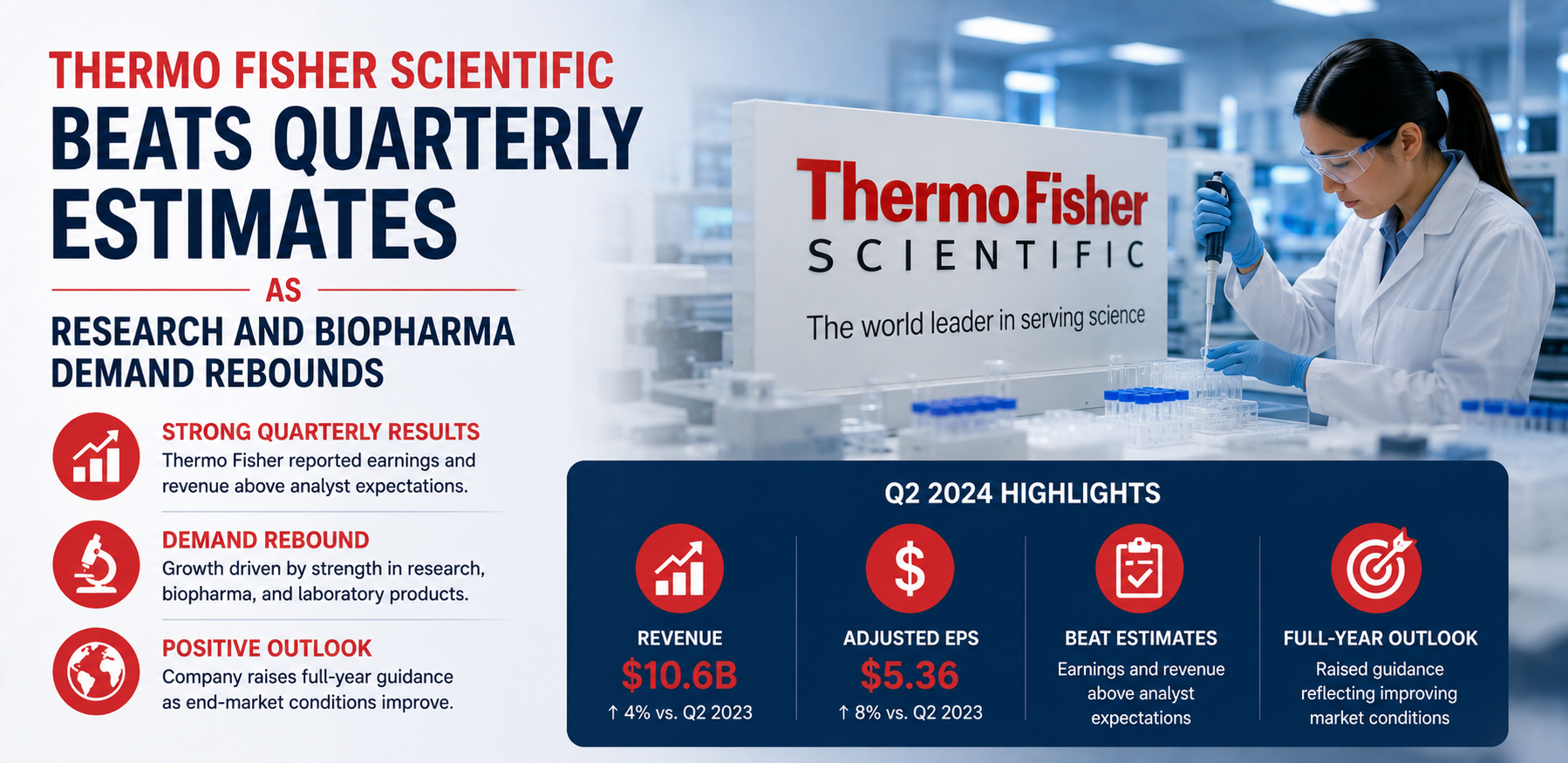
Thermo Fisher Scientific reported stronger-than-expected second-quarter results, signaling renewed momentum across the life sciences industry as customer spending on research, laboratory equipment, and biopharmaceutical services continues to recover.
The company exceeded Wall Street expectations for both revenue and earnings, driven by improving demand from pharmaceutical and biotechnology companies, academic research institutions, and healthcare laboratories. Growth was particularly evident in businesses supporting drug development, laboratory services, and bioproduction, areas that experienced slower spending following the post-pandemic slowdown.
The results suggest that the life sciences market is entering a new phase of growth, fueled by increased investment in precision medicine, biologics, cell and gene therapies, and advanced laboratory technologies.
For healthcare organizations, Thermo Fisher's performance offers another indication that research and development activity across the pharmaceutical ecosystem is gaining strength.
Understanding Thermo Fisher's Role in Healthcare
Unlike pharmaceutical companies that develop medicines, Thermo Fisher Scientific provides the tools, technologies, and services that enable scientific research and healthcare innovation.
Its products and services support virtually every stage of the healthcare ecosystem, including:
- Laboratory instruments.
- Diagnostic technologies.
- Clinical research services.
- Biopharmaceutical manufacturing.
- Genomic sequencing.
- Analytical testing.
- Drug development.
- Laboratory software and automation.
The company's customers include pharmaceutical manufacturers, biotechnology firms, hospitals, academic medical centers, public health laboratories, and government research organizations.
Because Thermo Fisher serves such a broad customer base, its financial performance is often viewed as an indicator of overall investment across the life sciences sector.
Research Spending Is Recovering
Following the extraordinary investment levels seen during the COVID-19 pandemic, many pharmaceutical and biotechnology companies reduced research spending as funding normalized.
Higher interest rates, venture capital slowdowns, and inventory corrections also contributed to weaker demand for laboratory equipment during 2023 and parts of 2024.
Recent results suggest those conditions are improving.
Life sciences organizations are once again increasing investments in:
- Drug discovery.
- Clinical trials.
- Laboratory modernization.
- Biomanufacturing.
- Genomics research.
- Precision medicine.
- Artificial intelligence for biomedical research.
As funding stabilizes and pharmaceutical pipelines continue expanding, demand for laboratory technologies is recovering across both commercial and academic research environments.
Innovation Is Driving Laboratory Growth
Several long-term trends continue supporting investment in advanced laboratory technologies.
Precision Medicine: Healthcare is increasingly moving toward treatments tailored to an individual's genetics, biomarkers, and disease characteristics. This requires sophisticated laboratory equipment capable of generating highly accurate molecular and genomic data.
Biologic Medicines: The growing pipeline of biologics, including monoclonal antibodies, cell therapies, gene therapies, and RNA-based medicines, depends on specialized analytical technologies throughout development and manufacturing.
Artificial Intelligence in Research: AI is helping researchers analyze massive biological datasets, identify potential drug candidates, and accelerate laboratory workflows. As AI adoption grows, demand for high-quality scientific data generated by advanced laboratory instruments continues to increase.
Global Clinical Trials: Drug developers continue expanding clinical research worldwide, creating sustained demand for laboratory testing, sample management, and analytical services that support regulatory submissions.
These structural trends provide long-term growth opportunities for companies supplying research infrastructure rather than individual medicines.
Industry Impact
- Pharmaceutical Companies: Thermo Fisher's results indicate improving confidence among pharmaceutical manufacturers, many of which are increasing investment in research, development, and manufacturing capacity. Strong demand for laboratory technologies often reflects healthy drug development pipelines.
- Biotechnology Companies: Emerging biotech firms rely heavily on laboratory equipment, analytical testing, and contract research services throughout product development. Improved spending suggests continued innovation across early-stage biotechnology.
- Healthcare Providers: Hospitals and academic medical centers benefit from advances in laboratory technologies that improve diagnostic accuracy, support clinical research, and enable precision medicine initiatives.
- Clinical Research Organizations: Growth in laboratory services reflects continued expansion of clinical trials and outsourced research activities. Organizations supporting pharmaceutical development may experience increased demand as drug pipelines advance.
- Investors: Because Thermo Fisher serves customers across nearly every segment of healthcare, its performance is often viewed as a barometer for the broader life sciences industry. Strong quarterly results may signal improving investment trends across pharmaceuticals, biotechnology, diagnostics, and academic research.
Why This Matters
Scientific innovation depends not only on breakthrough discoveries but also on the infrastructure that makes those discoveries possible.
Laboratory technologies are essential for identifying disease mechanisms, developing new medicines, validating diagnostics, and manufacturing advanced therapies.
Thermo Fisher's strong quarter suggests that healthcare organizations are once again increasing investments in research after a period of cautious spending.
As pharmaceutical pipelines continue expanding and precision medicine becomes more widespread, demand for sophisticated laboratory equipment and scientific services is expected to remain strong.
For the broader healthcare industry, continued investment in research infrastructure ultimately accelerates the development of new treatments, improves diagnostic capabilities, and supports better patient outcomes.
Looking Ahead
The life sciences industry is entering a period where technological advancement and scientific discovery are becoming increasingly interconnected.
Growth in AI-assisted drug discovery, genomics, biologics, personalized medicine, and advanced manufacturing will continue driving demand for companies that supply the foundational technologies supporting healthcare innovation.
Rather than serving as a temporary recovery, improving research spending may represent the beginning of a new investment cycle as healthcare organizations pursue more complex therapies and data-driven scientific research.
Companies capable of enabling that innovation through laboratory technologies, analytical services, and biopharmaceutical manufacturing support are likely to remain central to the future of healthcare.
Key Takeaways
- Thermo Fisher Scientific exceeded quarterly revenue and earnings expectations.
- Improving pharmaceutical and biotechnology spending contributed to stronger demand for laboratory technologies and scientific services.
- Recovery in research investment signals renewed momentum across the life sciences industry.
- Precision medicine, biologics, AI-driven research, and clinical trials continue driving long-term demand for advanced laboratory infrastructure.
- Thermo Fisher's performance provides insight into the overall health of the pharmaceutical and biotechnology research ecosystem.
What This Means for Healthcare Marketers
Thermo Fisher's results reinforce that investment in healthcare innovation extends well beyond drug manufacturers. Pharmaceutical companies, biotechnology firms, academic research centers, diagnostic laboratories, and contract research organizations continue expanding their research capabilities as scientific activity accelerates. For healthcare marketers, organizations investing in laboratory modernization, bioprocessing, genomics, automation, and clinical research infrastructure represent high-value prospects. Monitoring companies that report increasing R&D spending and capital investment can help identify healthcare organizations actively preparing for the next generation of medical innovation.