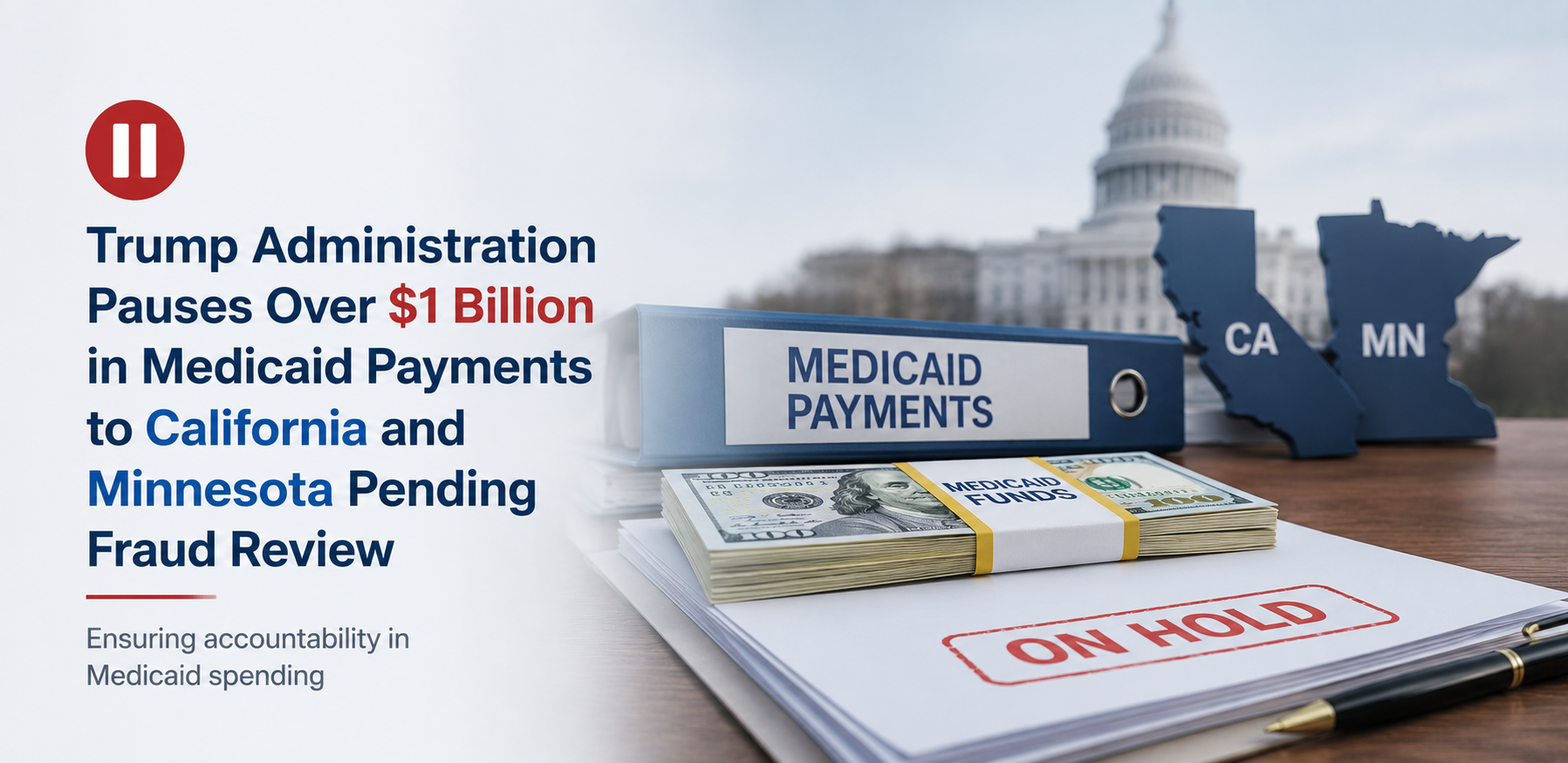
Trump Administration Pauses Over $1 Billion in Medicaid Payments to California and Minnesota Pending Fraud Review
What's Happening
The U.S. Department of Health and Human Services (HHS) and the Centers for Medicare & Medicaid Services (CMS) have deferred more than $1 billion in federal Medicaid payments to California and Minnesota while reviewing claims the agency says may involve fraud, waste, or insufficient documentation.
According to HHS Secretary Robert F. Kennedy Jr., CMS is withholding approximately $867.5 million from California and $199 million from Minnesota until the states provide additional documentation supporting certain Medicaid claims. Federal officials stressed that the payments are being deferred, not permanently cancelled, and can be released if the claims are validated.
The decision marks one of the largest recent Medicaid payment reviews and is part of the administration's broader effort to strengthen oversight of federal healthcare spending.
What Prompted the Review?
CMS said it identified areas where additional verification was needed before releasing federal funds.
For California, the review focuses largely on certain in-home care programs, where federal officials said spending has grown significantly faster than national trends.
For Minnesota, CMS is reviewing claims across 14 service areas that were previously identified as presenting elevated program integrity risks, including services associated with providers that had already drawn scrutiny during earlier reviews.
Federal officials have not publicly released evidence proving fraud but say the documentation review is intended to verify that taxpayer funds were used appropriately before payments are made.
What Is Medicaid?
Medicaid is the largest public health insurance program in the United States, jointly funded by the federal government and individual states.
The program provides healthcare coverage for:
- Low-income adults.
- Children.
- Pregnant women.
- Seniors with limited income.
- People with disabilities.
Although states administer their own Medicaid programs, the federal government reimburses a substantial portion of eligible healthcare expenditures.
Because of Medicaid's size, even small billing errors or improper claims can involve significant amounts of federal funding.
What Does a Payment Deferral Mean?
A payment deferral differs from a funding cut.
Under a deferral:
- States continue operating their Medicaid programs.
- Federal reimbursement is temporarily withheld.
- States can submit additional documentation supporting questioned claims.
- Payments may be released once CMS completes its review.
The administration emphasized that the action is intended to prevent improper payments before taxpayer funds are distributed rather than recovering money after it has already been spent.
States Push Back
Officials in both California and Minnesota criticized the federal action.
California Governor Gavin Newsom called the move politically motivated and said the state remains committed to protecting Medicaid beneficiaries while combating fraud.
Minnesota officials likewise disputed the administration's characterization of their Medicaid program and stated they have already begun submitting the requested documentation for federal review.
The disagreement highlights ongoing tensions between federal oversight responsibilities and state administration of Medicaid programs.
Expanded Anti-Fraud Authority
Alongside the payment deferrals, Secretary Kennedy announced plans to expand the authority of CMS and the HHS Office of Inspector General to exclude providers found to have engaged in fraud or abuse from participating in federal healthcare programs.
The administration says strengthening these enforcement tools will help prevent repeat violations and improve accountability across Medicare and Medicaid.
Industry Impact
- State Medicaid Programs: States may face increased documentation requirements and more intensive federal oversight of Medicaid spending, particularly in high-risk service categories.
- Healthcare Providers: Organizations participating in Medicaid programs could experience greater scrutiny of billing practices and program compliance as CMS expands fraud prevention efforts.
- Federal Regulators: The action signals a shift toward more proactive payment verification, with regulators seeking to identify questionable claims before federal funds are released.
- Medicaid Beneficiaries: Federal officials say the payment deferrals are intended to strengthen program integrity without reducing eligible patient access to care, though state leaders have expressed concerns about potential administrative disruptions.
Why This Matters
The decision represents a significant development in federal Medicaid oversight.
Rather than focusing primarily on recovering improper payments after audits, CMS is placing greater emphasis on verifying claims before reimbursement occurs. If this approach expands nationwide, states and healthcare providers may face more rigorous documentation requirements and longer review processes for certain categories of Medicaid spending.
The announcement also illustrates the growing policy debate over balancing fraud prevention with timely funding for essential healthcare services. While stronger oversight may improve accountability, prolonged payment delays could create operational challenges for state Medicaid programs and healthcare providers that rely on predictable federal reimbursement.
Key Takeaways
- The Trump administration has deferred more than $1 billion in Medicaid payments to California and Minnesota pending additional documentation.
- Approximately $867.5 million is being withheld from California and $199 million from Minnesota.
- CMS says the action is part of a broader effort to prevent fraud, waste, and unsupported Medicaid claims before payments are made.
- The payments are deferred—not permanently cancelled—and may be released after federal review.
- Federal officials also announced expanded authority to exclude providers found to have engaged in fraud from federal healthcare programs.
What This Means for Healthcare Marketers
The administration's action signals that program integrity and financial oversight are becoming increasingly important priorities across U.S. healthcare. Organizations serving Medicaid programs, including health systems, insurers, technology vendors, and compliance solution providers, may see growing demand for tools that improve documentation, claims validation, fraud detection, and regulatory reporting.
For healthcare marketers, the announcement underscores the importance of positioning solutions around transparency, compliance, and operational efficiency. As healthcare organizations prepare for heightened scrutiny, technologies that simplify auditing, automate documentation, and strengthen payment integrity are likely to receive greater attention from decision-makers.
For healthcare intelligence teams, the development serves as an important indicator of evolving federal policy. Monitoring Medicaid oversight initiatives, reimbursement changes, enforcement actions, and regulatory guidance can provide early insight into future purchasing priorities across public healthcare programs.