What's Happening
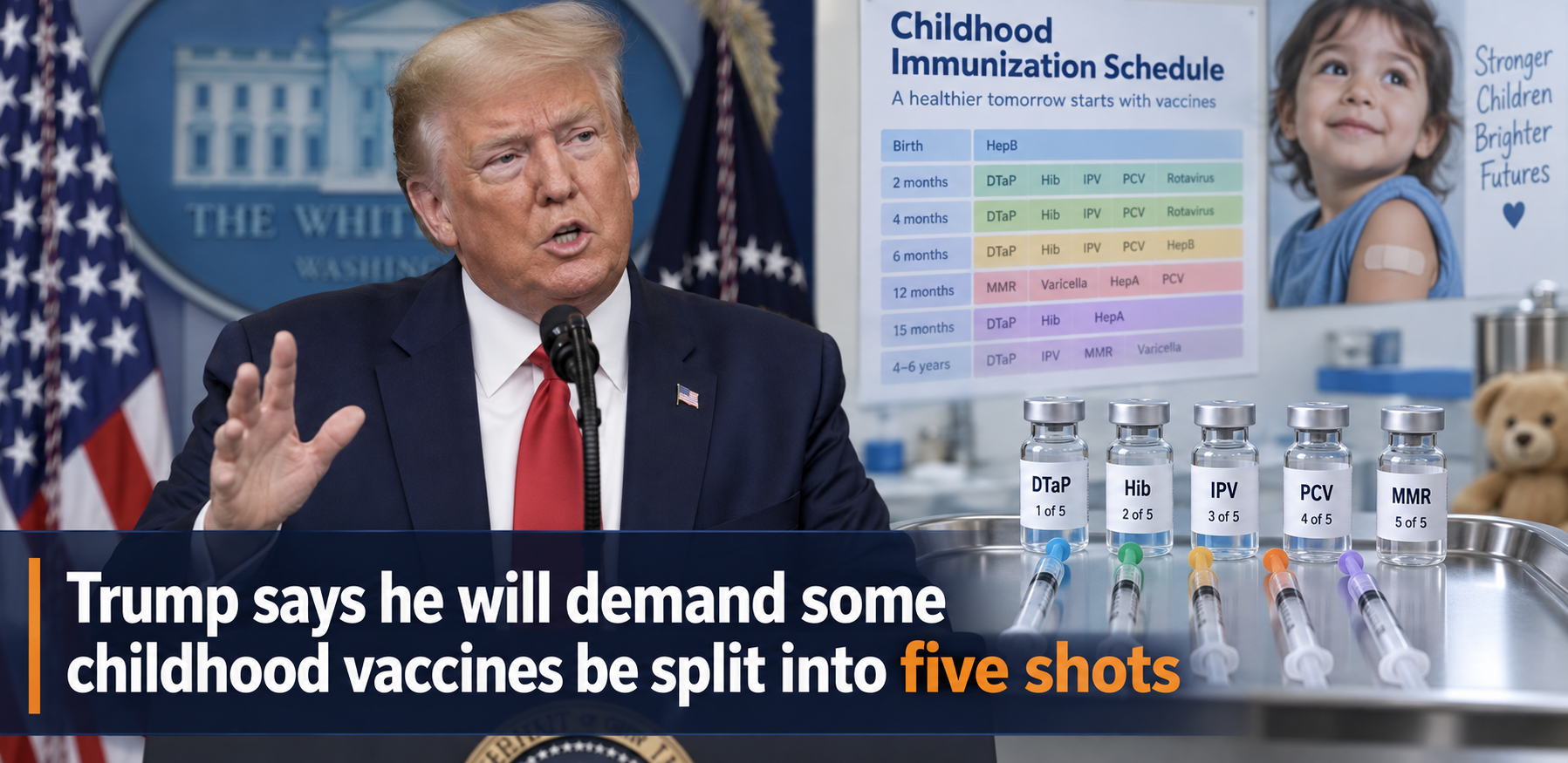
U.S. President Donald Trump said on September 18 that his administration plans to ask vaccine manufacturers to divide certain childhood vaccines into five separate doses, with the doses administered at six-month intervals.
Trump said the approach would involve giving children smaller amounts of vaccine over a longer period. He also said he believes the change would lead to a major reduction in autism. He did not identify which vaccines would be affected or provide scientific evidence supporting a connection between vaccination and autism.
The announcement comes after the administration took steps in August to change the U.S. childhood vaccination schedule and reduce the number of vaccines recommended universally for children.
What Trump Proposed
Speaking at an event in the Oval Office, Trump said vaccine makers should provide some childhood vaccines as five separate doses rather than as a single vaccination.
He proposed giving those doses six months apart, saying the goal would be to put a smaller amount of vaccine into a child's body at one time.
However, the administration has not publicly identified:
- Which specific vaccines would be divided
- Whether manufacturers would be required or formally directed to change existing products
- How the proposed five-dose schedule would be incorporated into the childhood immunization schedule
- What clinical evidence would support such a change
Those details remain unresolved.
Autism Claim Has Not Been Supported by the Established Evidence
Trump linked the proposed change to autism, saying that splitting vaccines could substantially reduce autism rates.
Reuters reported that scientists have repeatedly debunked the underlying idea that childhood vaccines cause autism, and Trump did not provide evidence supporting the claim in his announcement.
The World Health Organization's Global Advisory Committee on Vaccine Safety reviewed research published through August 2025 and reaffirmed that the available high-quality evidence does not show a causal relationship between vaccines and autism. The review examined 31 primary research studies as well as multiple meta-analyses. (World Health Organization)
The American Academy of Pediatrics likewise says research conducted over multiple decades and in different countries has found no link between vaccines and autism. (AAP)
The FDA's consumer guidance states that scientific evidence does not support a link between vaccination and autism. (U.S. Food and Drug Administration)
The Federal Position on Autism Has Become More Complicated
There is an important change in federal messaging that is relevant to this story.
The CDC updated its vaccine-safety information in July 2026 and now says that the statement "vaccines do not cause autism" is not an evidence-based claim because, according to the agency's current wording, studies have not ruled out the possibility of some infant vaccines contributing to autism. The CDC says HHS has launched a broader assessment of autism causes and potential biological mechanisms. (CDC)
That position differs from the long-standing stance of U.S. public-health agencies and from the conclusions of major scientific reviews, including the WHO's 2025 evidence review. (World Health Organization)
The distinction is important when interpreting Trump's remarks: his proposed vaccination changes and his autism-related rationale are part of an ongoing federal policy shift, while major scientific reviews continue to find no causal vaccine-autism relationship.
August Executive Order Already Changed the Direction of U.S. Vaccine Policy
Trump had already signed an executive order in August directing changes to the childhood immunization schedule.
The order called for the schedule to contain 11 childhood immunizations, down from the previous number recommended universally by federal health authorities, according to Reuters. Trump described the revised approach as providing "gold-standard" protection while bringing the U.S. closer to countries that recommend fewer routine shots.
The order also directed that children receive separate measles, mumps and rubella vaccines rather than the combined MMR vaccine.
That presents an immediate practical issue because individual measles, mumps and rubella vaccines are not currently licensed in the United States, meaning manufacturers would need to develop and obtain authorization for separate products before they could be routinely used. Reuters reported that experts said this could take years, if such products become available.
Combination Vaccines Are Commonly Used
The U.S. childhood vaccination system has historically relied in part on combination vaccines to reduce the number of injections children receive.
The CDC's vaccine information lists products that combine multiple components, including vaccines covering combinations of diphtheria, tetanus, pertussis, hepatitis B, polio and Haemophilus influenzae type B. It also lists the combined measles, mumps, rubella and varicella vaccine. (CDC)
Splitting vaccines into additional injections would therefore represent a significant change in how some childhood immunizations are delivered.
It could affect the number of healthcare visits, the timing of protection and the logistics involved for pediatric practices, parents and vaccine suppliers.
More Doses Could Mean More Healthcare Visits
A five-dose approach spaced six months apart would substantially change the timing of childhood vaccination.
Depending on which vaccines were affected, children could need more visits to physicians, pediatric clinics or pharmacies to complete a series.
That could have implications for:
- Parents and families: More appointments could mean additional transportation, scheduling and time costs.
- Pediatric practices: Clinics would need to manage additional vaccination appointments and maintain appropriate vaccine supplies.
- Public-health programs: Government vaccination programs would need to adjust procurement, scheduling systems and communications.
- Manufacturers: Existing vaccines might need new formulations, labeling or clinical and regulatory work if the administration seeks products designed specifically around a different dosing pattern.
The Measles Situation Adds Urgency to the Debate
The vaccination debate is unfolding while the United States is experiencing a significant measles outbreak.
The CDC reported 3,471 confirmed measles cases as of September 17, 2026, up from 3,294 one week earlier.
Pennsylvania alone has reported more than 700 cases and four measles-associated deaths, although the state and federal government have disagreed over how those deaths should be counted.
The CDC says two doses of MMR vaccine are about 97% effective against measles, while one dose is about 93% effective. (CDC)
That makes vaccination timing and completion particularly important while measles transmission is increasing.
The Proposed Five-Dose Approach Is Not Yet Fully Defined
Trump's announcement establishes an intended direction, but not a complete policy.
He did not specify which vaccines would be split or explain how the administration would implement the change.
There is also a distinction between a presidential statement about what the administration plans to request from manufacturers and an actual change to federal vaccine recommendations or vaccine licensure.
Vaccines licensed in the U.S. are subject to FDA review for safety and effectiveness. Any new formulation or dosing regimen would need to go through the applicable regulatory process. (U.S. Food and Drug Administration)
What Could Change for Vaccine Manufacturers
If manufacturers are asked to develop five-dose versions of existing childhood vaccines, companies could face additional research and development work.
A change in dosage schedule is not simply a packaging change. Manufacturers and regulators would need to establish that the proposed formulation and dosing schedule provide the intended immune response and maintain an acceptable safety profile.
Manufacturers could also face new production and distribution requirements because more individual doses would be needed to deliver the same immunization program.
At the same time, changes in the recommended schedule can influence demand forecasts, government procurement contracts and inventory planning.
Implications for Pediatric Healthcare
Pediatric healthcare systems could be affected even before any new vaccines reach the market.
Changes to recommendations can require providers to update clinical protocols, electronic medical records, staff training and patient communications.
More appointments could also put pressure on pediatric practices that already operate with limited appointment capacity.
Schools and childcare providers could eventually have to adjust documentation requirements if vaccination schedules change substantially, although the exact consequences would depend on federal and state policy.
Why This Matters
The proposal would represent a substantial change in the way childhood immunization is delivered in the United States.
It is occurring alongside other federal efforts to reshape vaccine recommendations, while measles cases are rising and public confidence in some childhood vaccines has weakened. Reuters/Ipsos polling earlier in September found that the share of Americans who considered measles, mumps and rubella vaccines safe had fallen from 84% in 2020 to 76% in 2026.
For the healthcare system, the consequences extend beyond the vaccines themselves. Changes to schedules can affect physician visits, procurement, insurance and government programs, patient communications and disease-prevention strategies.
The scientific evidence concerning autism also remains an important part of the discussion. Major independent evidence reviews continue to find no causal relationship between childhood vaccination and autism. (World Health Organization)
Looking Ahead
The administration would need to provide substantially more detail before the proposed five-dose approach could become a practical vaccination program.
The most important questions are which vaccines would be affected, what evidence would support the new schedules, how vaccine manufacturers would respond and what regulatory changes would be required.
The administration's broader vaccination policy is also continuing to develop, including the August changes to the number of universally recommended childhood immunizations and the direction to separate measles, mumps and rubella vaccination.
Meanwhile, public-health officials are dealing with an active measles outbreak and declining vaccine confidence, making the effects of any changes to vaccination schedules particularly consequential.
What This Means for Healthcare Marketers
For healthcare marketers, changing vaccine recommendations can create rapid shifts in patient demand, provider communication needs and healthcare purchasing patterns.
Pediatric healthcare organizations and vaccine manufacturers may need to communicate new schedules, explain changes to parents and manage questions about safety and effectiveness.
For healthcare B2B companies, developments such as changes to federal recommendations, manufacturer plans, vaccination rates and outbreak activity can serve as early indicators of shifts in demand across pediatric care, public health, diagnostics and vaccine supply chains.
Key Takeaways
- Trump said his administration plans to ask manufacturers to split certain childhood vaccines into five separate doses.
- He proposed giving those doses at six-month intervals.
- Trump linked the proposal to a belief that it could reduce autism but did not provide scientific evidence for that claim.
- Major scientific reviews, including a WHO review of research through 2025, have found no causal relationship between vaccines and autism. (World Health Organization)
- The administration had already moved to reduce the number of universally recommended childhood immunizations and directed that MMR vaccination be separated into individual shots.
- Individual measles, mumps and rubella vaccines are currently not licensed in the U.S., creating a practical barrier to that part of the policy.
- The proposal comes as U.S. measles cases continue to rise, with 3,471 confirmed cases reported nationally as of September 17.
- The details of the proposed five-dose approach, including which vaccines would be affected and how it would be implemented, have not yet been specified.