What's Happening
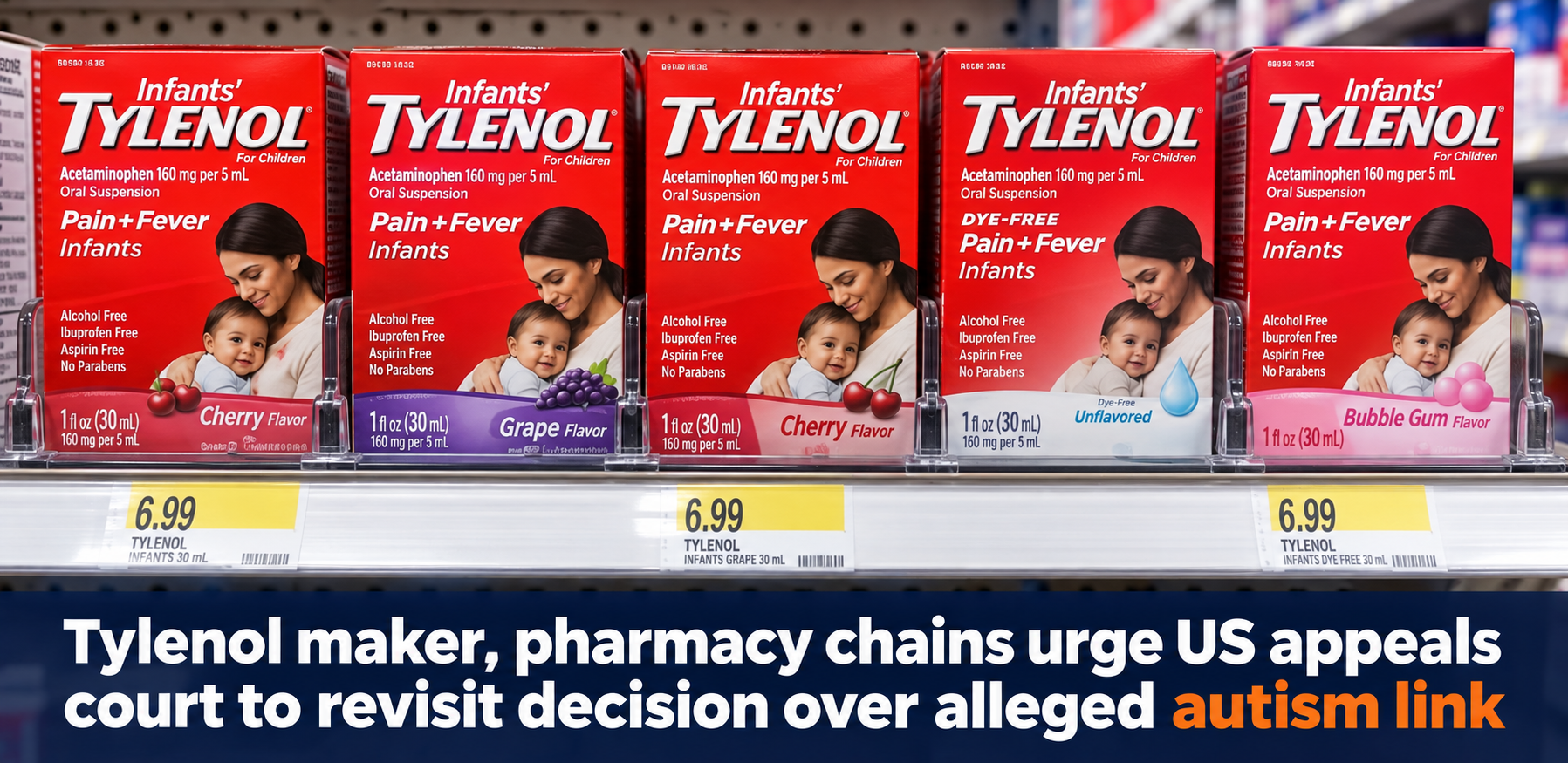
Kenvue, the maker of Tylenol, and a group of major U.S. pharmacy and retail chains have asked a federal appeals court to reconsider a decision that revived more than 500 lawsuits alleging that using Tylenol during pregnancy is linked to autism and attention-deficit/hyperactivity disorder (ADHD) in children.
In a filing with the 2nd U.S. Circuit Court of Appeals in Manhattan, the defendants argued that the appeals court was wrong to overturn a lower-court decision that had excluded expert testimony supporting the plaintiffs' claims.
The companies say the original district judge, Denise Cote, was properly acting as the gatekeeper for scientific evidence and that juries should not be asked to resolve complex scientific questions before courts establish that the evidence is reliable enough to be presented at trial.
The plaintiffs, meanwhile, are seeking to move forward with their claims against Kenvue and the retailer defendants.
The Appeals Court Previously Revived More Than 500 Lawsuits
The July decision changed the direction of the litigation
The current dispute follows a July 13 decision by the 2nd Circuit that revived more than 500 lawsuits that had been blocked by Judge Cote.
The appeals court ruled that Cote had improperly excluded testimony from three doctors who were prepared to testify about a possible connection between prenatal acetaminophen exposure and autism or ADHD.
The appellate court's decision did not determine that Tylenol causes autism or ADHD.
Instead, it focused on whether the scientific testimony should have been excluded before a trial.
That distinction is extremely important because allowing expert testimony does not mean the experts' conclusions have been scientifically proven.
The Defendants Say the District Judge Should Have the Final Word on Expert Evidence
The companies are challenging the scientific-evidence ruling
In their latest filing, Kenvue and the pharmacy chains argued that federal evidence rules make district judges the “true gatekeepers” for determining whether scientific testimony is reliable enough to reach a jury.
Their argument is that the appeals court went too far when it reinstated the lawsuits.
The defendants contend that Judge Cote carefully examined the methodology used by the plaintiffs' experts and correctly decided that their evidence did not meet the necessary standard for admission.
The companies therefore want the 2nd Circuit to reverse its July ruling.
Three Experts Are at the Center of the Fight
The scientists had different areas of expertise
Judge Cote had excluded testimony from three doctors whose opinions supported the plaintiffs' theory.
They include:
- Andrea Baccarelli, dean of the Harvard T.H. Chan School of Public Health
- Eric Hollander, a psychiatry professor at Albert Einstein College of Medicine
- Brandon Pearson, a toxicologist formerly affiliated with Columbia University
The defendants argue that their testimony should not have been allowed to reach a jury because the underlying scientific evidence is not sufficiently reliable or established.
The plaintiffs' lawyers, however, argue that the experts used legitimate scientific methods and should be permitted to explain their conclusions to jurors.
The Defendants Want the Appeals Court to Reconsider Its July Ruling
Reconsideration is rarely granted
The defendants are asking the 2nd Circuit to revisit its own decision.
That is a difficult request because federal appeals courts rarely reconsider their own rulings.
The companies have proposed an alternative outcome if the court refuses to completely reverse its earlier decision.
They want the court to make clear that the experts' opinions are not automatically admissible and send the issue back to Judge Cote for another assessment.
That would preserve the possibility that the lower court could once again exclude some or all of the disputed testimony.
Kenvue Is the Defendant Most Directly Associated With Tylenol
Kenvue owns the consumer Tylenol business
Kenvue is the company responsible for the Tylenol brand.
The company was separated from Johnson & Johnson in 2023 as part of the creation of Kenvue as an independent consumer-health company.
The litigation therefore involves a major consumer-health brand whose products are widely used for pain and fever relief.
That makes the scientific debate particularly consequential because any finding that materially changes how prenatal acetaminophen use is perceived could have substantial effects on consumer behavior and the broader pain-relief market.
Major Pharmacy and Retail Companies Are Also Defendants
The case extends beyond Kenvue
The defendants include a large group of pharmacy chains, retailers and other sellers.
Among them are:
- Albertsons, Costco, CVS, Dollar General, Dollar Tree, Family Dollar, Kroger, Safeway, 7-Eleven, Target, Walgreens and Walmart.
The inclusion of retailers is important because the lawsuits are not limited to allegations against the manufacturer.
Plaintiffs are also pursuing claims against companies that sold Tylenol and other acetaminophen products.
That creates potentially broad liability questions across the consumer-health distribution chain.
Medical Experts Generally Consider Acetaminophen Appropriate During Pregnancy
The scientific debate remains unsettled
Doctors and major medical organizations generally consider acetaminophen, the active ingredient in Tylenol, to be the preferred medication for treating pain and fever during pregnancy.
At the same time, the litigation concerns research examining whether prenatal exposure could be associated with certain neurodevelopmental outcomes.
The current legal fight is therefore taking place against a background of scientific disagreement and uncertainty, rather than an established medical finding that acetaminophen causes autism or ADHD.
Reuters notes that there is no firm scientific evidence establishing such a link.
The Appeals Court Did Not Rule That Tylenol Causes Autism
This point is central to understanding the case
The July appellate decision did not conclude that acetaminophen causes autism or ADHD.
Instead, the court ruled that Judge Cote had been wrong to exclude the plaintiffs' experts at the earlier stage of the litigation.
That means the legal process has moved closer to allowing the claims to be tested through litigation, but the underlying scientific question remains unresolved.
The defendants are now asking the appeals court to revisit that procedural decision.
The Debate Centers on How Courts Handle Unsettled Science
Judges must decide what evidence juries can hear
The case illustrates an important part of the U.S. legal system involving scientific evidence.
Before expert testimony is presented to a jury, judges can be required to determine whether the methods and evidence behind the testimony are sufficiently reliable.
That creates a difficult balance.
Courts want to prevent juries from hearing unsupported scientific claims.
But they also need to avoid excluding legitimate scientific opinions simply because a field contains competing interpretations or ongoing debate.
The 2nd Circuit's July decision emphasized that legitimate interpretations of scientific evidence can diverge.
The defendants argue that the appeals court applied that principle too broadly.
Political Attention Has Increased the Pressure
The issue has become part of a broader public debate
The Tylenol controversy gained significant political attention after President Donald Trump and senior U.S. health officials suggested a possible connection between acetaminophen use during pregnancy and autism in 2025.
That political discussion increased public attention around the scientific research and the lawsuits.
However, the federal court proceedings remain focused on the legal and evidentiary questions before the judges.
The appeals court is not being asked simply to decide whether a political statement is correct. It must determine whether the lower court properly handled expert scientific testimony under federal evidence rules.
Why This Matters
The latest filing is important because it could determine whether more than 500 Tylenol-related lawsuits proceed toward trials or face another major evidentiary barrier.
The central issue is not yet whether Tylenol causes autism or ADHD.
Instead, it is whether the plaintiffs should be permitted to present expert testimony arguing that such a connection exists.
That procedural question has enormous consequences because without admissible expert evidence, the plaintiffs' claims may have difficulty moving forward.
The case also demonstrates how courts handle controversial scientific questions where the research is still unsettled.
Looking Ahead
Next steps for the appeals court and litigation
The immediate question is whether the 2nd Circuit will agree to reconsider its July decision.
The court rarely revisits its own rulings, so the defendants face a significant procedural hurdle.
If the court refuses to reconsider the decision, the defendants have asked it to clarify that the experts' opinions are not automatically admissible and allow Judge Cote to conduct another review.
If the appeals court leaves the July ruling intact, the litigation could continue toward further proceedings involving the scientific evidence and potentially trials.
The outcome could have major implications for Kenvue and the retailer defendants, while also influencing how courts handle scientific evidence in other mass-tort cases involving widely used healthcare products.
Key Takeaways
- Kenvue and major pharmacy and retail chains have asked the 2nd Circuit to reconsider its decision reviving more than 500 lawsuits involving alleged prenatal Tylenol exposure and autism or ADHD.
- The lawsuits allege that acetaminophen use during pregnancy can be linked to autism and ADHD in children.
- The 2nd Circuit revived the cases on July 13 after finding that a lower court improperly excluded key expert testimony.
- The disputed experts include researchers from Harvard, Albert Einstein College of Medicine and Columbia University.
- Judge Denise Cote had excluded their testimony after reviewing the scientific evidence.
- The defendants argue that district judges should act as the gatekeepers of scientific evidence presented to juries.
- The companies say juries should not be asked to resolve complex scientific questions without first determining whether expert evidence is reliable.
- The defendants include Kenvue, Albertsons, Costco, CVS, Dollar General, Dollar Tree, Family Dollar, Kroger, Safeway, 7-Eleven, Target, Walgreens and Walmart, among others.
- Medical professionals and medical organizations generally consider acetaminophen the preferred treatment for pain and fever during pregnancy.
- There is no firm scientific evidence establishing that acetaminophen causes autism or ADHD.
- The July appeals-court decision did not rule that Tylenol causes autism or ADHD.
- Kenvue continues to maintain that Tylenol is safe and that reliable independent science has not established the alleged link.
- The 2nd Circuit rarely reconsiders its own decisions, making the defendants' request difficult.
- If the court does not reverse its earlier decision, the defendants want it to clarify the experts' admissibility and allow the lower court to reconsider the issue.
What This Means for Healthcare Marketers
This case shows how scientific uncertainty can become a major commercial signal before a final scientific or legal conclusion exists.
For consumer-health brands, a disputed health claim can affect consumer trust, physician conversations, product demand, labeling expectations and retail behavior long before a court determines whether the claim is true.
The key lesson is to distinguish between scientific association, expert testimony, regulatory conclusions and proven causation. They are not the same thing.
For healthcare marketers, monitoring litigation alongside scientific research is particularly important because a court decision can rapidly change how a product is discussed, even when the underlying medical question remains unsettled.