
uniQure Seeks U.S. Approval for Huntington’s Gene Therapy After FDA Reversal
What's Happening
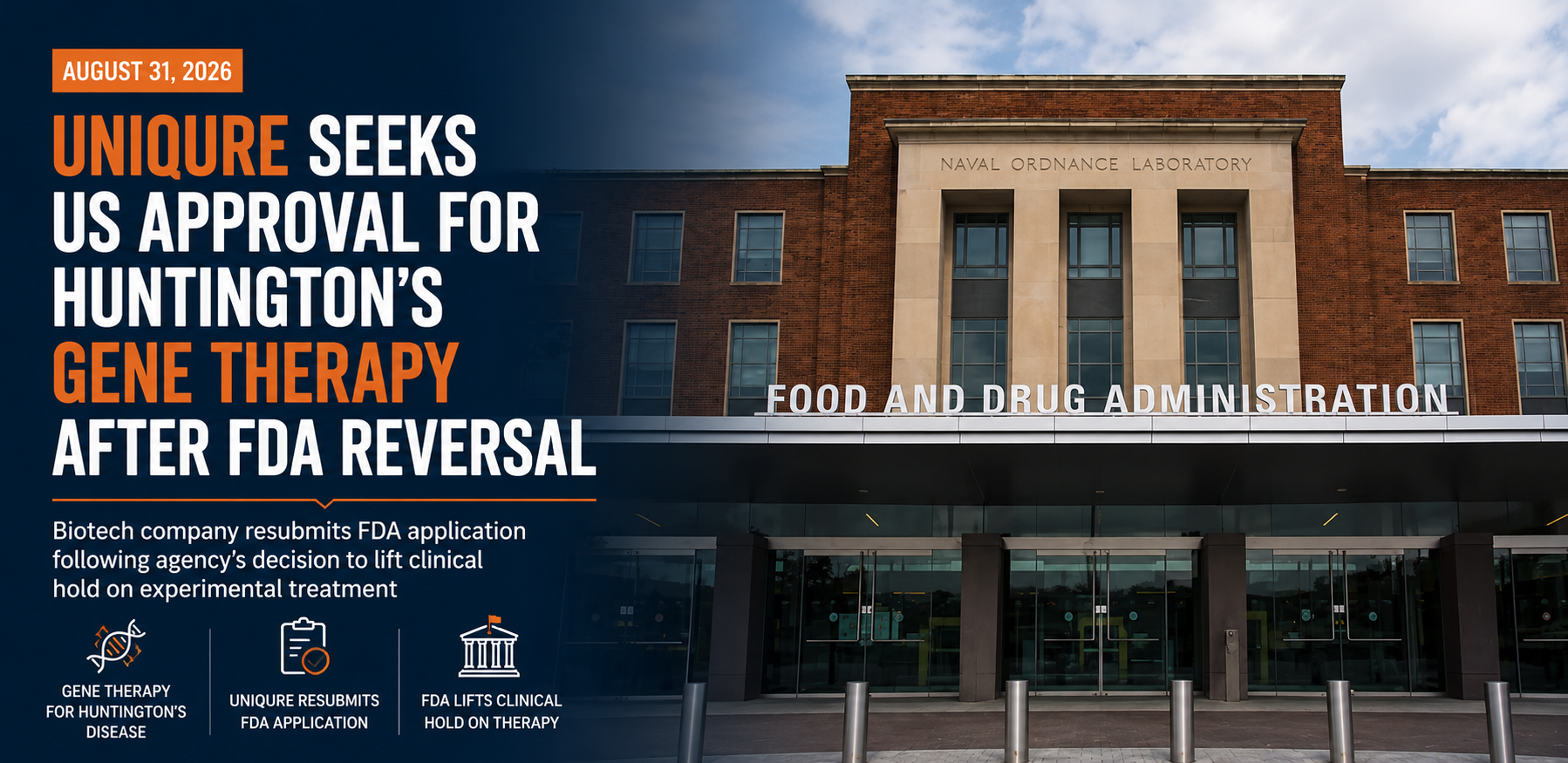
Dutch gene therapy developer uniQure has submitted an application to the U.S. Food and Drug Administration seeking accelerated approval for its experimental Huntington’s disease treatment, AMT-130, following a major reversal in the FDA’s position on the therapy.
The company said it submitted the marketing application for ifezuntirgene inilparvovec, also known as AMT-130, and has asked the FDA for priority review. If granted, priority review would reduce the FDA's review period to approximately six months, compared with the standard 10-month review period. (Reuters)
The filing is a significant turnaround after months of tension between uniQure and the FDA. The agency had previously told the company that its existing evidence was insufficient to support a marketing application and had pushed for a new trial involving a placebo-surgery control group. In June, however, the FDA reversed that position and agreed to accept the existing trial data for an accelerated review. (Reuters)
What Is Huntington's Disease?
A rare inherited neurological disorder
Huntington's disease is a rare inherited brain disorder that progressively damages neurological function.
The disease can cause:
- Movement difficulties
- Behavioral changes
- Cognitive decline
It is caused by an inherited genetic mutation and progressively affects the brain. There are currently no approved medicines that slow the underlying progression of Huntington's disease, making disease-modifying treatment a major unmet medical need. (Reuters)
Existing treatments can help manage certain symptoms, but they do not stop or substantially slow the progression of the disease.
That makes AMT-130 particularly important because it is intended as a gene therapy designed to alter the disease process, rather than simply treating symptoms.
uniQure Has Submitted AMT-130 for Accelerated Approval
The application is based on existing clinical data
uniQure's application is supported by three-year data from its clinical program.
The company said those data showed that patients treated with AMT-130 experienced slower disease progression compared with comparable patients drawn from an external Huntington's disease database. (Reuters)
uniQure expects to present four-year data later in the third quarter of 2026, giving regulators additional information as they assess the therapy. (Reuters)
The company is therefore asking the FDA to make a decision based on the existing evidence rather than requiring another large trial before considering approval.
Why the FDA Changed Its Position
The regulator initially rejected the available evidence
The relationship between uniQure and the FDA became increasingly contentious during the development of AMT-130.
The agency had previously indicated that the available data were not sufficient to support a marketing application.
A senior FDA official, Vinay Prasad, had gone further by referring to AMT-130 as a "failed product." (Reuters)
That position created significant uncertainty for uniQure because Huntington's disease presents unusual challenges for clinical trials.
The FDA wanted another controlled trial
The FDA had sought a new trial containing a placebo-surgery control group.
That request generated criticism because Huntington's disease gene therapy requires an invasive brain procedure to administer the treatment. A placebo-surgery study would therefore require some participants to undergo the invasive procedure without receiving the gene therapy itself. (Reuters)
For rare diseases, such a requirement can also create practical problems because the number of potential trial participants is limited.
The disagreement therefore became a major regulatory obstacle for uniQure.
The June FDA Reversal Changed the Development Path
In June, the FDA reversed its earlier position and told uniQure that it would accept the existing trial data for an accelerated review. (Reuters)
That decision opened the door for the company to submit the marketing application now before the agency.
For uniQure, the reversal effectively transformed AMT-130 from a program facing another potentially lengthy clinical trial into one that could potentially reach an FDA decision much sooner.
The development also represents a broader change in the FDA's relationship with rare-disease developers.
The FDA Leadership Change Is Part of the Story
Prasad left the agency
The dispute took place during the tenure of Vinay Prasad, who had been the FDA's senior regulator overseeing vaccines and gene therapies.
Prasad, who faced criticism over several decisions affecting rare-disease drug developers, left the FDA in April. (Reuters)
A new acting commissioner took over
Kyle Diamantas, who became acting FDA commissioner in May, has since sought to restore relationships with biotechnology companies and rare-disease groups.
Reuters reported that Diamantas has raised hopes among rare-disease advocates as the agency works to repair relationships with several biotechnology companies following a turbulent period for the FDA. (Reuters)
The shift in leadership provides important context for the reversal on AMT-130.
While the FDA's decision is ultimately about the scientific and regulatory evidence surrounding the therapy, changes in leadership can also affect how unresolved regulatory disagreements are handled.
This Is an Important Test for Gene Therapy Regulation
Gene therapies create unusual regulatory challenges
AMT-130 illustrates some of the difficulties regulators face when evaluating gene therapies for rare, progressive diseases.
Traditional drug development often relies on large patient populations and long-term randomized trials.
Rare neurological diseases such as Huntington's can make those traditional approaches more difficult because relatively few patients are available for clinical trials and meaningful disease progression can take years to measure.
For regulators, the challenge is determining how much evidence is enough to establish that a potentially transformative treatment works while ensuring that patients are not exposed to ineffective or unsafe products.
External Data Are Playing a Major Role
One of the most important aspects of uniQure's application is its use of an external Huntington's disease database as a comparison group.
Rather than relying solely on a traditional placebo arm within the same trial, uniQure's analysis compares treated patients with comparable individuals from an external dataset. (Reuters)
This type of approach can be particularly relevant in rare diseases where assembling large randomized control groups can be difficult.
At the same time, comparisons with external controls can create methodological challenges because differences between patient populations, treatment settings and data collection methods can influence the apparent treatment effect.
The FDA will therefore have to assess not just whether disease progression appears slower, but whether the evidence is sufficiently reliable to support accelerated approval.
Accelerated Approval Could Significantly Shorten the Path to Market
Priority review could cut the FDA timeline
uniQure has also requested priority review.
If the FDA grants that request, the agency's review would take approximately six months, compared with roughly 10 months under the standard review process. (Reuters)
For a disease with no approved treatment that slows progression, the difference could be highly meaningful.
A faster regulatory decision could allow patients with Huntington's disease to gain access to a potentially disease-modifying therapy sooner.
For uniQure, it would also bring the company closer to commercialization of a program that has been under development for years.
The Treatment Still Has to Clear the FDA
The FDA's reversal does not mean AMT-130 has been approved.
The agency has agreed to accept the existing evidence for an accelerated review, but it still has to evaluate the submission and determine whether the therapy meets the applicable standards for approval. (Reuters)
That distinction is important.
The reversal removes a major procedural obstacle, but uniQure still faces questions about the strength of the efficacy evidence, durability of benefit and safety profile.
The upcoming four-year data could also become important to the regulatory discussion.
uniQure Is Pursuing Approval in Britain Too
The company is not limiting its regulatory strategy to the United States.
uniQure has also submitted an application for AMT-130 to Britain's medicines regulator. (Reuters)
Parallel regulatory filings allow the company to pursue potential commercialization across multiple markets rather than waiting for the U.S. process to finish before approaching other regulators.
For rare-disease therapies, regulatory approval in multiple countries can be especially important because the patient population in any individual market is relatively small.
Why This Matters
AMT-130 represents a significant potential development for Huntington's disease because there are currently no approved treatments that slow the underlying progression of the disease.
The bigger significance, however, extends beyond one therapy.
The case demonstrates how rare-disease drug development can collide with traditional regulatory expectations. Requiring large, conventional placebo-controlled studies may be difficult when patient populations are small and the treatment itself requires an invasive procedure.
The FDA's reversal suggests greater willingness, at least in this case, to consider existing data and external controls for an accelerated review rather than automatically requiring another invasive trial.
For biotechnology companies developing gene therapies, that could become an important regulatory precedent.
Looking Ahead
The next major development will be the FDA's decision on whether to grant priority review and then how the agency evaluates uniQure's accelerated-approval application.
The company is also expected to release four-year AMT-130 data later in the third quarter of 2026, potentially providing more evidence about whether the treatment's apparent slowing of disease progression is sustained. (Reuters)
The U.S. regulatory decision could become one of the most closely watched gene-therapy decisions in rare neurological disease because it will test how regulators balance traditional evidence requirements against the realities of developing therapies for small patient populations.
The British regulatory review will provide another important indication of how international regulators view the therapy and the evidence supporting it.
Key Takeaways
- uniQure has filed for U.S. accelerated approval of AMT-130, its experimental gene therapy for Huntington's disease. (Reuters)
- The company has requested priority review, which could reduce the FDA review period from about 10 months to six months. (Reuters)
- The application is supported by three-year data showing slower disease progression compared with comparable patients in an external Huntington's disease database.
- uniQure expects to release four-year data later in Q3 2026. (Reuters)
- The FDA had previously said the existing evidence was insufficient and had sought a new placebo-surgery-controlled trial.
- In June, the FDA reversed that position and agreed to accept the existing data for accelerated review. (Reuters)
- The earlier regulatory dispute occurred during the tenure of Vinay Prasad, who subsequently left the agency.
- Acting FDA Commissioner Kyle Diamantas has sought to improve relationships with rare-disease biotechnology companies. (Reuters)
- Huntington's disease currently has no approved drugs that slow disease progression. (Reuters)
- uniQure has also filed for approval with Britain's medicines regulator.
- The FDA's acceptance of the application is not an approval; the agency still has to determine whether the evidence supports marketing authorization.
What This Means for Healthcare Marketers
AMT-130 highlights how regulatory events can be early indicators of market change, particularly in emerging healthcare categories such as gene therapy.
For rare-disease companies, a change in FDA requirements can fundamentally alter commercialization timelines, development costs, competitive positioning and patient-access expectations.
For healthcare marketers, the important signal is not just an eventual approval. The sequence of regulatory reversal → filing → priority-review request → new clinical data → potential approval can reveal a market that is moving toward commercialization well before the product actually reaches patients.
That makes regulatory activity an important source of market intelligence for companies operating around rare diseases, specialty care, precision medicine and advanced therapies.