UnitedHealth Raises 2026 Forecast as Lower Medical Costs Fuel Stronger-Than-Expected Earnings
What's Happening
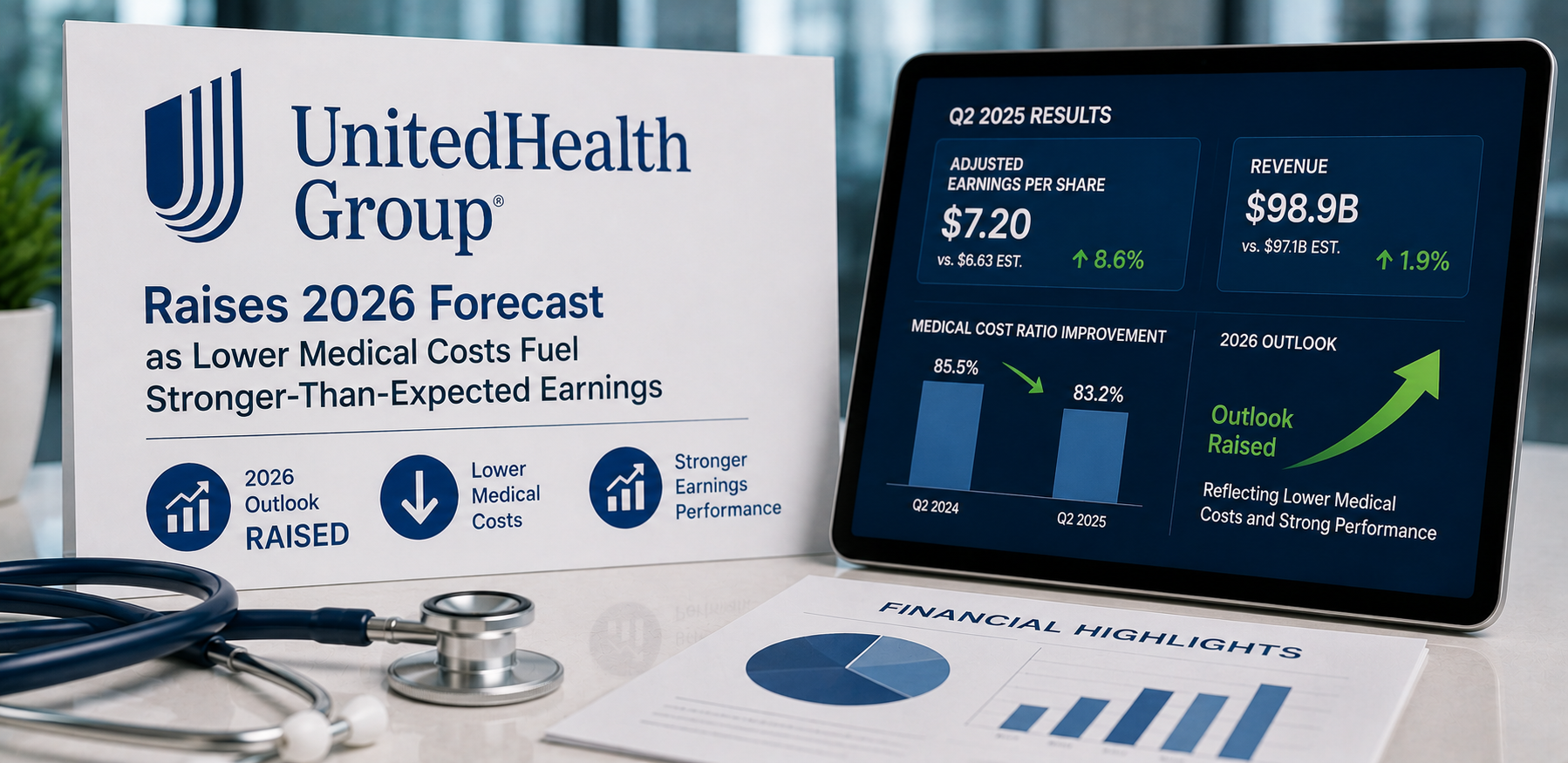
UnitedHealth Group reported stronger-than-expected second-quarter 2026 earnings and raised its full-year profit forecast after improving how it manages medical costs across its insurance business. The results marked another positive step in the company's turnaround efforts, with both its insurance division, UnitedHealthcare, and health services arm, Optum, showing improved performance. Shares rose sharply following the announcement as investors welcomed signs that profitability is recovering.
The healthcare giant posted adjusted earnings of $6.38 per share, well above analysts' expectations of about $4.90 per share, while quarterly revenue reached $112 billion. Based on the stronger performance, UnitedHealth increased its adjusted earnings outlook for 2026 to $19.50–$20.00 per share, significantly higher than its earlier guidance.
What Drove the Strong Results?
The biggest contributor was improved control over healthcare spending.
Health insurers collect premiums from members and pay healthcare providers for medical services. One of the most closely watched metrics is the medical cost ratio (MCR)—the percentage of premium revenue spent on medical care.
UnitedHealth improved its medical cost ratio to 86.7%, compared with 89.4% during the same period last year. A lower ratio generally means the insurer is spending less on medical claims relative to the premiums it collects, improving profitability. Company executives attributed the improvement to better insurance plan design, more accurate pricing, and stronger medical cost management across its Medicare business. Higher reimbursement rates for Medicaid plans also supported results.
Optum Continues Its Recovery
Another major contributor was Optum, UnitedHealth's healthcare services division.
Optum operates several businesses that support the broader healthcare system, including:
- Physician practices.
- Pharmacy benefit management.
- Healthcare technology.
- Data analytics.
- Revenue cycle management.
- Clinical care services.
Operating income at Optum increased 29% year over year to approximately $4 billion, recovering from weaker performance earlier in the year. Company leaders said operational improvements, stronger performance from Optum Insight, and better care coordination within Optum Health helped drive the rebound.
AI Is Playing a Bigger Role
UnitedHealth also highlighted how artificial intelligence is beginning to improve operations across the company.
Executives said the organization has invested roughly $1.5 billion in AI technologies that help:
- Reduce administrative work.
- Streamline billing processes.
- Improve documentation.
- Support clinical decision-making.
- Allow clinicians to spend more time with patients.
Rather than replacing healthcare workers, the company says these tools are helping automate routine administrative tasks while improving operational efficiency throughout the organization.
Changes in Medicare and Medicaid
The company also made several strategic adjustments to improve profitability.
UnitedHealth reduced participation in certain Medicare Advantage offerings while exiting less favorable coordinated care contracts within Optum. These decisions are part of a broader strategy to focus on business lines that generate stronger long-term returns.
Meanwhile, higher reimbursement rates for Medicaid plans serving low-income Americans helped offset some healthcare costs during the quarter. Executives emphasized that the improved financial results reflect stronger execution rather than a permanent decline in healthcare utilization, noting that medical costs across the industry remain elevated.
Insurance Membership Continues to Shift
Although earnings improved, UnitedHealth experienced a decline in insurance membership in certain markets.
The company expects approximately 500,000 people to leave Affordable Care Act marketplace plans during 2026 following the expiration of enhanced pandemic-era premium subsidies, making coverage less affordable for some individuals.
Despite this membership decline, better pricing strategies and disciplined cost management more than offset the impact on earnings.
Industry Impact
- Health Insurers: UnitedHealth's results suggest that disciplined pricing and improved medical cost management can help insurers navigate continued healthcare inflation and changing reimbursement environments.
- Healthcare Providers: Hospitals and physician groups may continue seeing insurers place greater emphasis on care management, efficiency, and value-based reimbursement strategies.
- Investors: The earnings report reassured investors that UnitedHealth's turnaround efforts are progressing faster than expected, restoring confidence after previous operational challenges.
- Patients: While insurers continue focusing on affordability and operational efficiency, healthcare organizations will likely keep investing in technologies that simplify administrative processes and improve patient care.
Why This Matters
UnitedHealth's results offer an important snapshot of the current U.S. healthcare landscape. Even as medical costs remain elevated across the industry, insurers are finding ways to improve profitability through better pricing, operational efficiency, and technology investments rather than relying solely on premium increases.
The performance also demonstrates the growing importance of healthcare services businesses like Optum, which increasingly combine clinical care, pharmacy services, analytics, and technology to improve both patient outcomes and operational performance.
As healthcare organizations continue adopting artificial intelligence and value-based care models, companies that successfully balance cost management with patient access may be better positioned for long-term growth.
Key Takeaways
- UnitedHealth exceeded Wall Street's earnings expectations and raised its 2026 adjusted profit forecast.
- Improved medical cost management reduced the company's medical cost ratio to 86.7%, strengthening profitability.
- Optum's operating income grew 29% as healthcare services and technology businesses recovered.
- Artificial intelligence investments are helping reduce administrative work and improve clinical operations.
- The results highlight continued momentum in UnitedHealth's turnaround while demonstrating the importance of operational efficiency in today's healthcare market.
What This Means for Healthcare Marketers
UnitedHealth's earnings demonstrate that success in today's healthcare market extends beyond enrollment growth. Organizations are increasingly creating value through operational efficiency, data-driven care management, and technology that improves both financial performance and the patient experience. Companies that can demonstrate measurable improvements in affordability, care delivery, and administrative efficiency are likely to remain competitive as healthcare costs continue rising.
For healthcare marketers, the results reinforce the growing importance of communicating outcomes rather than simply promoting products or services. Messaging around artificial intelligence, value-based care, care coordination, and measurable operational improvements is becoming increasingly relevant for health systems, payers, and healthcare technology companies.
For healthcare intelligence teams, UnitedHealth's performance provides valuable signals about broader industry trends. Monitoring insurer earnings, medical cost ratios, reimbursement changes, AI adoption, and healthcare services businesses like Optum can help organizations anticipate where investment, innovation, and competitive activity are likely to accelerate across the U.S. healthcare ecosystem.