
UnitedHealthcare to Drop Prior Authorization Requirements for a Range of Conditions from October 1
What’s Happening
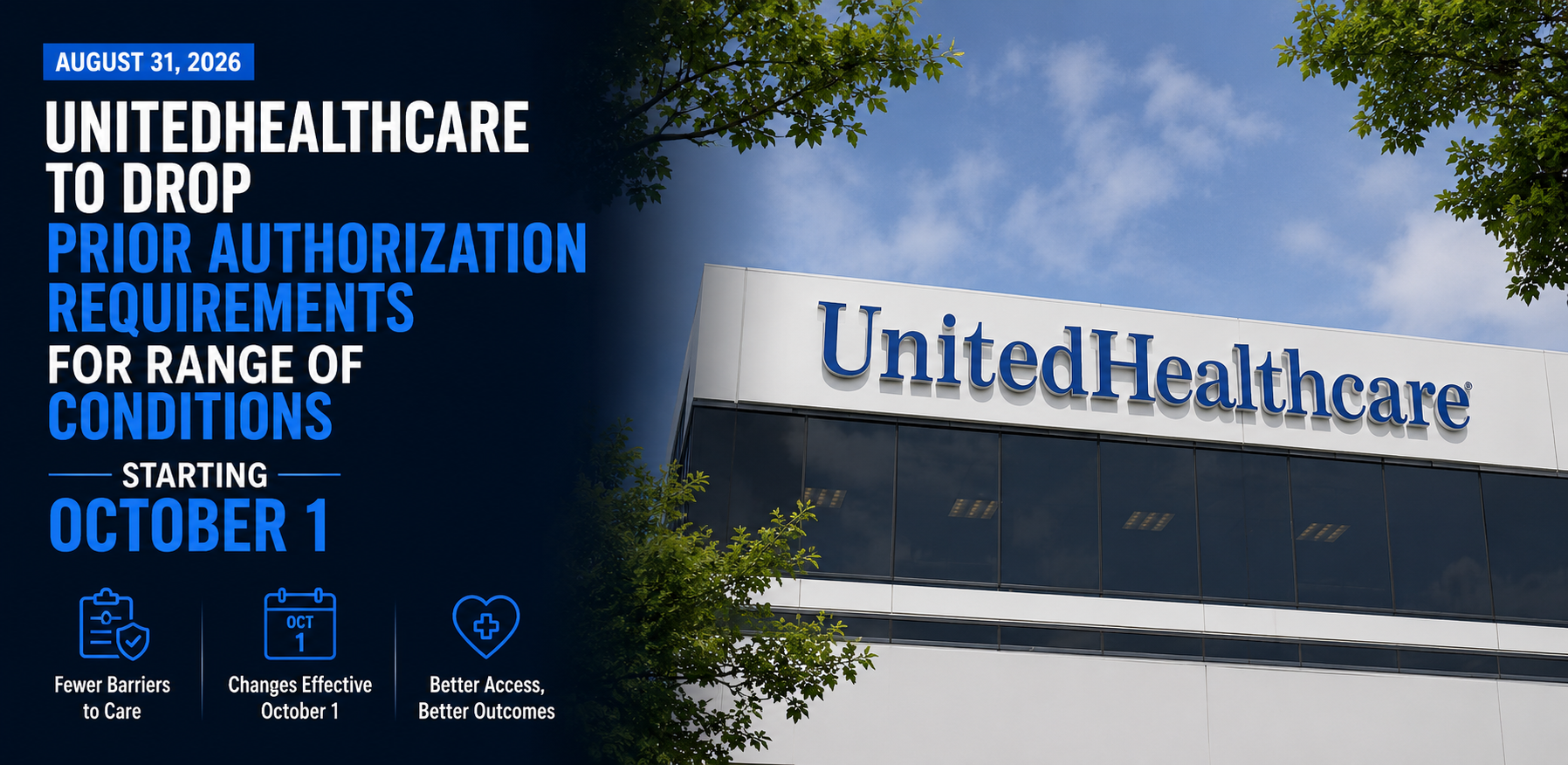
UnitedHealthcare, the insurance arm of UnitedHealth Group, said it will remove prior authorization requirements for a broad range of healthcare services beginning October 1, 2026.
The move is part of the insurer's broader effort to reduce the amount of care that requires advance approval. UnitedHealthcare said it is aiming to eliminate prior authorization for 30% of healthcare services by the end of 2026. (Reuters)
The changes will affect multiple medical specialties and several major types of insurance coverage, including commercial plans, Medicare Advantage and individual Affordable Care Act plans. (Reuters)
Which Services Will Be Affected
Multiple clinical specialties
The reduction in authorization requirements will cover a wide range of services rather than being limited to one particular area of medicine.
UnitedHealthcare said the changes include services involving:
- Cardiology
- Genetic and laboratory testing
- Chiropractic care
- Physical, occupational and speech therapy
- Orthopedic and musculoskeletal procedures
The company described the changes as spanning a broad mix of healthcare services across multiple clinical specialties. (Reuters)
That breadth is important because prior authorization has traditionally been used across many different categories of medical treatment and procedures.
What Prior Authorization Has Meant for Patients and Providers
Prior authorization requires a physician or other healthcare provider to obtain approval from an insurer before certain treatments, tests or procedures can be performed or covered.
Insurers have historically used the process to control costs and ensure that certain services meet coverage criteria.
But physicians and patients have increasingly criticized the system because the administrative process can create delays and, in some cases, result in care being denied.
UnitedHealthcare said its changes are intended to reduce unnecessary paperwork, make requirements easier to understand and give patients and providers more time to focus on care. (Reuters)
The Changes Will Reach Several Major Insurance Markets
Commercial insurance
UnitedHealthcare will eliminate the specified authorization requirements across its commercial plans.
For employers and employees, that could mean fewer administrative steps before eligible services can move forward.
Medicare Advantage
The changes will also apply to Medicare Advantage, which covers older adults through privately administered Medicare plans.
That makes the move particularly significant because administrative requirements can affect a large volume of routine and specialized care within Medicare Advantage.
Affordable Care Act plans
Individual insurance plans sold through the Affordable Care Act marketplace will also be included, along with certain other types of plans. (Reuters)
The result is that the policy is not limited to a single customer segment. It affects multiple parts of UnitedHealthcare's insurance business.
UnitedHealthcare Is Also Targeting Rural Healthcare
New rural prior authorization waiver
The insurer said it will introduce a rural prior authorization waiver program on November 1.
The program is designed to reduce administrative requirements for eligible rural hospitals and affiliated providers. (Reuters)
Rural providers can face particularly difficult administrative and staffing constraints, so reducing authorization work could have an outsized operational impact for some hospitals.
Faster payments for rural hospitals
UnitedHealthcare is also accelerating payments by up to 50% for approximately 1,400 rural hospitals and Critical Access Hospitals during the third quarter. (Reuters)
That means the company's approach extends beyond simply changing authorization rules. It also includes changes to how quickly certain rural providers receive payment.
Why Health Insurers Are Reducing Prior Authorization
UnitedHealthcare's announcement reflects growing pressure across the insurance industry to simplify prior authorization.
Patients and physicians have increasingly argued that excessive administrative requirements can slow treatment and create unnecessary paperwork. (Reuters)
Insurers have responded by reviewing which services genuinely require advance approval and which can be handled without it.
The underlying objective is to maintain utilization and cost controls where they are considered useful while reducing administrative friction for services where approval adds limited value.
This Is Part of a Larger Industry Shift
UnitedHealthcare is not operating in isolation.
Health insurers have been taking steps to simplify prior authorization requirements for both medications and medical services following complaints from physicians and patients.
That suggests the industry is moving toward a model in which prior authorization is used more selectively rather than automatically across large categories of care. (Reuters)
The important shift is therefore not simply that UnitedHealthcare is eliminating certain requirements. It is that administrative friction itself is increasingly becoming a target for healthcare reform.
Potential Impact on Providers
For healthcare providers, fewer authorization requirements could reduce administrative workload.
Staff who previously spent time submitting documentation, responding to insurer requests and waiting for approvals may be able to redirect some of that effort toward patient care and other operational responsibilities.
It could also make scheduling more predictable because providers may be less dependent on receiving authorization before proceeding with certain services.
However, the impact will vary by service and plan because UnitedHealthcare is removing requirements for specified categories rather than eliminating prior authorization altogether.
Potential Impact on Patients
For patients, the most immediate potential benefit is faster access to covered services.
Removing an approval step can reduce the time between a physician deciding that a service is appropriate and that service actually being delivered.
It may also reduce uncertainty for patients who previously had to wait while a provider and insurer exchanged documentation.
The changes could be particularly meaningful for services involving rehabilitation, diagnostic testing and other forms of care that can be delayed by administrative processes.
What This Means for Healthcare Costs
The relationship between prior authorization and healthcare spending is complicated.
Prior authorization is intended in part to prevent unnecessary or inappropriate utilization. Eliminating it can therefore potentially increase use of some services if the requirement was previously acting as a utilization-control mechanism.
At the same time, excessive administrative requirements create their own costs for insurers, providers and patients.
UnitedHealthcare's strategy suggests it believes some authorization requirements create enough administrative burden that removing them can improve the overall healthcare experience without requiring approval for every service.
Why This Matters
UnitedHealthcare is one of the largest U.S. health insurers, so a change affecting a broad range of services could influence expectations across the healthcare system.
If fewer services require authorization, providers may begin to expect faster workflows and less administrative overhead from insurers.
It could also increase competitive pressure on other insurers to simplify their own requirements, particularly in areas where providers already consider authorization burdensome.
The move is therefore not simply an operational decision by one insurer. It is another sign that reducing friction between insurers, providers and patients is becoming an important area of healthcare reform.
Looking Ahead
The first major milestone will be October 1, when the expanded removal of prior authorization requirements takes effect.
UnitedHealthcare has also set a target of eliminating prior authorization for 30% of healthcare services by the end of 2026, making additional changes possible later in the year. (Reuters)
The rural waiver program beginning November 1 will provide another test of whether reducing administrative requirements can improve relationships between insurers and providers in underserved markets.
The longer-term question will be whether these changes lead to measurable improvements in speed of care, provider workload and patient experience without producing significant increases in unnecessary healthcare utilization.
Key Takeaways
- UnitedHealthcare will eliminate prior authorization requirements for a broad range of healthcare services beginning October 1, 2026.
- The changes span areas including cardiology, genetic and laboratory testing, rehabilitation, chiropractic care and orthopedic procedures.
- The changes apply across commercial, Medicare Advantage and individual ACA plans, among others. (Reuters)
- UnitedHealthcare wants to eliminate prior authorization for 30% of healthcare services by the end of 2026.
- A new rural prior authorization waiver will begin November 1.
- The insurer is also speeding payments by up to 50% for about 1,400 rural and Critical Access Hospitals during the third quarter. (Reuters)
- The broader industry is facing pressure to reduce authorization-related paperwork and delays.
What This Means for Healthcare Marketers
This shift can change how healthcare organizations think about access, patient acquisition and provider engagement.
When administrative barriers are reduced, patients may move from clinical recommendation to actual treatment faster. Providers may also have more capacity to evaluate, recommend and deliver services instead of spending as much time navigating insurer requirements.
For healthcare companies, that can change the timing of demand signals. A provider's decision to pursue a treatment or procedure may translate into action more quickly when fewer insurance hurdles stand in the way.
It also reinforces a broader market lesson: changes in payer policy can directly change where, when and how healthcare demand turns into actual utilization.