Universal Health Services Lowers 2026 Outlook Amid Medicaid Reimbursement Uncertainty
What's Happening
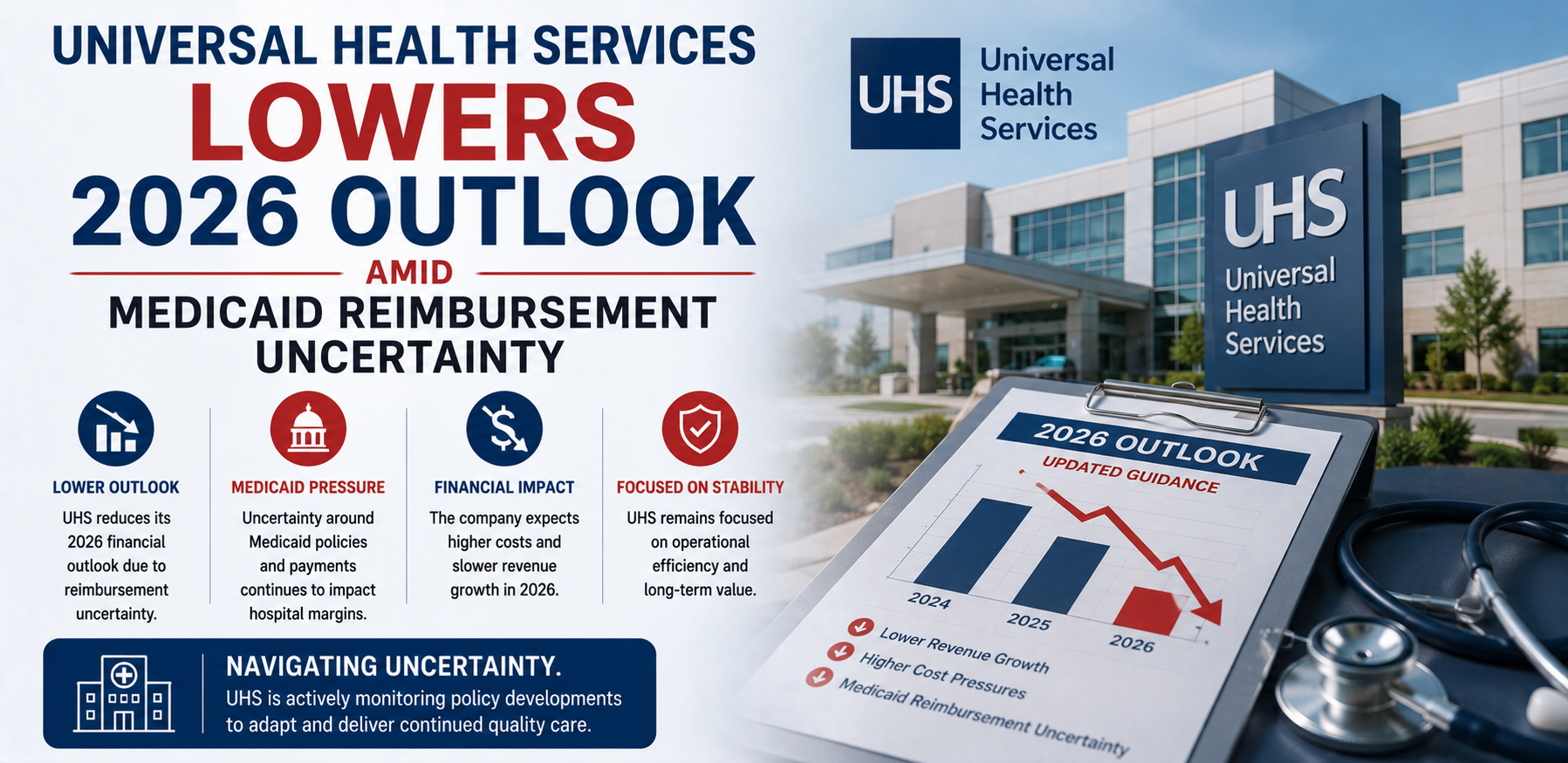
Universal Health Services (UHS), one of the largest hospital operators in the United States, has lowered its financial outlook for 2026 after warning that uncertainty surrounding Medicaid supplemental reimbursement programmes could affect future earnings.
The company cited concerns over whether certain state Medicaid payment programmes will continue to receive federal approval, making it difficult to accurately forecast future revenue. Following the announcement, UHS shares fell nearly 8% in after-hours trading as investors reacted to the revised guidance.
Understanding the Issue
Hospitals rely on multiple sources of reimbursement for patient care, including commercial insurance, Medicare and Medicaid. For hospitals serving a large number of low-income patients, Medicaid supplemental payment programmes provide additional funding beyond standard reimbursement rates.
These programmes require approval from the Centers for Medicare & Medicaid Services (CMS) and are often renewed periodically. If approvals are delayed, modified or not renewed, hospitals may receive significantly less funding than anticipated.
In UHS's case, the company benefited from an expanded Florida Medicaid managed care payment programme during the first half of 2026. However, because CMS has not yet approved similar payments beyond the current programme period, the company chose not to assume those funds would continue when forecasting the rest of the year.
Why Medicaid Reimbursement Matters
For many health systems, Medicaid reimbursement is a critical component of financial stability.
Supplemental payments help hospitals:
- Offset the cost of caring for Medicaid patients.
- Support emergency departments and essential community services.
- Maintain staffing and infrastructure.
- Invest in new technologies and patient care programmes.
When the future of these payments becomes uncertain, hospitals often become more cautious with budgeting, hiring and capital investments.
The situation also highlights how healthcare providers remain heavily influenced by evolving federal and state reimbursement policies, making policy decisions just as important as patient volumes in determining financial performance.
Industry Impact
- Hospitals and Health Systems: Hospital operators that depend heavily on Medicaid funding may experience increased financial pressure if supplemental payment programmes change or expire. This could lead to tighter operating budgets and more conservative financial planning.
- Investors: The market reaction demonstrates how closely investors monitor reimbursement policy. Even when hospital demand remains strong, uncertainty around government funding can significantly affect earnings expectations and stock performance.
- Healthcare Policy: The announcement reflects broader uncertainty across the healthcare industry as providers continue to evaluate how federal and state Medicaid policies may evolve. Changes to reimbursement structures have the potential to affect hospital finances well beyond a single organisation.
Looking Ahead
Financial performance in healthcare is increasingly tied not only to patient care but also to reimbursement policy. Hospitals must balance delivering essential services with navigating a complex funding environment where government payment programmes can change over time.
As reimbursement models continue to evolve, providers that effectively manage financial risk, diversify revenue sources and adapt to policy changes will be better positioned to maintain stability while continuing to serve their communities.
Key Takeaways
- Universal Health Services lowered its 2026 financial forecast because of uncertainty surrounding Medicaid supplemental reimbursement programmes.
- The company excluded potential future Medicaid payments that have not yet received federal approval from its revised outlook.
- Investors responded by sending the company's shares lower following the announcement.
- The development highlights the significant influence of reimbursement policy on hospital financial performance.
- Medicaid funding remains a critical issue for hospitals serving large populations of low-income patients.
What This Means for Healthcare Marketers
Reimbursement uncertainty influences far more than hospital finances. It also affects purchasing decisions, technology investments and strategic priorities across health systems. Organisations selling software, medical devices, analytics platforms or healthcare services should recognise that budget decisions are often shaped by changes in government reimbursement. Monitoring reimbursement trends can help commercial teams better understand when providers may delay investments, shift spending priorities or seek solutions that improve operational efficiency and financial performance.