U.S. Cyclosporiasis Cases Surpass 4,100 as CDC Investigates Expanding Lettuce-Linked Outbreak
What's Happening
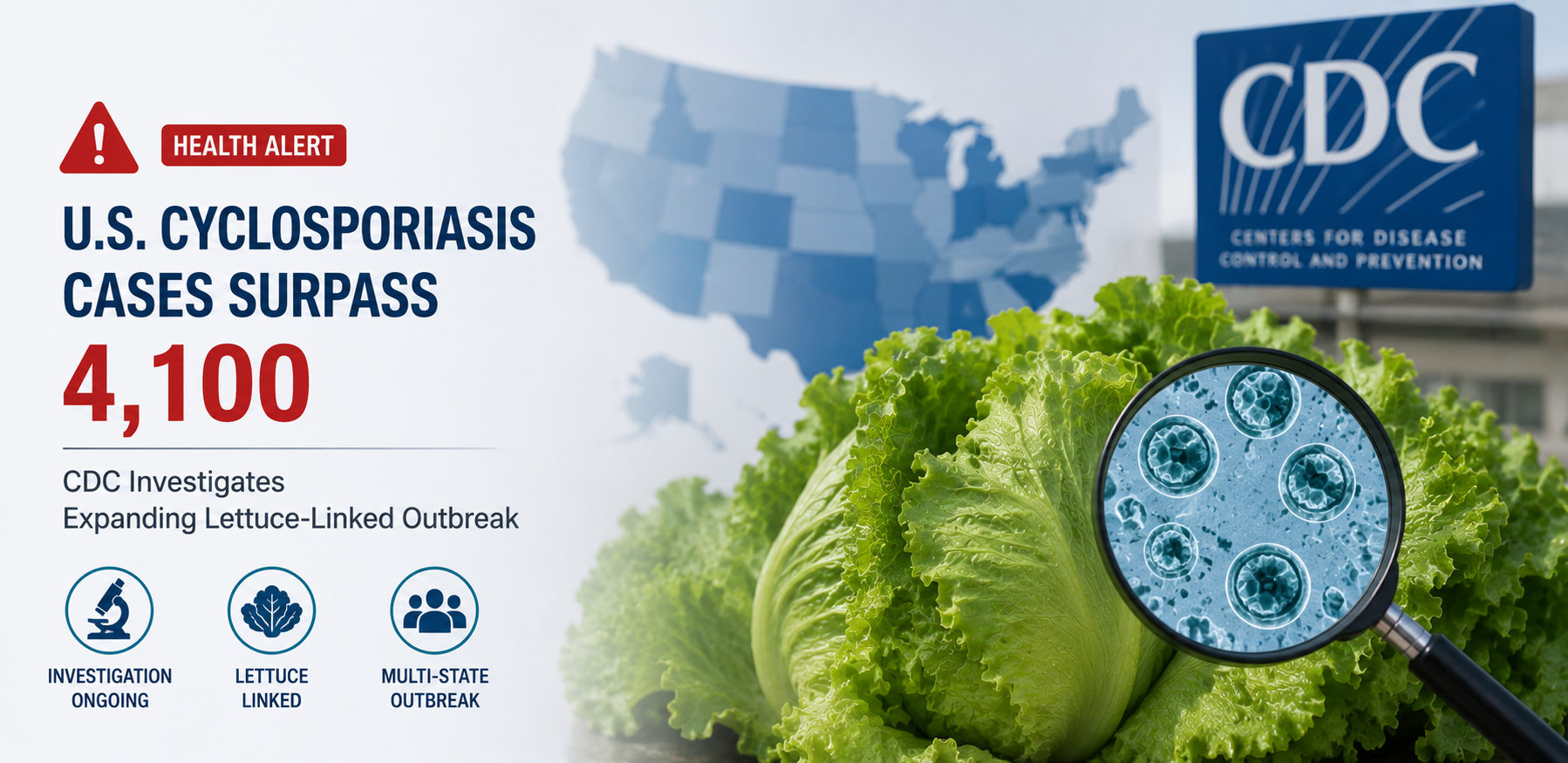
The United States is experiencing one of its largest recorded outbreaks of cyclospora, a foodborne parasitic illness, with the Centers for Disease Control and Prevention (CDC) reporting 4,173 laboratory-confirmed, domestically acquired cases since May 1.
In addition to the confirmed infections, the CDC says it is investigating more than 7,400 additional reported cases that have not yet been laboratory confirmed. Many of these pending reports have come from Michigan and Ohio, suggesting the true scale of the outbreak is considerably larger than the confirmed case count.
Federal and state health officials continue investigating multiple outbreaks, including a large multistate cluster linked to shredded iceberg lettuce distributed to Taco Bell restaurants in five Midwestern states.
What Is Cyclospora?
Cyclospora is a microscopic parasite (Cyclospora cayetanensis) that causes an intestinal illness known as cyclosporiasis.
People typically become infected after consuming food or water contaminated with the parasite. Unlike many bacterial foodborne illnesses, cyclospora has a relatively long incubation period, meaning symptoms often appear about one week after exposure, making outbreaks significantly harder to investigate.
Common symptoms include:
- Prolonged watery diarrhea.
- Stomach cramps.
- Nausea.
- Fatigue.
- Loss of appetite.
- Weight loss.
- Bloating.
Without treatment, symptoms can persist for several weeks and may return after temporarily improving.
Why Are Cases Rising So Quickly?
The CDC noted that reported cases continue to increase because of both ongoing transmission and delays in disease reporting.
Between the time someone becomes ill, seeks medical care, undergoes laboratory testing, and the case is officially reported to federal authorities, several weeks can pass.
As a result, public health officials expect confirmed case numbers to continue rising even if the outbreak begins slowing.
Among the confirmed domestic cases:
- 308 people have been hospitalized.
- No deaths have been reported.
- Cases have been identified in 41 states.
- Patients range in age from 2 to 95 years, with a median age of 44.
- Approximately 56% of patients are female.
The Lettuce Investigation
The FDA, CDC, and state health departments continue tracing one of the largest outbreak clusters to shredded iceberg lettuce served at Taco Bell restaurants in:
- Indiana.
- Kentucky.
- Michigan.
- Ohio.
- West Virginia.
Investigators linked the lettuce to Taylor Farms' operations in central Mexico, prompting a voluntary recall of affected iceberg lettuce distributed to restaurants, retailers, and food-service customers across 27 states.
Although the FDA recently determined that a laboratory test showing cyclospora in one lettuce sample was a false positive, the agency emphasized that epidemiological evidence and traceback investigations continue to support the connection between the outbreak and the recalled lettuce products.
Why This Outbreak Has Been So Difficult to Trace
Cyclospora outbreaks are among the most challenging foodborne illnesses to investigate.
Several factors contribute to the difficulty:
- The parasite cannot currently be grown in laboratory culture.
- Contaminated produce is often consumed before testing begins.
- Symptoms develop several days after exposure.
- Patients frequently struggle to remember exactly what they ate.
- Fresh produce is distributed through complex national supply chains.
Instead of relying solely on laboratory confirmation, investigators combine patient interviews, purchase records, restaurant supply information, and traceback analysis to identify likely sources of infection.
Travel-Related Cases Continue
Alongside the domestic outbreak, the CDC has also identified 767 travel-associated cases linked to food or water consumed outside the United States.
These travel-related infections have resulted in 33 hospitalizations, with no reported deaths.
Health officials continue monitoring both domestic and international sources of infection while emphasizing that the current U.S. outbreak remains primarily associated with contaminated produce.
Industry Impact
- Food Manufacturers: Produce growers and distributors may face increased scrutiny of food safety practices, supply chain traceability, and contamination prevention as regulators work to identify the precise source of the outbreak.
- Restaurants and Food Service: Restaurant chains are reinforcing supplier verification and traceability systems to quickly identify and remove potentially contaminated ingredients when outbreaks occur.
- Public Health Agencies: The outbreak underscores the importance of coordinated surveillance among the CDC, FDA, and state health departments to rapidly detect and investigate foodborne illnesses.
- Consumers: While officials continue recommending consumption of fresh fruits and vegetables, consumers are advised to avoid products included in active recalls and to follow food safety guidance issued by public health authorities.
Why This Matters
The growing cyclospora outbreak highlights the continuing challenges of protecting the U.S. food supply from contamination involving fresh produce.
Unlike bacterial outbreaks that can often be confirmed through laboratory testing, cyclospora investigations depend heavily on epidemiology and supply chain tracing because the parasite is exceptionally difficult to detect in food samples. This makes rapid identification of contaminated products far more complex.
The outbreak also illustrates the importance of modern food traceability systems. As fresh produce moves through increasingly global supply chains, the ability to quickly identify where products originated—and where they were distributed—has become essential for limiting the spread of foodborne illnesses and protecting public health.
Key Takeaways
- The CDC has confirmed 4,173 domestically acquired cyclospora cases since May 1, with more than 7,400 additional reported cases still under investigation.
- 308 confirmed patients have been hospitalized, but no deaths have been reported.
- Cases have been identified in 41 states, making this one of the largest U.S. cyclospora outbreaks on record.
- Investigators continue linking a major outbreak cluster to recalled shredded iceberg lettuce supplied through Taylor Farms' operations in central Mexico despite a previously reported false-positive laboratory result.
- The CDC expects confirmed case counts to continue rising because of reporting delays and ongoing investigations.
What This Means for Healthcare Marketers
The expanding cyclospora outbreak demonstrates how food safety events can rapidly evolve into nationwide public health challenges requiring coordinated action across government agencies, healthcare providers, laboratories, and the food industry. Organizations involved in diagnostics, public health surveillance, infectious disease monitoring, and supply chain technology are likely to see growing interest in solutions that improve outbreak detection and response.
For healthcare marketers, the outbreak highlights the importance of communicating scientific findings clearly while acknowledging uncertainty as investigations evolve. Trustworthy, evidence-based messaging becomes especially valuable during rapidly changing public health events where recommendations may shift as new information becomes available.
For healthcare intelligence teams, monitoring outbreak trends, regulatory investigations, recall activity, and food supply chain disruptions provides valuable insight into emerging public health risks. These developments can influence healthcare utilization, laboratory testing demand, infectious disease surveillance, and broader conversations around food safety and preventive health.