U.S. Launches $5 Billion AI Initiative to Accelerate Health Research and Drug Discovery
What's Happening
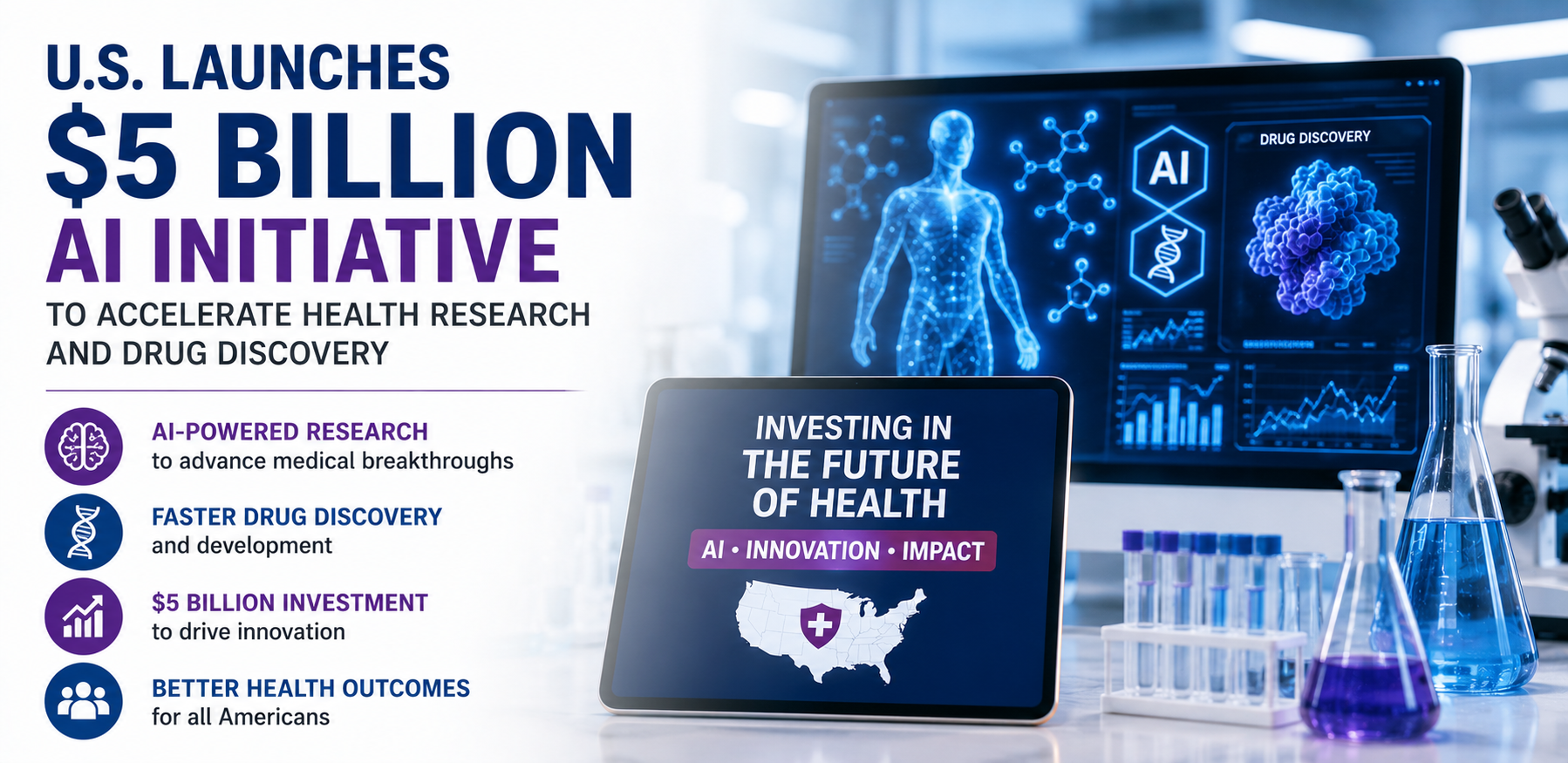
The U.S. government has announced a $5 billion artificial intelligence initiative aimed at tackling some of the country's most complex scientific challenges, including identifying the causes of chronic diseases, accelerating drug discovery, and advancing biomedical research. The initiative brings together 15 federal agencies in one of the largest coordinated government efforts to apply AI across scientific research.
Participating agencies include the Departments of Health and Human Services, Energy, Defense, Transportation, and Interior. Scientists involved in the program will gain access to the Department of Energy's supercomputers, specialized datasets, and advanced AI tools to conduct large-scale research that would otherwise take years using conventional methods.
The initiative is also expected to receive support from the private sector. Microsoft has committed $40 million in AI computing credits over the next three years to help researchers carry out AI-powered scientific studies.
Why AI Is Becoming Essential in Healthcare Research
Artificial intelligence has rapidly become one of the most powerful tools available to medical researchers.
Unlike traditional research methods, AI systems can analyze enormous volumes of biological, clinical, and genomic data within hours, helping researchers identify patterns that might otherwise remain hidden.
Healthcare researchers are increasingly using AI to:
- Identify the biological causes of chronic diseases.
- Discover potential drug candidates.
- Predict how diseases progress.
- Analyze medical imaging.
- Improve clinical trial design.
- Personalize treatment strategies.
- Detect safety signals earlier during drug development.
As healthcare data continues to grow, AI is becoming an essential technology for turning complex information into actionable scientific insights.
What the Initiative Will Focus On
The new federal program extends beyond healthcare, but medicine represents one of its primary objectives.
According to the administration, researchers will use AI to:
- Better understand chronic diseases.
- Accelerate the discovery of new medicines.
- Improve biomedical research.
- Analyze large government health datasets.
- Develop new scientific models that support future medical innovation.
Scientists will also apply AI to research in areas such as infrastructure, materials science, energy, and construction, demonstrating how machine learning can address challenges across multiple disciplines.
Why Government Data Matters
One of the initiative's greatest advantages is access to federal datasets.
The U.S. government maintains some of the world's largest scientific databases, including information related to:
- Patient health.
- Chemicals.
- Environmental exposures.
- Critical minerals.
- Energy systems.
- Public health surveillance.
When combined with advanced AI models, these datasets can help researchers generate new hypotheses, identify previously unknown relationships, and accelerate scientific discovery.
Rather than replacing scientists, AI serves as a powerful analytical tool that helps researchers interpret increasingly complex data more efficiently.
A New Approach to Federal Research Funding
Alongside the AI initiative, the administration has proposed changes to how federal scientific research is funded.
The proposal encourages greater support for individual researchers and AI-enabled scientific projects, while placing increased emphasis on accountability for federally funded research.
Supporters believe this approach could encourage innovation and speed scientific breakthroughs. Others note that changes to funding priorities will require careful implementation to ensure that collaboration among universities, government agencies, and research institutions continues to thrive.
Industry Impact
- Healthcare Research Organizations: Academic medical centers and research institutions may gain new opportunities to collaborate with federal agencies on AI-driven biomedical research.
- Pharmaceutical Companies: Faster drug discovery methods could reduce research timelines and improve the efficiency of identifying promising therapeutic candidates.
- Technology Companies: Providers of AI infrastructure, cloud computing, and high-performance computing systems may play an increasingly important role in supporting government-funded scientific research.
- Patients: If successful, AI-assisted research could accelerate the development of new treatments for chronic diseases while improving the overall efficiency of medical innovation.
Why This Matters
Scientific research is becoming increasingly data intensive. Traditional research methods remain essential, but the sheer volume of biomedical information now available requires tools capable of analyzing data at an unprecedented scale.
This initiative reflects growing recognition that artificial intelligence can help researchers solve scientific problems more quickly by identifying patterns, generating predictions, and supporting faster decision making. Access to federal datasets and advanced computing infrastructure may also help researchers investigate diseases that have remained difficult to understand for decades.
If the initiative delivers meaningful results, it could influence not only healthcare research but also how governments invest in scientific discovery in the years ahead.
Key Takeaways
- The U.S. government is investing $5 billion in an AI initiative focused on healthcare, scientific research, and other national priorities.
- Fifteen federal agencies will participate, including the Department of Health and Human Services.
- Researchers will use AI to investigate chronic diseases, accelerate drug discovery, and analyze large scientific datasets.
- Scientists will have access to Department of Energy supercomputers, AI tools, and specialized government datasets.
- Microsoft will contribute $40 million in AI computing credits to support the initiative over the next three years.
What This Means for Healthcare Marketers
The federal government's investment signals that artificial intelligence is becoming a foundational technology for healthcare innovation. Organizations developing AI platforms, clinical decision support tools, data analytics solutions, and drug discovery technologies are likely to benefit from increased attention on AI-enabled research and collaboration.
For healthcare marketers, this creates an opportunity to highlight how AI delivers measurable value rather than simply emphasizing the technology itself. Messaging focused on accelerating research, improving clinical decision making, enhancing operational efficiency, and supporting better patient outcomes is likely to resonate with healthcare leaders evaluating AI investments.
For healthcare intelligence teams, the initiative provides an early indicator of where future public and private investment may be directed. Tracking AI funding, research partnerships, regulatory developments, and technology adoption can help organizations identify emerging opportunities and better understand how artificial intelligence is reshaping the healthcare landscape.