What's Happening
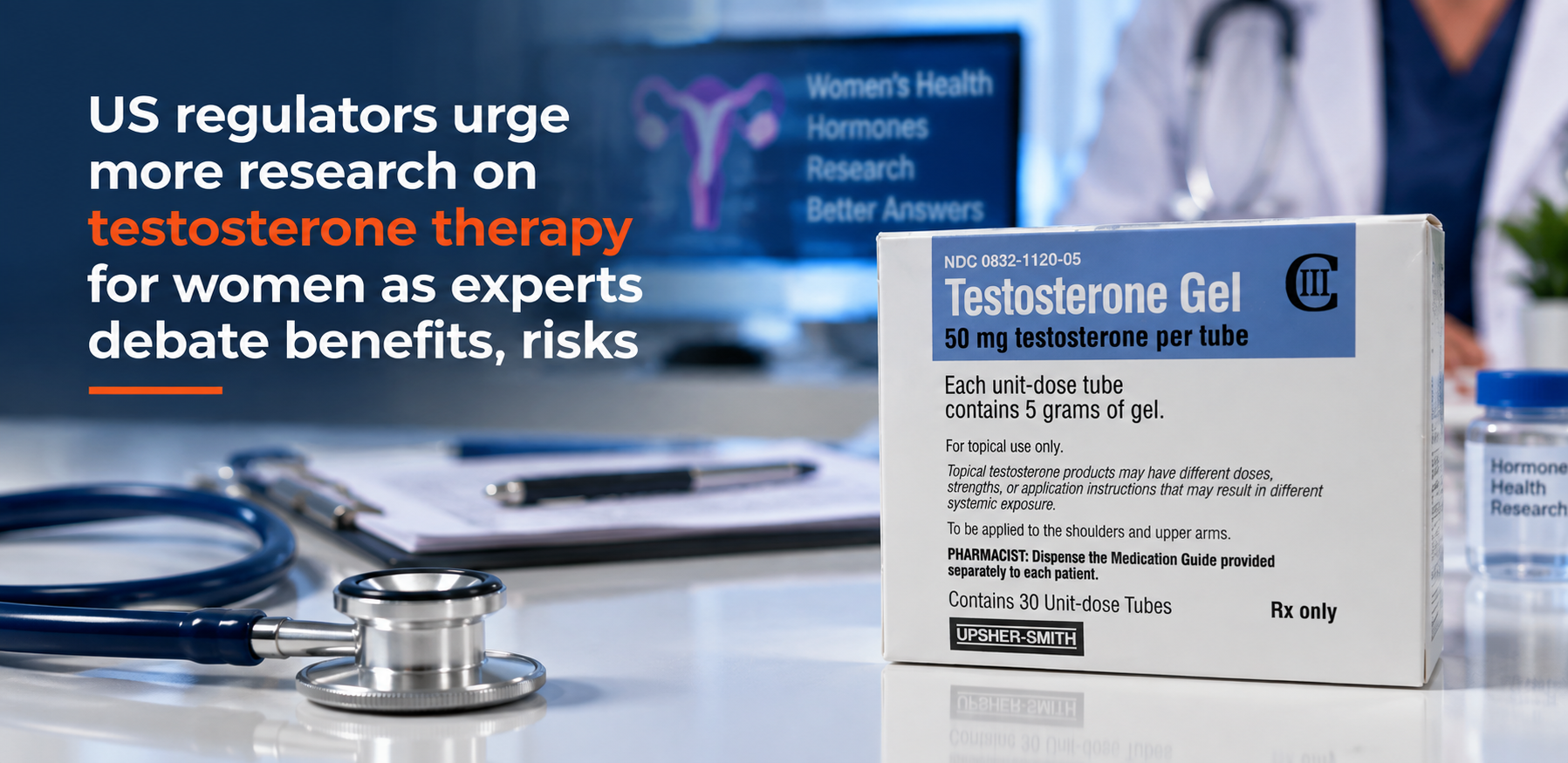
U.S. health regulators are calling for more research into testosterone therapy for menopausal women, as use of the hormone grows and questions remain about its benefits, appropriate dosing and long-term safety.
The FDA held a public workshop on September 17 to examine the available evidence and identify gaps that need to be addressed before female-specific testosterone products could potentially be developed and approved in the United States. (Reuters)
The discussion comes after years of off-label testosterone use among women, particularly for hypoactive sexual desire disorder, or HSDD, a condition involving persistently low sexual desire that causes distress. (Reuters)
No Testosterone Product Is FDA-Approved Specifically for Women
The U.S. currently has no FDA-approved testosterone therapy specifically for women, despite testosterone being prescribed off-label for years.
Doctors commonly use low doses of testosterone products that were approved for men. This can involve adjusting or dividing existing products such as AbbVie's AndroGel and Keenova Therapeutics' Testim. Some patients also receive compounded testosterone formulations. (Reuters)
This creates a gap between how the therapy is being used in clinical practice and how products have been formally developed and evaluated by the FDA for women.
Other countries, including the United Kingdom, Australia, New Zealand and South Africa, have approved or licensed testosterone products specifically for women. (Reuters)
FDA Says International Data Could Be Used
FDA officials indicated that manufacturers could potentially use clinical data from testosterone products already approved overseas when seeking U.S. approval.
However, the agency said those products and their supporting evidence would still have to meet U.S. regulatory standards. FDA's Anandi Kotak said foreign data would be evaluated on a case-by-case basis, while emphasizing that the approval standard remains the same for drugs regardless of where the supporting evidence originates. (Reuters)
This creates a potential path for companies that already have female-specific testosterone products in other markets to consider U.S. development.
Federal Health Officials Push for a Female-Specific Option
At the workshop, federal health officials argued that women should have access to testosterone products specifically formulated and dosed for women, rather than relying on products originally developed for men. (Reuters)
Assistant Secretary for Health Admiral Brian Christine said the absence of a U.S.-approved female testosterone treatment is a problem given that female-specific options are available in other countries. (Reuters)
Dorothy Fink, deputy director of the Eunice Kennedy Shriver National Institute of Child Health and Human Development, similarly emphasized the need for products designed around the needs and dosing requirements of women. (Reuters)
But experts at the meeting also made an important distinction: creating a female-specific product does not automatically establish that testosterone should be used broadly for multiple menopause-related symptoms.
The Strongest Evidence Is for Low Sexual Desire
The evidence discussed at the FDA workshop points most clearly toward testosterone's use in postmenopausal women with HSDD.
Rajita Patil, director of the UCLA Comprehensive Menopause Care Program, said current evidence supports testosterone for this specific population, while there is not enough evidence to recommend it for broader outcomes such as mood, cognition or general well-being. (Reuters)
She also said oral testosterone is not recommended because of unfavorable effects on cholesterol levels. (Reuters)
That distinction is significant because interest in testosterone has expanded beyond sexual health.
Broader Claims Are Outpacing the Evidence
Interest in testosterone among menopausal women has also been fueled by claims online that it can help with energy, muscle mass, bone health and cognitive function.
The FDA says these are among the areas where important knowledge gaps remain. The agency's workshop specifically examined testosterone's potential effects on sexual function, cognition, mood and musculoskeletal health. (U.S. Food and Drug Administration)
Specialists cited by Reuters said the evidence is much stronger for HSDD than for these broader uses. (Reuters)
This leaves a substantial gap between growing consumer interest and the amount of clinical evidence supporting different uses.
Long-Term Safety Remains a Major Concern
The FDA has reviewed testosterone for women multiple times but has not approved it, in part because of insufficient long-term safety data.
Specific concerns include possible cardiovascular and breast cancer risks. (Reuters)
The agency's workshop highlighted the need for more evidence on these long-term risks, particularly because menopause treatment can involve extended periods of use. (U.S. Food and Drug Administration)
There are also risks associated with excessive testosterone exposure.
Doctors cited acne and increased hair growth as possible effects. More significant androgen-related effects can include voice deepening and hair loss, which may be irreversible. (Reuters)
Testosterone is also generally not recommended for women with a history of breast cancer because testosterone can be converted into estrogen in the body, which may be relevant to certain hormone-sensitive cancers. (Reuters)
Oral Testosterone Raises Additional Questions
The form in which testosterone is administered matters.
Patil said oral testosterone is not recommended because of its unfavorable effect on cholesterol levels. This is one reason experts are looking not just at whether testosterone works, but also at formulation, dose and route of administration. (Reuters)
The FDA also identified challenges in accurately measuring and interpreting testosterone levels in menopausal women, adding another layer of complexity to treatment and clinical research. (U.S. Food and Drug Administration)
Patient Demand Is Growing
The FDA's request for public input ahead of the workshop generated hundreds of submissions.
Many women described improvements in areas such as libido, energy and quality of life while taking testosterone. These experiences have contributed to the growing public demand for more treatment options. (Reuters)
However, individual experiences and patient-reported benefits are different from the controlled clinical evidence required to establish the effectiveness and safety of a drug for regulatory approval.
The public comment period connected to the workshop remains open through October 19, 2026. (Reuters)
Other FDA-Approved Treatments Already Exist
Testosterone is not the only drug option being considered for women with HSDD.
The FDA has already approved Addyi, from Sprout Pharmaceuticals, and Vyleesi, from Cosette Pharmaceuticals, for certain patients with HSDD. (Reuters)
Cosette said postmenopausal women should have access to additional treatment options for sexual-function concerns, showing that pharmaceutical companies see an opportunity for further development in this area. (Reuters)
The FDA Is Looking Beyond the Current Market
The September 17 workshop was not an approval meeting for a particular testosterone product.
Its purpose was to examine the existing scientific evidence, identify unanswered questions and help guide future research and potential drug development. (U.S. Food and Drug Administration)
For manufacturers, this is important because the FDA is now publicly defining the evidence it wants to see around female testosterone use.
The agency has indicated that it is willing to discuss potential applications with companies and consider international evidence, while maintaining U.S. regulatory requirements. (Reuters)
Why This Matters
The issue reflects a broader shift in women's health and menopause care, where patient demand is increasingly drawing attention to treatment areas that historically had limited pharmaceutical development.
For patients and physicians, the lack of an FDA-approved female testosterone product means treatment can involve off-label use of medicines intended for men or compounded products. That raises questions around dosing, consistency, availability and access. (Reuters)
For pharmaceutical companies, a clearer regulatory discussion could open a path toward developing products designed specifically for women.
But the opportunity comes with a substantial evidence burden. Companies would need to demonstrate not only that a therapy provides meaningful benefits, but also that its risks are adequately understood.
Looking Ahead
The immediate next step is additional research and public input.
The FDA has identified several areas where stronger evidence is needed, including sexual function, cognition, mood, musculoskeletal health, testosterone measurement and long-term cardiovascular and breast cancer risks. (U.S. Food and Drug Administration)
Manufacturers interested in developing female-specific testosterone products will need to determine which patient populations should be studied, what doses and formulations are appropriate, and how long-term safety should be evaluated.
The FDA's willingness to consider overseas clinical data could help companies that already have female-specific products outside the U.S., but those products will still need to satisfy American regulatory requirements. (Reuters)
What This Means for Healthcare Marketers
The testosterone market shows how patient demand can expand before regulatory clarity catches up.
For healthcare and pharmaceutical marketers, that makes signals such as rising prescribing, physician interest, clinical-trial activity, patient discussions and FDA workshops particularly important.
It also highlights the need to distinguish between established evidence and broader claims circulating among consumers. In emerging treatment categories, demand may grow faster than the evidence supporting all of the ways a therapy is being promoted.
Key Takeaways
- The FDA is calling for more research into testosterone therapy for menopausal women.
- There is currently no FDA-approved testosterone product specifically for women in the U.S.
- The strongest evidence supports testosterone for postmenopausal women with HSDD.
- Evidence is currently insufficient to recommend testosterone broadly for mood, cognition or general well-being.
- Long-term safety questions remain, particularly around cardiovascular and breast cancer risks.
- Excessive exposure can cause effects including acne, increased hair growth, voice deepening and hair loss.
- FDA officials said international clinical data could potentially support U.S. applications, but products must still meet U.S. approval standards.
- The FDA public-comment period remains open through October 19, 2026. (Reuters)